 Priya Nair
Weligama is one of the easiest places in the world to learn to surf: come in the south coast season from November to April, learn on a gentle sandy beach break in the mornings, add yoga in the late afternoon, and expect steady progress rather than instant skill. Surfers who can already trim along a wave will outgrow the main bay quickly, but reef breaks a short ride away at Midigama and Ahangama give this coast a genuine second act.
Quick Facts
- Best season: November to April on the south coast, with December to March the most consistent months.
- Off season: May to October, when the southwest monsoon brings rougher seas and more rain.
- Main break: Weligama Bay, a wide sandy beach break with no reef in the learner zone, ideal for complete beginners.
- Progression: Reef breaks at Midigama and Ahangama, a short ride east, for intermediates and above.
- Daily rhythm: Surf early, roughly 7am to 10am before the wind picks up, rest in the heat, yoga in the late afternoon.
- Getting there: About 2.5 hours from Colombo by road on the Southern Expressway, longer from the airport, or around 3 hours by coastal train from Colombo Fort.
- Character: A working fishing town first and a surf town second, which shapes both its charm and its limits.
When is the surf and yoga season in Weligama?
Sri Lanka works on a two coast calendar. The south coast, including Weligama, Mirissa, Ahangama and Midigama, is in season from November to April, when swell wraps into the bays and morning winds are offshore. December to March is the core and the safest window for a learn to surf trip. November and April are quieter shoulder months. From May to October the southwest monsoon dominates, seas turn choppier, and the surf focus shifts to the east coast around Arugam Bay.
Beginners can often find small morning waves in the off season too, but if your dates fall in June or July and surfing is the priority, base on the east coast instead. Within the day, early mornings are cleaner and less crowded, while by late morning the wind picks up and the learner zone fills with lessons.
Why is Weligama Bay so good for learning to surf?
The bay is a wide crescent of sand with a gently shelving, sand bottomed entry and no reef in the learner area. Waves roll in as long, soft lines, the water stays shallow for a long way out, and falling off, which is most of learning, happens onto sand in waist deep water. Warm water in the high twenties Celsius means no wetsuit, just a rash vest. That rare combination explains why so many first stand ups happen here.
Be honest about what the bay is not. It is not a powerful wave and it will not challenge an experienced surfer. Rides are short, the whitewater does much of the work, and at peak season the learner zone can hold a hundred people at once. Judged as a classroom, though, it is excellent: constant repetitions, space to practise, and instructors who teach this break daily.
How do surf schools and board hire actually work?
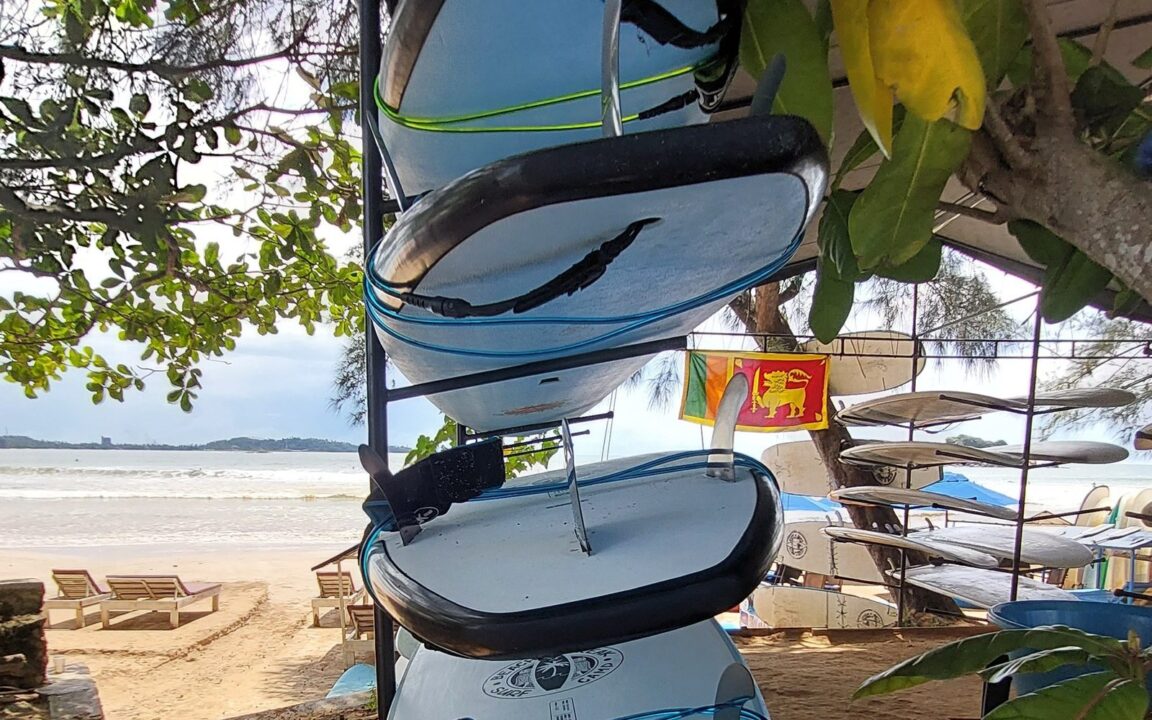
Schools and hire stalls line the bay. A group lesson typically runs around 90 minutes to two hours, starting with a beach briefing on safety, paddling and the pop up, then moving into the whitewater with an instructor alongside. Learners use large soft top boards, usually 8 feet or longer, with rash vests commonly included. Private lessons cost more and give faster feedback for the first sessions.
Prices are low by global standards but vary by school and season, so confirm the current price on the beach rather than trusting older guides. Multi lesson packages usually cost less per lesson and suit how learning works, in consecutive mornings rather than a single taster. Choose on group size, instructors staying in the water, and a clear safety briefing. Boards are widely available by the hour or day for independent practice; check for damage first and rent a board big enough for your level.
Where should intermediate surfers go instead?
Head east, where the coast changes from sand to reef. Midigama offers a cluster of reef breaks close together. Lazy Left and Lazy Right are the usual first steps onto reef, with Lazy Right the mellower introduction and Lazy Left longer and more demanding. Plantations and Coconuts suit intermediates too, while Rams is a short, fast, shallow right hander for advanced surfers only. At Ahangama, Kabalana is best known for The Rock, a reef A-frame that rewards confident intermediates and above.
Reef changes the safety calculation. Falls can mean contact with reef, and lineups expect competent board control and respect for priority. Reef boots help, and a first session should start with watching from shore. The reward is real progression: longer walls and the first genuine green wave rides.
What is the yoga scene in Weligama really like?
Yoga grew up here alongside the surf schools. Surfing loads the shoulders, back and hips, while yoga gives surfers a structured way to stretch, strengthen and slow down between sessions. Studios and shalas offer daily drop in classes through the season, timed around the surf, plus longer retreats away from the busiest strip. Styles range from strong morning vinyasa to slower evening yin, and quality varies, so look for a named teacher and a schedule that is actually kept.
Our guide to Ayurveda retreats in Kerala covers the treatment led end of regional wellness travel, while our earlier stay at Ulagalla Resort in Sri Lanka shows the heritage side of Sri Lanka beyond the coast. Book retreat places well ahead for December to February and check timetables locally.
What else shapes a stay in Weligama?
Weligama, whose name is often translated as sandy village, is a working fishing and market town in Matara District, not a purpose built resort. The main road runs close behind the beach and the town centre is busy and practical. Travellers expecting a secluded boutique strip can feel briefly disappointed; travellers expecting a real coastal town with great beginner surf attached tend to settle in quickly.
The most distinctive sight is stilt fishing, known locally as ritipanna. Fishermen perch on a petta, a narrow crossbar on a pole driven into the seabed, fishing for small fish such as spotted herring and mackerel, most visibly at dawn and dusk. The practice is found only along this stretch of coast and is commonly traced to the period around the Second World War, later passed down within families. Far fewer fishermen now earn a living this way, and the 2004 tsunami damaged many traditional spots. Watch respectfully, and tip if you photograph at close range. Beyond the bay, easy trips include Galle Fort and whale watching boats from Mirissa in season.
How do you get to Weligama and get around?
By road, the Southern Expressway drive from Colombo city is commonly around 2.5 hours in good conditions. From Bandaranaike International Airport, north of Colombo, allow 3 to 4 hours depending on traffic. By rail, trains run from Colombo Fort along the coastal line to Weligama, a scenic journey hugging the ocean, commonly around 3 hours depending on the service. Book reserved seats ahead in peak season and check the current timetable with Sri Lanka Railways close to travel. Once there, surf points and studios are reached on foot or by tuk-tuk.
What are the honest expectations to set before you go?
Expect to stand up, not to surf well, in week one. Most beginners stand in whitewater in their first lesson and reach small green waves within a week of daily lessons, but timing and turns take weeks and months. Expect peak season crowds, occasional flat days even in season, and a town that is functional before it is beautiful. Set that way, Weligama delivers: a low consequence place to learn a hard skill in warm water, with yoga and good food wrapped around the effort.
Frequently Asked Questions
What is the best month to surf and practise yoga in Weligama?
December to March is the most reliable window, with consistent surf and the fullest yoga schedules. November and April are quieter but less predictable. May to October is the monsoon off season.
Can a complete beginner learn to surf in Weligama?
Yes. The sandy bottom, gentle beach break, shallow water and concentration of surf schools make it one of the most beginner friendly places in Asia. Book a block of morning lessons, use a large soft top board, and plan on whitewater progress first.
How long does it take to get from Colombo to Weligama?
Around 2.5 hours by road from Colombo city in good conditions, and typically 3 to 4 hours from the international airport. By train from Colombo Fort, around 3 hours depending on the service. Allow extra time in peak holiday traffic.
Where should I surf once Weligama Bay feels too easy?
Look east to the reefs of Midigama and Ahangama, starting with mellower options such as Lazy Right. Reefs demand better board control, so watch first and ask locally about tides and hazards.
Is Weligama worth visiting in the off season?
It can be, for yoga and a quieter town, and beginners may still find small morning waves. But if surfing is the main purpose between May and October, Arugam Bay is the better base.
Last updated November 2026. Season and transport information checked at the time of writing. Confirm surf school prices, yoga schedules and train times locally, as all three change by season.