 LeVar Thomas
Banff in winter is a trade, and it is worth understanding before you book. You get a frozen Lake Louise, quiet trails, steaming hot springs and some of the best skiing in Canada, and in exchange you accept real cold, short days and a few rules that matter more in January than they do in July. Plan around the cold and the daylight and the trip works. Ignore them and the same trip becomes a lesson in frostbite and missed buses.
The short version: buy a park pass before you stop anywhere in the park, soak at Banff Upper Hot Springs in the evening, see Lake Louise in the morning light, ski the resort if that is your thing, and treat avalanche and ice warnings as instructions, not suggestions. The rest of this guide fills in the details, with hours and prices verified against Parks Canada on November 9, 2026.
Quick Facts
- Where: Banff National Park, Alberta, in the Canadian Rockies, about 128 km west of Calgary.
- When to go: December and January for the coldest, quietest winter. The ski season runs from mid-November to early May.
- Park pass: Required to stop anywhere in the park. Daily adult CAD $12.25, senior CAD $10.75, youth free, family or group CAD $24.50.
- Hot springs: Banff Upper Hot Springs, open daily 10 am to 10 pm, last entry 9:30 pm. Adult CAD $19.75, first-come, first-served, no reservations.
- Lake Louise: The lakeshore is open year-round. The lake freezes in winter. Moraine Lake is inaccessible in winter because of avalanche hazard.
- Daylight: On December 21, 2026, Banff gets 7.88 hours of daylight, with sunrise at 8:44 am and sunset at 4:37 pm, according to the National Research Council of Canada.
- Temperatures: December averages a high of -4.6 C (about 24 F) and a low of -13.4 C (about 8 F), using Environment and Climate Change Canada 1991 to 2020 normals for Banff.
What Winter in Banff Actually Feels Like
Start with the numbers, because Banff winter is colder than most visitors expect, and the cold is the thing that shapes every plan. Environment and Climate Change Canada gives Banff a December daily average of -9.0 C (about 16 F), with a daily high of -4.6 C (about 24 F) and a daily low of -13.4 C (about 8 F). January is nearly identical: a daily average of -8.5 C (about 17 F), a high of -3.5 C (about 26 F) and a low of -13.5 C (about 8 F). December averages 23.0 cm of snow and January 21.2 cm, and the extreme minimum recorded in the normal period reaches -42.0 C in December and -44.2 C in January. Those extremes are rare, but they explain why Parks Canada lists hypothermia and frostbite among its winter hazards, and why a warm layer you thought was optional becomes essential.
The cold is dry, which helps, and it is also still. A calm -10 C day in Banff can feel manageable with the right layers, while the same temperature with wind on an exposed ridge feels punishing. Check the forecast the morning you head out, not the week before, and build your day so the hardest outdoor time happens in the middle of the day. For a full layering system that works in this kind of cold, see our carry-on checklist for New York in December, which covers the same base layer, insulation and shell logic, then add warmer boots and heavier gloves for Banff.
Daylight is the other constraint. Banff sits at about 51 degrees north, and the National Research Council of Canada calculates sunrise at 8:44 am and sunset at 4:37 pm on December 21, 2026, the shortest day of the year, giving 7.88 hours of daylight and 9.21 hours of total illumination including twilight. That is the planning window for everything outdoors. The Lake Louise Ski Resort runs its lifts from 9:30 am to 4:30 pm in winter, which is a useful anchor: if the ski hill fits its day inside those hours, so should you. Do the lake and the trails in the morning and early afternoon, and keep the evenings for the hot springs, a meal and rest.
One more reassurance first: Banff National Park is open year-round, according to Parks Canada. Winter does not close the park. It changes which roads, trails and services are practical, and it rewards visitors who check conditions daily.
The Park Pass Comes First
Before any of the fun, sort out the park pass, because it is a legal requirement, not a suggestion. Parks Canada states that you must buy a pass if you are spending time in a national park, which includes road trips, camping, backcountry adventures, visits to picnic sites and viewpoints, and stops in towns and villages. You also need one to travel the scenic parkways, the Icefields Parkway (Highway 93 North) between Lake Louise and Jasper and the Bow Valley Parkway (Highway 1A) between Banff and Lake Louise. You do not need a pass if you are travelling through the park without stopping, except on those scenic parkways, and westbound vehicles can use the through lane at the Banff East Gate on the Trans-Canada Highway. In practice, any winter visitor who stops to look at anything needs a pass.
As of November 9, 2026, a daily pass costs CAD $12.25 for an adult, CAD $10.75 for a senior, and CAD $24.50 for a family or group, while youth are free. A commercial group pays CAD $10.42 per person. If you are visiting for more than a few days, the annual Parks Canada Discovery Pass costs CAD $83.50 for an adult, CAD $71.50 for a senior and CAD $167.50 for a family or group. Buy a pass online, at a Parks Canada visitor centre, at the gate or from a partner, and keep it displayed in your vehicle. The pass is separate from every other fee in this guide: it does not cover the hot springs, the ski resort or parking.
Banff Upper Hot Springs: The Evening Anchor
The hot springs are the best reason to plan your evenings in Banff, and they are the most forgiving winter activity in the park. Parks Canada calls a visit to the Upper Hot Springs one of the park’s greatest traditions, and the setup explains why: an outdoor pool of mineral-rich water kept between 37 and 40 C (98 and 104 F), described as Canada’s highest outdoor pool, set among the jagged peaks of Rundle and Cascade Mountains. The water carries sulphate at 572 mg/l, calcium at 205 mg/l, bicarbonate at 134 mg/l, magnesium at 42 mg/l and sodium at 6.6 mg/l. The bathhouse is a federal heritage building. On a -10 C evening, stepping from the cold air into 38 C water is the single best feeling a winter trip to Banff offers.
The practical details, verified against Parks Canada on November 9, 2026: the springs are open daily from 10 am to 10 pm, with last entry at 9:30 pm, and they stay open on Canadian holidays including Christmas Day, Boxing Day and New Year’s Day. Hours are subject to change, so check the Parks Canada page before you go. Single-entry admission costs CAD $19.75 for an adult, CAD $17.25 for a senior, CAD $17.25 for a youth aged 3 to 17, and CAD $64.25 for a family, while children under 3 are free. A locker token is included with single entry. Rentals cost CAD $5.00 for a swimsuit, CAD $3.00 for a towel and CAD $2.00 for an extra locker token. An annual pass is also available at CAD $254.50 for an adult, CAD $216.50 for a senior or youth, and CAD $753.75 for a family.
Two rules shape the visit. First, entry is first-come, first-served, and admission can only be purchased in person at reception. There are no online bookings, reservations or advance tickets, so arrive early in the evening or later at night rather than at the busiest hour, and expect a line on holiday weekends. Second, the springs can close with limited or no notice during cold periods if the flow of natural spring water is insufficient to fill the pool, and Parks Canada notes the Upper Hot Springs are the hottest of the park’s springs. A closure is a real possibility in the coldest weeks, so have a backup evening plan and check the hot springs page the day you go.
Getting there is simple. The springs sit on Mountain Avenue, four kilometres south of the Town of Banff, and the easiest way to reach them is Roam Public Transit Route 1, the Sulphur Mountain route, which runs every 20 minutes from downtown Banff during regular hours. Parking at the springs is limited and fills quickly, so the bus is the better choice on a winter evening. For a different take on a historic hotel stay built around warming up and slowing down, see our guide to The Plaza Hotel in New York.
A Frozen Lake Louise
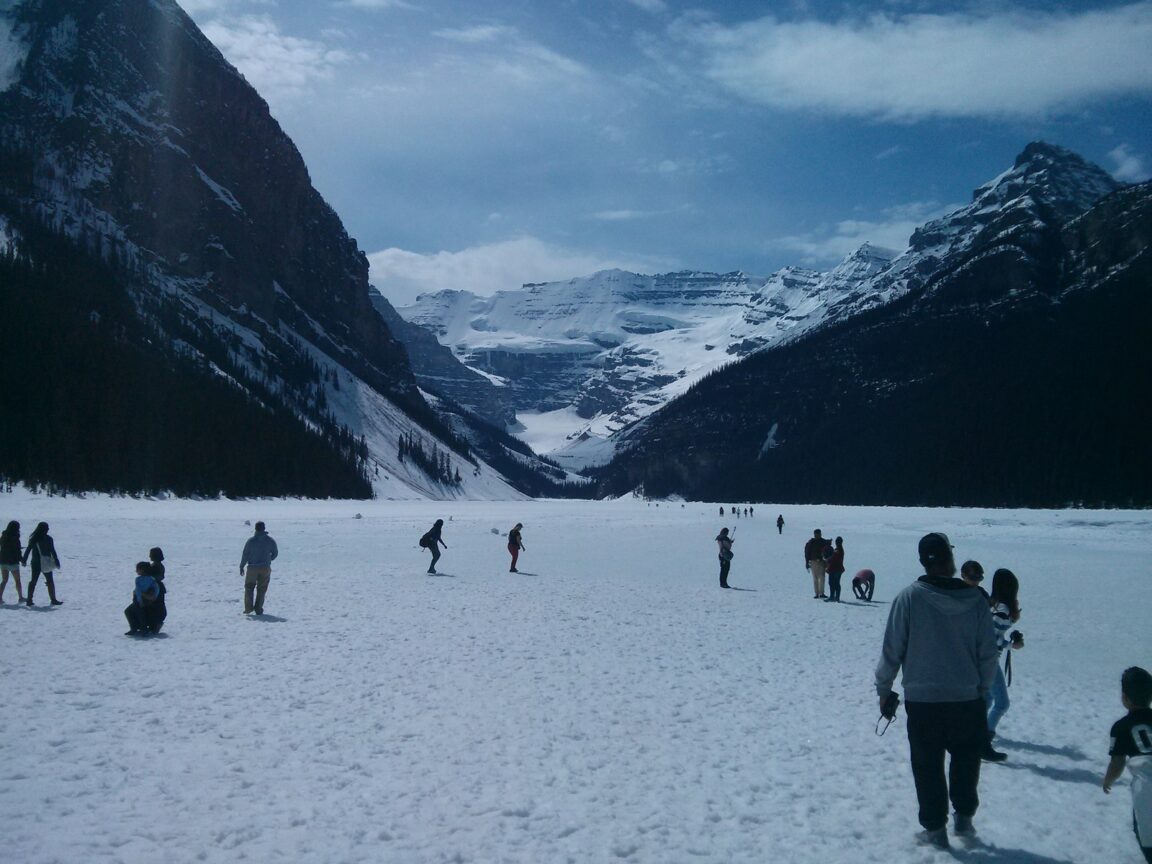
Lake Louise is the image most people carry into a Banff winter trip, and in winter the lake itself is the attraction. The lake sits 55 km west of the Town of Banff on the Trans-Canada Highway, and the community there began in 1890 as Laggan Station, a wild outpost at the end of the Canadian Pacific Railway. The Lake Louise lakeshore is open year-round, according to Parks Canada, and the lakes usually melt by late May, which means a December or January visit finds the lake frozen, snow-covered and framed by the Fairmont Chateau Lake Louise and the peaks behind it. The photo at the top of this article was taken from the Fairview Lookout, about one kilometre from the trailhead, and it shows the view that makes the short walk worthwhile.
In winter, the lake is a place to walk, look and take photographs, and when conditions allow, to skate. That last point needs care. Parks Canada states plainly that it does NOT monitor natural ice surfaces for safety or mark potential hazards, and it gives a recommended ice thickness of 15 cm for walking or skating alone and 20 cm for skating parties or games. Do not assume the ice is safe because other people are on it, and do not step onto the lake without checking the current trail condition report and the conditions on the day. The ice carving competition held at the lake in January, the Ice Magic Festival, is a good time to visit, because the sculptures and the cleared skating area give the frozen lake a focus, but the same ice safety rule applies.
Winter access to Lake Louise is simpler than summer access, which is a pleasant surprise. Parks Canada runs its shuttles only from May to October, and parking payment at the lakeshore applies from May to October, so neither is a winter concern. Roam Public Transit runs year-round, and personal vehicles can reach the lake year-round. Drive carefully, keep the car winterized, and arrive in the morning, when the light on the lake is best and the day is still ahead of you.
Do not plan a winter trip to Moraine Lake. The road to Moraine Lake is closed to personal vehicles year-round, and Parks Canada states that during winter the road is track-set for skiing and the lake itself is inaccessible due to avalanche hazard. Save Moraine Lake for a summer visit, when the shuttles run from June to mid-October.
Skiing at Lake Louise
If skiing is the reason you are coming, Lake Louise delivers it on a serious scale. The Lake Louise Ski Resort, a separate operation from the lake itself, reports that it is open for the 2026-27 season, with the Glacier Chair, Juniper Chair and Magic Carpet running. New lift hours for winter are 9:30 am to 4:30 pm, and the 2026-27 season pass covers unlimited skiing and riding from November 6 to May 2, 2027. The resort describes three mountains of expansive terrain with world-famous views, and it was named Canada’s Best Ski Resort at the 2025 World Ski Awards. Parks Canada puts the start of the ski season in mid-November. The resort sits at 1 Whitehorn Road, Lake Louise, Alberta. Book lift tickets, lessons and rentals ahead of time, and plan your ski day inside the lift hours, which are set around the short winter daylight.
Staying Safe in the Cold
Banff in winter is safe when you respect the cold, the ice and the avalanche risk, and it is unforgiving when you do not. Parks Canada lists the winter hazards plainly: avalanches, disorientation, thin ice, hypothermia and frostbite. Treat each one as a planning item, not a warning to ignore.
Avalanches are the most serious risk. Parks Canada writes, “Caution: Avalanche danger! Know before you go, don’t take the risk! Thousands of avalanches occur throughout Banff National Park.” Check the avalanche forecast before any backcountry travel, and stay on marked, maintained trails unless you have avalanche training and equipment. Winter travel to the Plain of Six Glaciers, for example, requires avalanche training and equipment. The reason Moraine Lake is off limits in winter is the same avalanche hazard, so do not look for a workaround.
Ice is the second risk. As noted above, Parks Canada does not monitor natural ice surfaces, and the recommended thickness is 15 cm for walking or skating alone and 20 cm for skating parties or games. Skate only where the ice is maintained and checked, and keep off frozen water you have not verified.
Cold is the third risk, and the easiest to manage. Dress in layers: a moisture-wicking base layer, an insulating mid layer and a windproof, waterproof shell, plus a warm hat, insulated gloves, a scarf or neck gaiter, and insulated, waterproof boots with good grip. Parks Canada recommends ice cleats for winter walking, because most trails become snow-packed and slippery. Our New York December packing guide explains the same layering system in detail, and the Banff version of it is simply warmer and more waterproof.
Driving and wildlife need a line each. From November to March, make sure your car is winterized, and check road conditions on Alberta 511 and the Parks Canada trail condition report before you set out. Bears hibernate in winter but can wake for short periods, and cougars, wolves and other wildlife stay active all year, so give any animal plenty of space and never approach it. The Banff Legacy Trail carries a winter warning, is not maintained in winter, and its use is not recommended.
Finally, know how to get help. In an emergency, call 911 or the Banff Emergency Dispatch Centre, and remember that cell phones are not always reliable in the mountains. Tell someone where you are going and when you expect to be back, carry a headlamp for the early dark, and check in at a Parks Canada Visitor Centre for advice before a big day out.
A Sensible Winter Day in Banff
Put the pieces together and a good winter day almost plans itself. Start at Lake Louise in the morning, when the sun clears the peaks and the light is at its best, and be back in Banff town by early afternoon. Spend the afternoon skiing, snowshoeing or walking a maintained trail near town, with ice cleats in your bag. Then head to Banff Upper Hot Springs in the evening, arriving before the 9:30 pm last entry, and let the 37 to 40 C water do the work of warming you up. One lake, one trail and one soak is a full day in winter, because the daylight runs out at about 4:37 pm and the cold takes the rest. Trying to fit more in is how winter trips go wrong.
Frequently Asked Questions
Do I need a park pass to visit Banff in winter? Yes, if you stop anywhere in the park. Parks Canada requires a pass for road trips, viewpoints, picnic sites, stops in towns and villages, and travel on the Icefields Parkway and the Bow Valley Parkway. A daily adult pass costs CAD $12.25, a senior pass CAD $10.75, a family or group pass CAD $24.50, and youth are free. The only exception is travelling through the park without stopping, except on the scenic parkways.
Can you skate on Lake Louise in winter? The lake freezes, and skating is possible when conditions allow, but Parks Canada does not monitor natural ice surfaces for safety or mark hazards. Its guidance is 15 cm of ice for walking or skating alone and 20 cm for skating parties or games. Check the trail condition report and the conditions on the day before stepping onto the ice.
What should I wear in Banff in December? Layers. Start with a moisture-wicking base layer, add insulation, and finish with a windproof, waterproof shell, plus a warm hat, insulated gloves, a scarf and insulated, waterproof boots. December averages a high of -4.6 C (about 24 F) and a low of -13.4 C (about 8 F), and Parks Canada recommends ice cleats for winter walking.
Is Moraine Lake open in winter? No. The road to Moraine Lake is closed to personal vehicles year-round, and in winter the road is track-set for skiing while the lake itself is inaccessible due to avalanche hazard. Visit Moraine Lake between June and mid-October instead.
What are the Banff Upper Hot Springs hours? The springs are open daily from 10 am to 10 pm, with last entry at 9:30 pm, including Christmas Day, Boxing Day and New Year’s Day. Admission is first-come, first-served, and tickets are sold in person only. Adult admission is CAD $19.75, and the springs can close with limited or no notice during cold periods if the spring water flow is insufficient.
Sources: Parks Canada, Banff National Park, verified November 9, 2026: Banff Upper Hot Springs, hours and fees; park passes and fees; Winter in Banff National Park; Lake Louise and Moraine Lake; Visiting Lake Louise and Moraine Lake. Lake Louise Ski Resort, skilouise.com. Environment and Climate Change Canada, Canadian Climate Normals 1991-2020, Banff station. National Research Council Canada, sunrise and sunset calculator, Banff, December 21, 2026. All prices are in Canadian dollars.