 LeVar Thomas
Swimming with whale sharks at Ningaloo Reef works because it is tightly regulated: licensed operators only, a maximum of ten swimmers in the water with one shark, at least 3 metres from the head and body and 4 metres from the tail, and no touching, ever. The season runs from about mid March, following the mass coral spawning, with tours operating into July and, for some operators, early August. Base yourself in Exmouth or Coral Bay, book a full-day licensed tour well ahead for April to June, and budget accordingly: one long-running Exmouth operator lists its 2026 full-day tour at A$620 per adult. This guide explains the season, the rules and the real costs, verified against Western Australia’s parks authority guidance and operator listings.
Quick Facts
- Where: Ningaloo Marine Park, off Exmouth and Coral Bay on Western Australia’s Coral Coast, about 1,250 kilometres north of Perth. The Ningaloo Coast was inscribed on the UNESCO World Heritage List in 2011.
- Season: Whale sharks aggregate from about mid March, triggered by mass coral spawning, with the core season running to July and some operators extending into early August.
- The rules: Maximum 10 people in the water with a shark at one time; stay at least 3 metres from the head and body and 4 metres from the tail; no touching or riding; no flash photography; no motorised propulsion aids.
- Vessel rules: A 250 metre exclusive contact zone applies around a whale shark, with only one vessel operating inside it at a time, for up to 90 minutes, and vessels must not approach closer than 30 metres to the shark.
- Who can run tours: Only operators licensed by Western Australia’s Department of Biodiversity, Conservation and Attractions, through Parks and Wildlife.
- Example 2026 cost: A$620 per adult, A$550 per child and A$250 per non-swimming observer for a full-day tour with 3 Islands Whale Shark Dive in Exmouth, listed by the operator for 2026, including the marine park fee. Prices vary by operator and date, so confirm before booking.
- Prices checked: 9 November 2026.
Why do whale sharks come to Ningaloo?
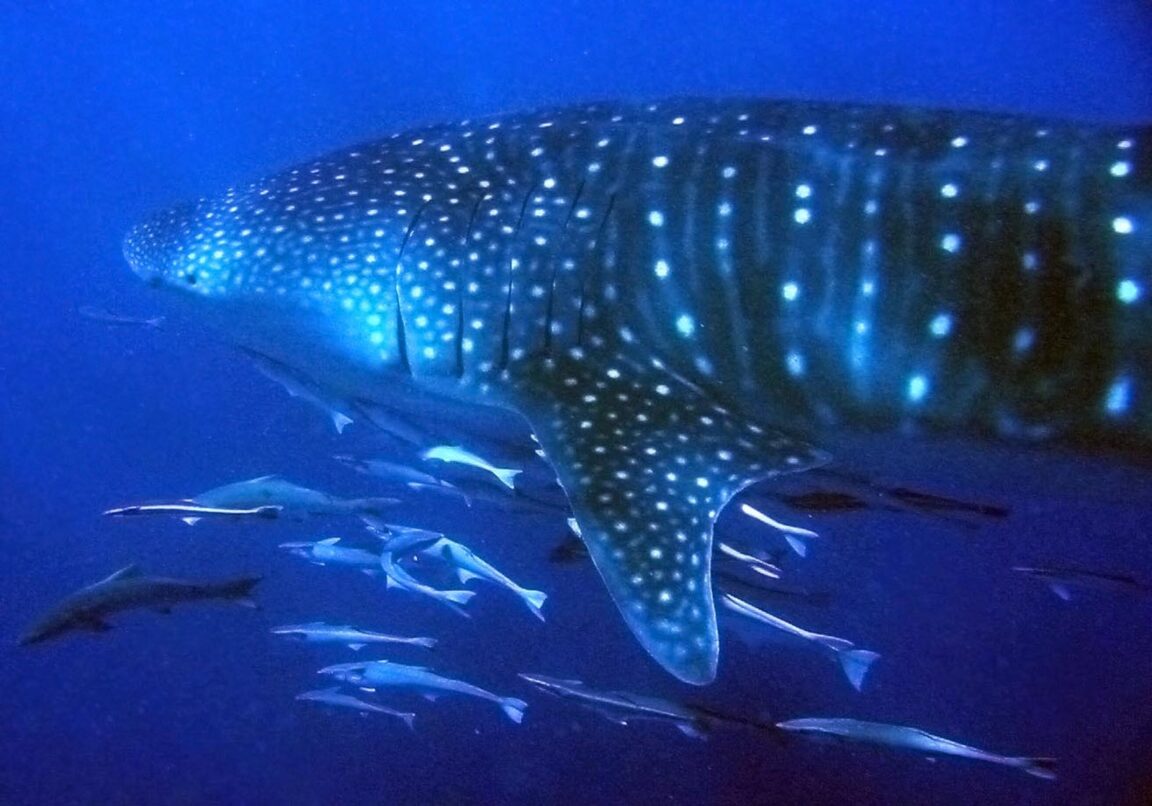
Ningaloo is one of the world’s longest fringing reefs, stretching about 260 kilometres along the North West Cape, close enough to shore that snorkellers can reach coral gardens from the beach. Each year in March and April the reef’s corals spawn en masse, and the resulting pulse of plankton and krill draws whale sharks, the world’s largest fish, into the waters outside the reef to feed. Western Australia’s parks department notes the sharks encountered at Ningaloo are commonly in the range of about 2 to 12 metres long. They are filter feeders that strain plankton through enormous mouths, they are protected in Australian waters, and the species is listed as Endangered on the IUCN Red List, which is why the interaction rules below are licence conditions, not suggestions.
The aggregation is unusually predictable for a wild animal encounter, and that predictability built the tour industry at Exmouth and Coral Bay. Predictable does not mean guaranteed. Sharks move, weather closes days, and every reputable operator runs a no-sighting policy of some kind, typically a free repeat tour or a voucher or partial refund. Read that policy before you pay, because it is the clause you are most likely to use.
When is the best time to go?
The core season, roughly April to July, offers the most consistent sightings, with April, May and June the months most operators and local guides point to first. Tours begin from about mid March as the first sharks arrive after spawning, and some operators continue into early August as numbers taper and the humpback whale migration season begins to overlap. Shoulder dates are not a mistake: late season days can combine whale sharks with humpbacks, manta rays, which are present year-round, turtles and dugongs. They are simply a trade, slightly lower whale shark reliability in exchange for more variety and, sometimes, better availability.
Book peak dates early. Exmouth’s visitor peak runs through the whale shark months and Western Australian school holidays, so boats, accommodation and the best Coral Bay and Cape Range campsites all fill. If your dates are fixed in April or May, the tour booking should happen months ahead, not on arrival. If your dates are flexible, travelling on the edges of the peak can make the whole trip easier to assemble.
What are the rules in the water?
The code of conduct published for Ningaloo interactions is specific, and crews enforce it in the water. Swimmers must not attempt to touch or ride a whale shark, must not restrict its normal movement or behaviour, and must stay at least 3 metres from the head and body and 4 metres from the tail. Flash photography is prohibited, as are motorised propulsion aids, and no more than ten people may be in the water with a shark at any one time, which is why boats split guests into groups and rotate them.
Around the shark, a 250 metre radius exclusive contact zone applies. Only one vessel may operate inside it at a time, for a maximum of 90 minutes, the second vessel to arrive keeps 250 metres away, later vessels keep 400 metres away, and vessels inside the zone must not approach closer than 30 metres to the shark. Only operators holding a departmental licence may run these tours commercially. In practice the rules feel simple rather than bureaucratic: your guide places the group ahead of the shark’s path, you enter the water, the shark passes and you swim alongside without intercepting it, and when the encounter ends you return to the boat. A shark that is left alone keeps swimming at the surface. A harassed shark dives, and the encounter is over for everyone.
What does a tour day actually look like?
Full-day tours from Exmouth and Coral Bay follow a similar rhythm. A spotter aircraft searches the outer reef and radios shark positions to the boats, which is why Ningaloo’s success rate is high by world standards. Between whale shark swims, boats typically stop for a reef snorkel, and lunch is served on board. Individual swims with one shark are short, often a few minutes of swimming alongside before the animal moves on or the group rotates, and a good day strings several swims together rather than one long one.
You need to be a confident snorkeller rather than an athlete, but honesty about your swimming matters. The swims happen in open ocean outside the reef, you enter and exit the water repeatedly, and keeping position a respectful 3 metres from a large animal that cruises steadily requires comfortable finning. Operators supply wetsuits and snorkel gear, and observers who do not want to swim can usually book a cheaper observer place and watch from the boat, which is the right choice for nervous swimmers and young children.
What does it cost, in full?
The swim itself is the headline cost, and it is a premium wildlife tour by any measure. As a current, checkable example, 3 Islands Whale Shark Dive, an Exmouth operator, lists 2026 pricing at A$620 per adult, A$550 per child up to 17 years, A$2,200 for a family of two adults and two children, and A$250 for observers, with the Ningaloo Marine Park fee and whale shark conservation levy included. Other licensed operators price differently, and third-party booking platforms sometimes show lower headline figures in other currencies, so compare the operator’s own listing, check what is included, and confirm the no-sighting policy, inclusions and cancellation terms before paying.
Then budget the trip around the tour. Exmouth is remote: most visitors fly from Perth to Learmonth airport or build Ningaloo into a long Coral Coast road trip. Add several nights of accommodation, because one night is a gamble against weather, meals in a small town at peak-season prices, and, if you plan to enter Cape Range National Park for its beaches and gorges, the applicable park pass and pre-booked campsites where relevant. For comparison with Australia’s other great reef coast, see our guide to Lizard Island Resort on the Great Barrier Reef, and for another warm-water trip built around a single signature stay, our round-up of the best beach resorts in Tulum.
How do you choose an operator responsibly?
Choose on licence, policy and practice, not only price. Confirm the operator is licensed for whale shark interactions in Ningaloo Marine Park, uses a spotter plane, states a clear no-sighting policy, and briefs the 3 metre and 4 metre distances before anyone gets wet. Small operational details tell you a lot: a crew that enforces distance calmly, rotates groups fairly and ends a swim when a shark changes behaviour is running the encounter for the animal first, which is precisely what keeps Ningaloo’s sharks returning and its encounters worth travelling for.
Frequently Asked Questions
When is whale shark season at Ningaloo Reef?
Whale sharks aggregate at Ningaloo from about mid March, following the mass coral spawning, and the core season runs through July, with some licensed operators offering tours into early August. April to June is generally the most reliable window. Exact timing varies each year and sightings are never guaranteed.
How close can you get to a whale shark at Ningaloo?
The code of conduct requires swimmers to stay at least 3 metres from the head and body and 4 metres from the tail, with no touching or riding, no flash photography and a maximum of ten people in the water with one shark at a time. Your guide will position the group and enforce the distances.
How much does a Ningaloo whale shark tour cost?
Expect premium full-day pricing. One Exmouth operator, 3 Islands Whale Shark Dive, lists 2026 prices of A$620 per adult, A$550 per child and A$250 for non-swimming observers, including the marine park fee. Prices vary by operator, date and inclusions, so verify the current price and the no-sighting policy on the operator’s own site before booking. Prices in this guide were checked on 9 November 2026.
Do you need to be a strong swimmer?
You need to be a comfortable, confident snorkeller in open ocean. Swims take place outside the reef, involve repeated water entries, and require steady finning to keep pace alongside a cruising shark while holding the required distance. If that sounds like too much, book an observer place and watch from the boat instead.
What happens if you do not see a whale shark?
Most licensed operators run a no-sighting policy, commonly a free repeat tour on the next available day, a voucher for a future tour, or a partial refund. The exact terms differ by operator and are the most important small print on the booking, so read them before you pay and leave a spare day in Exmouth if you can.
Can you swim with whale sharks without a tour?
Commercial interactions are restricted to licensed operators, and the vessel and swimmer code of conduct applies to everyone in the contact zone, including private vessels: one vessel at a time inside 250 metres, no closer than 30 metres by vessel, and the same swimmer distances. In practice, a licensed tour with a spotter plane is the realistic and responsible way to do it.