 James Wolfe
Go to the Faroe Islands for sea cliffs, grass roof villages and waterfalls that fall straight into the North Atlantic, and go in summer for the best odds of usable weather. This self governing archipelago of 18 islands sits between Iceland, Norway and Scotland, flies in through Vágar Airport two to three hours from continental Europe, and can also be reached by ferry from Denmark and Iceland. For most first time visitors, late May to early September, with June to August at the core, is the practical window: the longest days, the widest choice of tours and ferries, and cool rather than warm temperatures. Pack for wind and rain in every season, book flights, cars and beds early for summer, and treat the islands as their own destination, not as a side trip from Denmark.
Quick Facts
- Where: An archipelago of 18 islands in the North Atlantic, between Iceland, Norway and Scotland, at about 62 degrees north.
- Status: A self governing territory within the Kingdom of Denmark, with its own parliament, the Løgting, and its own language and flag. It is not part of the European Union or the Schengen Area.
- Capital: Tórshavn, on the island of Streymoy, one of the smallest capitals in Europe and the usual base for a first trip.
- Main gateway: Vágar Airport (FAE) on the island of Vágar, the only airport in the islands, linked by road to Tórshavn and the main islands.
- Language: Faroese is the main language, Danish has official status, and English is widely spoken, so visitors rarely face a language barrier.
- Currency: The Faroese króna, issued at par with the Danish krone (DKK). Danish krone notes are used alongside Faroese notes, and payment cards are widely accepted.
- Best time to visit: June to August for the most stable weather and longest daylight, within a broader visiting season that runs roughly from May to September.
- Typical summer weather: Cool and changeable. Visit Faroe Islands gives average summer temperatures of 10 to 13 degrees Celsius, with July generally the warmest month.
- Getting there: Flights with Atlantic Airways and SAS, plus a Smyril Line ferry, the M/S Norröna, from Hirtshals in Denmark and Seyðisfjörður in Iceland. There is no regular direct flight from the United States, so US travelers connect in Europe.
Why Go to the Faroe Islands?
The Faroe Islands reward travelers who prefer landscape and quiet to landmarks and crowds. Steep grass covered mountains rise directly from the sea, fjords cut between villages, and a short drive can move you from a harbor town to an empty headland or a waterfall in under an hour, making even a four or five day trip feel varied.
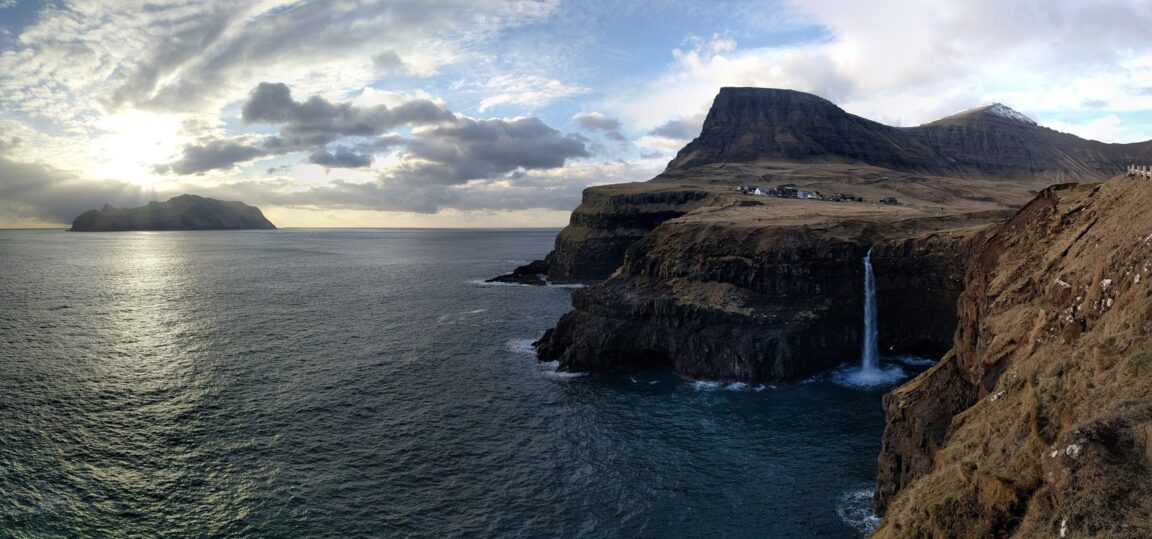
Three kinds of experience define a first visit. The first is the coast itself, seen from cliff paths, boat trips and viewpoints such as Múlafossur at Gásadalur, where a stream drops off the cliff edge into the ocean below the village. The second is village life in places such as Saksun, Tjørnuvík and Gjógv, where small harbors, grass roof houses and a single church or cafe make up the whole settlement. The third is wildlife, above all seabirds. In summer, cliffs and offshore islands hold large numbers of nesting puffins, guillemots and fulmars, and boat and walking tours are built around seeing them at close range without disturbing them.
The culture is distinct, too. Faroese is a living North Atlantic language with roots in Old Norse, and the food culture is built around fish, lamb and preserved traditions. Readers drawn to high latitude islands will find a useful comparison in our guide to sustainable travel in Svalbard at the edge of the Arctic, which covers a very different Arctic community facing some of the same questions about visitors, wildlife and weather.
A Place of Its Own: Autonomy, Language and Daily Life
The islands are not simply a region of Denmark. They have been self governing within the Kingdom of Denmark since home rule in 1948, run most domestic affairs, and have chosen to stay outside the European Union, a decision closely tied to fishing. Day to day government sits in Tórshavn, in and around the red painted, turf roofed buildings of Tinganes, where assemblies have met for centuries.
That status has real travel consequences. Entry rules are not identical to Denmark’s, payments work on the Danish krone system rather than the euro, and visitors do best to refer to the Faroe Islands and Faroese people on their own terms, rather than describing a trip here as a trip to Denmark.
When to Go: Seasons, Weather and Daylight
Visit Faroe Islands sums up the climate in one word: changeable. The weather is mild, oceanic, windy and fast moving in every month, and sun, mist, rain and clear sky can follow each other on the same drive. There is no month in which a waterproof layer is optional. What changes with the seasons is daylight, temperature and how much visitor infrastructure is open.
Summer, June to August
Summer is the default answer for a first trip, and the official advice agrees: June to August offers the most stable weather and the longest daylight, making it the most popular season. Average summer temperatures sit around 10 to 13 degrees Celsius, so think cool spring day rather than beach weather. Days are very long around midsummer, seabirds are nesting, and ferries and tours run at their fullest. The trade off is demand: flights, rental cars and accommodation are limited and book out early, so plan a summer trip further ahead than the islands’ remote image might suggest.
Shoulder Season, May and September
May brings long days and the start of the bird season with fewer visitors, while September keeps much of the summer infrastructure as the light turns lower. Weather is less settled, some tours wind down, and ferries to smaller islands run reduced timetables, so itineraries need more flexibility. For photographers and walkers who can absorb a cancelled boat trip, the shoulder months can be the sweet spot.
Autumn and Winter, October to April
Winter is cool rather than extreme, with temperatures typically between 3 and 7 degrees Celsius and occasional snow, but daylight is the real constraint. Around the solstice there are only a few hours of usable light, storms are more frequent, and many tours and guesthouses close or cut hours. What winter offers is atmosphere: dramatic seas, empty roads, a small chance of northern lights, and Tórshavn at its most local. It suits a short, town based trip, and makes island hopping difficult.
How to Reach the Faroe Islands
By Air Through Vágar Airport
Flying is how almost every visitor arrives. All flights use Vágar Airport on the island of Vágar, and Visit Faroe Islands puts the islands at just a two to three hour flight from continental Europe. The national airline, Atlantic Airways, operates from Denmark, Iceland, Norway, the United Kingdom and France. Copenhagen is the main hub, with several flights a day operated by Atlantic Airways and SAS, which makes it the simplest connection from most of Europe and from long haul flights into Denmark. Atlantic Airways also flies direct from Paris twice a week from May to October, and the Norwegian airline Widerøe operates between two and four flights a week between Norway and the Faroe Islands. Other links, including to Iceland and Edinburgh, run on seasonal patterns, so check the current Atlantic Airways timetable for your dates rather than relying on a route list from a previous season.
From the United States there is no regular nonstop service, so the standard routings are a transatlantic flight to Copenhagen or to Keflavík in Iceland, then a short onward flight to Vágar. Build in a sensible connection time, as North Atlantic weather can delay the final leg. From the airport, Tórshavn is reached by bus, taxi or rental car.
By Ferry With Smyril Line
Smyril Line’s ferry M/S Norröna sails to Tórshavn from Hirtshals, in the north of Denmark, and from Seyðisfjörður in eastern Iceland, carrying passengers and vehicles. Frequency varies by season: the Denmark link runs year round, while the Iceland leg is seasonal and pauses in winter. The ferry suits travelers bringing a car or camper, or combining the Faroes with a road trip in Iceland. Book cabins and vehicle space early for summer, and check the current Smyril Line timetable, as sailing days change across the year.
Getting Around the Islands
Most main islands are linked by bridges and undersea tunnels, so a rental car turns Vágar, Streymoy, Eysturoy and the northern islands into one connected road trip. Distances are short, but single track roads, sheep and fast changing fog argue for unhurried driving. A car is close to essential for trailheads and villages, and automatics should be reserved well ahead in summer.
Buses and domestic ferries run by Strandfaraskip Landsins connect towns and inhabited islands, and multi day travel cards cover buses and most ferries. The limits are frequency rather than coverage: services thin out on Sundays and require planning around the last return sailing. Mykines, for puffins, and Kalsoy, for the Kallur Lighthouse walk, are reached only by ferry; those sailings are weather dependent and, for Mykines in season, need booking in advance.
What to See and Do on a First Trip
Tórshavn and Tinganes
Give the capital at least a day. Walk the lanes of Tinganes and the old town of Reyn, where turf roofed houses line narrow passages above the harbor, visit Tórshavn Cathedral, and use the National Museum and National Gallery for context on Faroese history and art. With the islands’ best choice of restaurants and cafes, Tórshavn is the natural base for travelers who prefer to day trip rather than move beds every night.
Múlafossur and Gásadalur, Vágar
On the same island as the airport, Gásadalur sits above the cliff where Múlafossur falls about 30 metres directly into the sea. For years the village was reached only on foot over the mountain or by boat, before a road tunnel connected it to the rest of Vágar. The viewpoint is a short walk from the village, and nearby Bøur, the lake Sørvágsvatn and the Trælanípa cliff viewpoint make western Vágar a rewarding first or last day of a trip.
Saksun, Tjørnuvík and the North
The turf roofed church and lagoon at Saksun are among the most photographed scenes in the islands. Continue to Tjørnuvík, which looks across to the sea stacks Risin og Kellingin, the Giant and the Witch, off Eysturoy. The village of Gjógv, built around a natural harbor in a cleft in the cliffs, and the Fossá waterfall round out a full day’s loop from the capital.
Bird Cliffs, Mykines and Boat Trips
In summer, take to the water at least once. Boat trips to the Vestmanna bird cliffs, on the west coast of Streymoy, sail below towering cliffs while seabirds nest above. A day trip to Mykines, the westernmost island, is the classic puffin outing, but it requires a booked ferry and a willingness to accept that weather can cancel the whole plan. Keep to marked paths and never approach cliff edges in high wind.
Practical Planning Notes
Entry requirements. The Faroe Islands are outside the European Union and the Schengen Area. US citizens can visit without a visa for short stays of up to 90 days with a valid passport, but a standard Schengen visa does not on its own cover the Faroe Islands. Visa required travelers need a visa issued specifically as valid for the Faroe Islands, through a Danish diplomatic mission, so check current Danish guidance for your nationality before booking.
Money and costs. Accommodation, car rental, eating out and tours cost more than in most of continental Europe, reflecting a small, import dependent economy. Cards are accepted almost everywhere. Faroese króna notes are the local issue of the Danish krone, and Danish notes are accepted in return; spend or exchange Faroese notes before leaving, as they are not readily exchangeable abroad.
Weather and packing. Pack as if for four seasons in one trip: waterproof and windproof outer layers, warm mid layers including a hat and gloves even in summer, and sturdy waterproof footwear. Leave room in the itinerary, too: one flexible day absorbs a cancelled ferry or a fogged viewpoint better than any item of clothing.
Hiking and access. Many paths cross farmland. Some well known routes are managed with local guides, marked trails or access arrangements that change by season, so check current Visit Faroe Islands hiking guidance, stay on marked paths, and close gates behind you. Lambing season, nesting birds and wet ground can all close a walk, and local instructions on the day override any guidebook.
How long to stay. Three days covers Tórshavn, Vágar and one Streymoy and Eysturoy loop at a brisk pace. Five to seven days is the comfortable first trip, adding a bird island or boat trip and a weather buffer. For another European destination that repays this kind of unhurried, base and explore approach, see our first timer’s guide to Kotor, Montenegro, where a walled town and a fjord like bay reward the same slower pacing.
Frequently Asked Questions
Are the Faroe Islands part of Denmark?
They are a self governing territory within the Kingdom of Denmark, with their own parliament, language and flag, outside the European Union and the Schengen Area. Domestic government is Faroese and based in Tórshavn.
What is the best month to visit the Faroe Islands?
For a first trip, choose June, July or August. Visit Faroe Islands identifies summer as the season with the most stable weather and longest daylight, and July is generally the warmest month, with average summer temperatures of 10 to 13 degrees Celsius.
How do I get to the Faroe Islands from the United States?
There is no regular nonstop flight from the United States. Fly transatlantic to Copenhagen or Keflavík in Iceland, then take a short onward flight to Vágar Airport, leaving a generous connection for weather delays.
Can I visit the Faroe Islands on a Schengen visa?
Not on a Schengen visa alone. Travelers who need a visa must hold one issued specifically as valid for the Faroe Islands, obtained through a Danish diplomatic mission. US citizens and other visa exempt visitors can enter for short stays of up to 90 days with a valid passport.
Do I need a car in the Faroe Islands?
A car is not compulsory, but it makes a first trip far easier. Buses and domestic ferries cover the main towns, yet services are infrequent and viewpoints are spread out. Travelers without a car should base in Tórshavn and book tours for bird cliffs and smaller islands.
What should I pack for the Faroe Islands in summer?
Pack for cool, wet and windy weather even in July: waterproof and windproof outer layers, warm layers, a hat and gloves, and sturdy waterproof boots. Average summer temperatures of 10 to 13 degrees Celsius feel colder in North Atlantic wind.