 James Wolfe
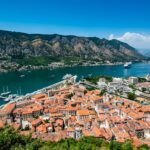
Kotor is the town in Montenegro that first-time visitors remember longest, and the reason is the setting. A walled Old Town sits at the head of the Bay of Kotor, a winding natural harbour on the Adriatic coast, with steep mountains rising straight from the water behind it. The Old Town is small enough to walk across in minutes, yet it holds centuries of history inside its walls, and the climb to St John’s Fortress above it gives one of the best views in the Balkans. This guide covers the bay and the Old Town, the walls and the fortress climb, how to arrive, how to time a visit around cruise ships, where the Old Town sits in relation to Dobrota, and how to pair Kotor with Perast.
The short version is simple. Kotor is a UNESCO World Heritage site, listed in 1979 as the Natural and Culturo-Historical Region of Kotor. The Old Town is a compact maze of stone lanes, squares and churches inside medieval walls, and the fortress above it is reached by a long, steep stairway. Most visitors arrive by air through Tivat, Podgorica or Dubrovnik and continue by road, or by bus along the coast. Cruise ships call at Kotor and their passengers fill the Old Town in the middle of the day, so early mornings and evenings are the quietest times to explore. A stay of two days allows time for the Old Town, the fortress climb and a trip to Perast.
Quick Facts
What it is: A walled Old Town at the head of the Bay of Kotor in Montenegro, on a natural harbour on the Adriatic coast.
UNESCO status: The Natural and Culturo-Historical Region of Kotor was listed as a UNESCO World Heritage site in 1979, under criteria (i), (ii), (iii) and (iv).
The Old Town: A compact maze of stone lanes, squares and churches inside medieval town walls, with St John’s Fortress on the hillside above it.
How to arrive: By air through Tivat, Podgorica or Dubrovnik airports, then by road or bus. Tivat is the nearest of the three gateways.
Best time of day: Early morning and evening, when the Old Town is quietest. Cruise ship passengers fill the lanes in the middle of the day.
How long to stay: Two days for the Old Town, the fortress climb and a trip to Perast, or one full day for the Old Town and the climb alone.
What the Bay of Kotor Is
The Bay of Kotor is a winding inlet of the Adriatic Sea, and UNESCO describes it as a natural harbour on the Adriatic coast of Montenegro. The bay is often compared to a fjord, because the mountains rise steeply from the water on both sides, but it is a drowned river valley rather than a glacial fjord. The water is calm, the shoreline is lined with small towns and villages, and the bay narrows and widens as it winds inland to Kotor at its far end. The towns around the bay, including Perast, Dobrota and Kotor itself, grew up as trading and seafaring ports, and their stone houses and churches face the water.
The UNESCO listing covers the whole region, not just the town of Kotor. The Natural and Culturo-Historical Region of Kotor was listed in 1979 under four criteria, which recognise the region’s natural beauty, its architecture, its history and its cultural traditions. The listing notes that the region’s four Romanesque churches and its town walls were severely damaged by the earthquake of 1979, and that the restoration work carried out with UNESCO assistance did not alter their original form. That history is part of what makes Kotor feel authentic. The Old Town is not a reconstruction, but a restoration of a town that has been lived in for centuries.
For a first-time visitor, the bay is the first thing to understand, because it shapes everything else. The road from the airport follows the shoreline, and the view changes with every bend. The bay is the reason Kotor exists where it does, as a sheltered harbour at the end of a winding inlet, and it is the reason the town’s walls and fortress were built to guard it. A boat trip on the bay, or a drive along its shore to Perast, is the best way to see the scale of the place, and to understand why the bay matters as much as the town.
The Walled Old Town
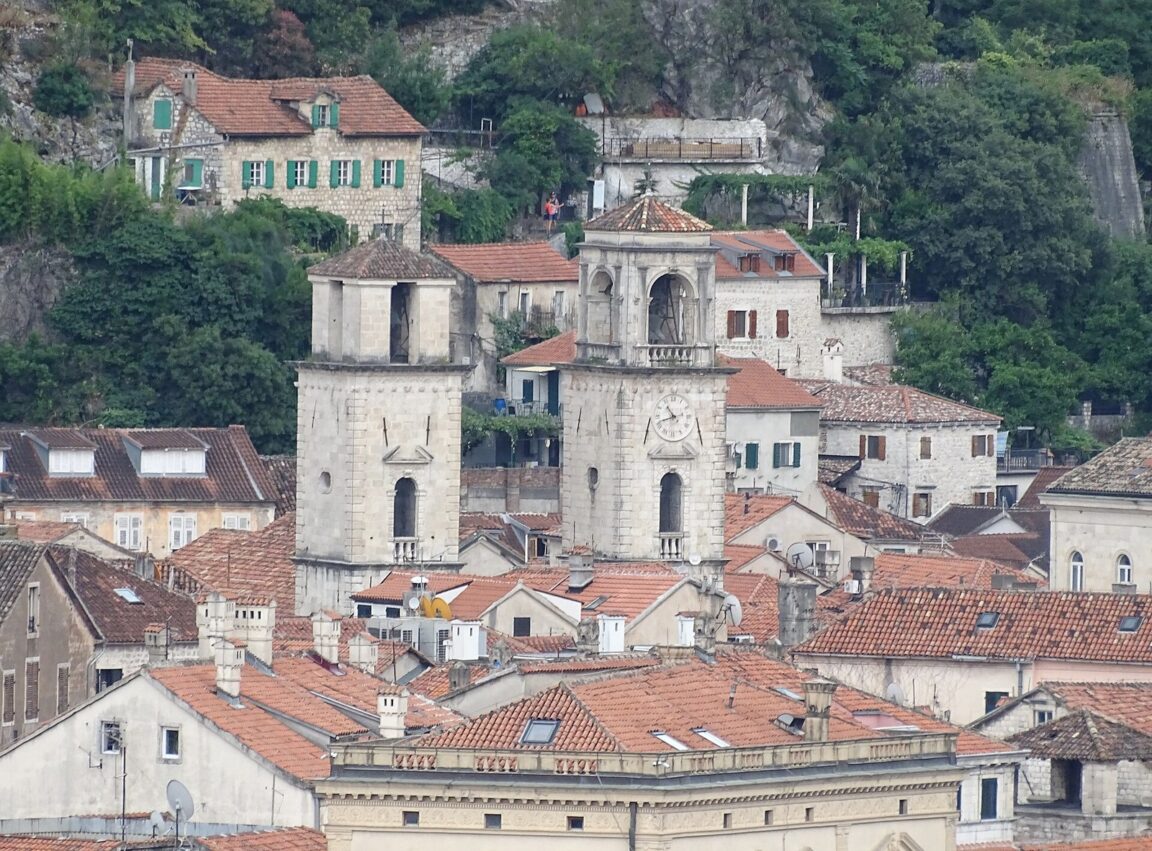
The Old Town of Kotor is small, and that is its charm. It is a compact maze of stone lanes, squares and churches, enclosed by medieval walls, and it can be crossed on foot in a few minutes. The main square, the Square of Arms, is the natural starting point, and from there the lanes lead to the Cathedral of St Tryphon, the town’s best known church, and to the smaller squares and churches that fill the Old Town. The lanes are narrow and paved with stone, and they are easy to get lost in, which is part of the pleasure of the place. A map helps, but the Old Town is small enough that getting lost is never a problem for long.
The town walls are the defining feature of the Old Town. They enclose the town on three sides, and they climb the hillside behind it to St John’s Fortress. The walls are part of the UNESCO listing, and they are the reason the Old Town has kept its shape. Inside the walls, the buildings are stone, the roofs are tiled, and the squares are shaded by trees and by the walls themselves. The Old Town is a living place, with shops, restaurants and hotels, and it is also a historic place, with churches and palaces that date back centuries. The mix of the two is what makes it feel alive rather than like a museum.
The best way to explore the Old Town is on foot and without a fixed plan. The lanes reward wandering, and the squares are good places to stop and watch the town go by. The churches are worth a look, and the small museums and galleries are worth a visit, but the Old Town itself is the main attraction. A slow walk through the lanes, with time to stop for coffee in a square, gives a better sense of Kotor than a rushed tour of its sights.
The City Walls and St John’s Fortress
The climb to St John’s Fortress is the best known walk in Kotor, and it is also the most demanding. A long, steep stairway of stone steps climbs the hillside behind the Old Town to the fortress at the top, and the views over the bay get better with every step. The fortress itself is a ruined stronghold, and the walls that lead up to it are part of the town’s defences. The climb is a workout, and it takes time, so travelers should wear good shoes, carry water and allow plenty of time for the ascent and the descent.
The best time to climb is early in the morning or late in the afternoon, when the sun is lower and the steps are cooler. Midday in summer is hot, and the stairway has little shade. The views from the top take in the whole of the Bay of Kotor, the Old Town below, and the mountains on the far side of the water. It is the classic photograph of Kotor, and it is worth the effort. Travelers who do not want to climb all the way to the top can stop at the church of Our Lady of Remedy, which sits partway up the stairway and offers a good view of its own.
The fortress climb is also a good way to understand the town’s history. The walls and the fortress were built to guard the harbour, and the stairway follows the line of the defences. The climb shows how the town was protected, and how the bay was watched from above. It is a physical experience of the history of the place, and it is one of the reasons the climb is so popular with first-time visitors.
How to Arrive
Most visitors to Kotor arrive by air, and there are three gateways. Airports of Montenegro, the official operator, lists Tivat Airport and Podgorica Airport as the country’s two international airports, and Tivat is the nearest to Kotor. Dubrovnik Airport, across the border in Croatia, is the third gateway, and it is a common choice for travelers combining Montenegro with Croatia. From any of the three airports, the journey continues by road, by taxi or by bus, and the road to Kotor follows the coast or crosses the mountains, depending on the route.
Buses also link Kotor with the towns along the coast and with the cities inland. Coastal buses run between Kotor, Budva, Podgorica and Dubrovnik, and local buses connect Kotor with Perast and the villages around the bay. The bus station in Kotor is a short walk from the Old Town, and the buses are a practical way to travel without a car. Travelers should check the current timetables before the trip, since services vary by day and season, and should allow time for the journey, since the coastal road is winding and the buses stop often.
Driving to Kotor is also possible, and the coastal road from Dubrovnik or from Budva is one of the most scenic drives in the region. The road follows the shoreline of the bay, and the views are constant. Parking in Kotor is limited, and the Old Town is a pedestrian area, so drivers should expect to park outside the walls and walk in. The practical rule is to arrive by air or by bus, and to explore Kotor and the bay on foot and by local bus or boat.
Cruise Ships and Crowd Timing
Cruise ships are a fact of life in Kotor, and they shape the rhythm of the Old Town. Ships dock in the bay and their passengers come ashore for the day, filling the lanes and the squares in the middle of the day. The Old Town is busiest when several ships are in port at once, and quietest in the early morning and in the evening, after the passengers have returned to their ships. First-time visitors who want to see the Old Town at its best should plan their exploring for the morning or the evening, and should save the middle of the day for the fortress climb, a boat trip on the bay, or a visit to Perast.
The cruise season runs through the warmer months, and the number of ships varies by day. Travelers can check the cruise schedule for Kotor before the trip, and can plan around the busiest days. The rise of small-ship cruising is changing the pattern, with smaller ships calling at smaller ports, but Kotor remains a popular call for ships of all sizes. The advice is the same whatever the ship. The Old Town is at its best when it is quiet, and the quiet hours are the early morning and the evening.
Old Town Versus Dobrota
Dobrota is the settlement along the bay just beyond the Old Town, and it is worth understanding before choosing where to stay. The Old Town is inside the walls, and it is where the history, the churches and the squares are. Dobrota is outside the walls, along the waterfront to the north, and it is quieter and more residential. Its houses face the bay, and its promenade is a pleasant walk from the Old Town. Travelers who stay in Dobrota get a quieter base and a waterfront view, and they can walk to the Old Town in a few minutes. Travelers who stay inside the walls get the experience of living in the historic town itself, with the lanes and the squares on their doorstep.
The choice depends on what the traveler wants. The Old Town is better for travelers who want to be in the middle of the history and the activity, and who do not mind the noise of the lanes. Dobrota is better for travelers who want a quieter stay and a view of the bay, and who are happy to walk to the Old Town. Both are part of the same town, and both are within easy reach of each other. The practical point is that Kotor is small, and the distance between the Old Town and Dobrota is short, so the choice of where to stay matters less than the choice of when to explore.
Pairing Kotor With Perast
Perast is the small town across the bay from Kotor, and it is the natural companion to a visit. It is a baroque town of stone houses and churches, built by seafaring families, and it sits on the water with the mountains behind it. A local bus or a boat links Kotor with Perast, and the journey takes a short time. The town is small enough to explore on foot in an hour, and its waterfront is a good place to sit and look back across the bay to Kotor.
Off the shore of Perast lie two islets, one of which holds the church of Our Lady of the Rocks. Boats from Perast visit the islet, and the church is a small, whitewashed building with a long history. The pairing of Kotor and Perast works well because the two towns are different. Kotor is walled and busy, Perast is open and quiet, and seeing both gives a fuller picture of the bay than either town alone. The Albanian Riviera to the south is another Adriatic coast worth knowing about for travelers who want to continue along the shore, and it shows the same logic that applies to Kotor. The Adriatic coast rewards travelers who move slowly and who give each bay town time.
Frequently Asked Questions
Is Kotor worth visiting for a first trip to Montenegro?
Yes. Kotor is the most visited town in Montenegro for good reason. Its walled Old Town, its fortress climb and its position at the head of the Bay of Kotor make it the best introduction to the country, and it is a UNESCO World Heritage site.
How do I get to Kotor?
Most visitors fly into Tivat, Podgorica or Dubrovnik airports and continue by road or bus. Tivat is the nearest airport to Kotor. Buses also link Kotor with Budva, Podgorica and Dubrovnik along the coast.
How long does the climb to St John’s Fortress take?
The climb is a long, steep stairway of stone steps, and it takes time and effort. Travelers should wear good shoes, carry water, allow plenty of time, and climb early in the morning or late in the afternoon when the steps are cooler.
When is the Old Town least crowded?
Early in the morning and in the evening, when cruise ship passengers are not ashore. The Old Town is busiest in the middle of the day, when cruise ships are in port.
What is Perast, and is it worth a visit from Kotor?
Perast is a small baroque town across the bay from Kotor, reached by local bus or boat. It is worth a visit for its waterfront, its stone houses and the islet church of Our Lady of the Rocks offshore.
Sources checked on 9 November 2026: the UNESCO World Heritage listing for the Natural and Culturo-Historical Region of Kotor, and the Airports of Montenegro site for the Tivat and Podgorica gateways. Travelers should recheck transport timetables and cruise schedules before departure, since services vary by day and season.