 Priya Nair
Three days in Kathmandu is enough for the valley’s great squares and stupas if the sights are grouped by geography and the altitude question is kept in proportion. Kathmandu sits at about 1,400 metres, which is a mild elevation that most visitors notice only as cooler evenings, not a place for formal acclimatisation. Spend day one in the old city around Durbar Square, day two between Swayambhunath, Boudhanath and Pashupatinath, and day three on the short trip to Patan, using Thamel as a convenient base while eating and exploring well beyond it. Arrive through Tribhuvan International Airport, sort the visa on arrival or online in advance, and time the trip for the clear skies of October to November or March to April if mountain views matter.
What are the quick facts for a first Kathmandu trip?
- Altitude: About 1,400 metres, a mild elevation with no acclimatisation schedule needed for the city itself
- Base: Thamel for first time convenience, with quieter options on its northern and western edges
- Airport: Tribhuvan International Airport, the main international gateway
- Visa: Tourist visa on arrival for most nationalities, listed by Nepal’s Department of Immigration at US$30 for 15 days, US$50 for 30 days and US$125 for 90 days, all multiple entry, at the time of checking
- Best seasons: October to November and March to April for clearer skies and comfortable temperatures
- Core sights: Kathmandu Durbar Square, Swayambhunath, Boudhanath, Pashupatinath and Patan Durbar Square
- Heritage status: The Kathmandu Valley’s seven monument zones were inscribed by UNESCO as a World Heritage Site in 1979
How much does the altitude actually matter in Kathmandu?
Kathmandu’s elevation of about 1,400 metres, roughly 4,600 feet, places it well below the altitudes where acute mountain sickness becomes a routine concern. Visitors arriving from sea level may sleep a little lightly on the first night and feel the sun more strongly than expected, but the city does not require the staged ascent, rest days or medication discussions that apply to Himalayan trailheads and high passes. Any guide that frames Kathmandu itself as a high altitude acclimatisation stop is overstating the case.
The sensible response is ordinary travel care. Drink water regularly in the dry season dust, use sun protection at midday, and keep the first evening easy after a long flight, which has more to do with jet lag than elevation. The altitude conversation changes completely if the trip continues to trekking regions, where trailheads and lodges sit far higher and a proper acclimatisation plan, built with a reputable trekking agency and current medical advice, becomes essential. For a city only itinerary, simply note the figure, pack a warm layer for evenings, and move on.
Where should first time visitors base themselves?
Thamel remains the default base for good reason. It concentrates hotels at every budget, trekking agencies, bookshops, money changers and restaurants within a few walkable blocks, and Kathmandu Durbar Square is reachable on foot in about fifteen to twenty minutes. Its drawbacks are noise and density: bars and traffic run late on the main lanes, so a room on a side street or in the quieter northern part of the district makes a material difference to sleep.
Travellers who want Thamel’s convenience without its intensity can look just outside it, towards Lazimpat, where larger hotels sit on calmer roads. Wherever the base, confirm hot water and backup power with the property, because infrastructure in the valley can be intermittent.
What should day one cover in the old city?
Start at Kathmandu Durbar Square, the former royal palace complex of the Malla and later Shah kings, entered through a heritage site ticket that foreign visitors pay at the entrances. The square layers pagoda roofed temples, the Hanuman Dhoka palace, courtyards and the Kumari Ghar, home of the Living Goddess, whose carved wooden windows are among the finest in the valley. Some structures were damaged in the 2015 earthquake and restoration is ongoing, which means scaffolding on individual buildings is normal and does not diminish the whole.
From the square, walk north through the market streets of Indra Chowk and Asan, where spice, fabric and brassware shops serve local shoppers, and the route bends back towards Thamel. The old city is a working commercial centre that happens to contain a World Heritage Site. Finish with dinner in Thamel and an early night. Travellers combining Nepal with wider South Asia travel may find the pacing pairs well with the approach in our Ayurveda retreat guide to Kerala.
How should day two combine the great religious sites?
Begin at Swayambhunath, the hilltop stupa west of the city often called the Monkey Temple for its resident monkeys. The climb up the eastern stairway is steep, so visitors with limited mobility should ask a driver about the western approach, which involves far fewer steps. From the top, the white dome, gilded spire and all seeing eyes look out over the whole valley, and on a clear autumn morning the Himalayan foothills frame the view. Circle the stupa clockwise, as local worshippers do, and give the monkeys a wide berth, especially around food.
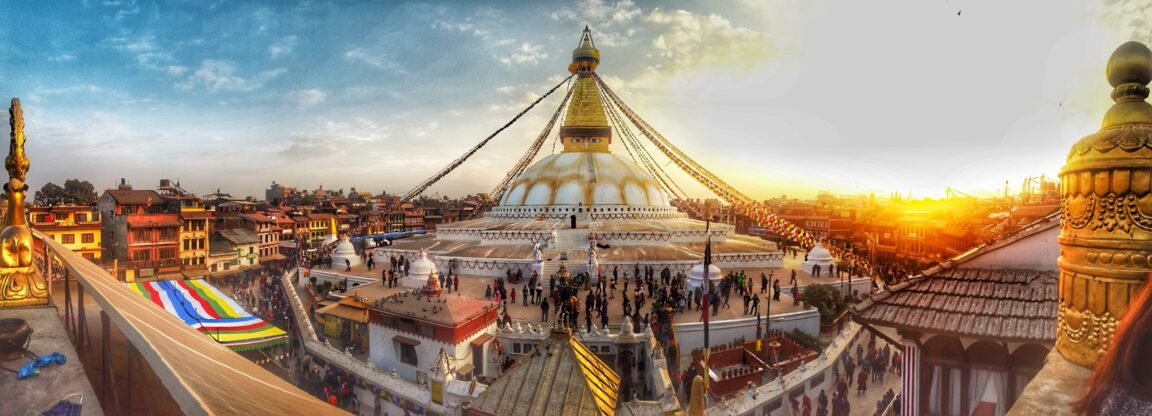
Continue east to Boudhanath, one of the largest stupas in South Asia and the centre of Kathmandu’s Tibetan Buddhist community. Its white dome fills a circular plaza ringed by monasteries and rooftop cafes. Late afternoon suits it best, when monks and laypeople perform kora, walking circuits of the stupa in the softening light.
What are the rules and the right approach at Pashupatinath?
Pashupatinath, on the banks of the Bagmati River in eastern Kathmandu, is Nepal’s most sacred Hindu temple, dedicated to Shiva as Pashupati. The key rule for international visitors is clear: non-Hindu visitors are not allowed inside the main temple. That restriction should be planned around, not treated as a problem. Non-Hindu visitors can walk the wider complex, view the main temple’s gilded roof and silver doors from across the river, and watch the evening aarti ceremony from the opposite bank, where terraces give a clear view.
The complex also includes the open air cremation ghats along the Bagmati. Visitors should approach this area with restraint: cremations are funerals for grieving families, not a spectacle, so photography should be minimal, discreet and never directed at mourners, and a licensed local guide helps interpret what is happening respectfully. Dress modestly, remove shoes where required in areas open to visitors, and follow the instructions of temple staff. Pashupatinath pairs naturally with Boudhanath on the same day, since the two sites sit close together on the city’s eastern side.
Why is Patan worth the third day?
Patan, officially Lalitpur, lies just across the Bagmati River south of Kathmandu and holds what many consider the finest Durbar Square in the valley. Its palace, now housing the Patan Museum, faces a dense line of temples including the stone Krishna Mandir, and the surrounding lanes contain working metal workshops, hidden courtyards called bahals, and the Golden Temple. Patan has a strong craft identity, and buying metalwork or woodcarving here, directly from workshops, is a more meaningful souvenir stop than the generic shops of Thamel.
Patan works as a relaxed final day. Travel by taxi or ride hailing across the river in the morning, spend two to three hours in the square and museum, eat lunch in a courtyard cafe, and return with the afternoon free for shopping, packing or a final walk in the Garden of Dreams, the restored early twentieth century garden near Thamel. If a fourth day appears, Bhaktapur, the third royal city, is the obvious extension, but do not sacrifice Patan to squeeze it in. For a comparison of how three days can be structured in another dense Asian capital, see our first time Bangkok three day itinerary.
How do arrival, visas and seasons shape the trip?
Most international visitors arrive at Tribhuvan International Airport. Nepal’s Department of Immigration lists tourist visas on arrival for most nationalities at US$30 for 15 days, US$50 for 30 days and US$125 for 90 days, all multiple entry, with an online form and e-visa options available through the official NepaliPort portal. Some nationalities must apply in advance, so check the official immigration site before flying, fill in the online form up to 15 days before arrival to shorten the airport queue, and keep passport validity of at least six months. Fees and procedures can change, so the official source, checked close to departure, is the authority.
Season matters more than almost any other choice. October and November bring the clearest post monsoon skies and the busiest crowds. March and April offer warm days, with some haze late in the period. The monsoon from June to September brings heavy rain and obscured views, while winter nights are cold in unheated rooms.
What are the most common questions about a first Kathmandu trip?
Do visitors need to acclimatise in Kathmandu?
No. At about 1,400 metres the city is a mild elevation where formal acclimatisation is not required. Normal hydration, sun protection and rest after a long flight are sufficient. Acclimatisation planning becomes important only for onward travel to high trekking regions.
Can non-Hindu visitors enter Pashupatinath Temple?
Non-Hindu visitors cannot enter the main temple, but they can explore the wider complex and view the temple and the evening aarti from across the Bagmati River. The visit remains worthwhile and should be approached respectfully, especially near the cremation ghats.
How much is a Nepal tourist visa on arrival?
Nepal’s Department of Immigration lists US$30 for 15 days, US$50 for 30 days and US$125 for 90 days, all multiple entry, at the time of checking. Travellers should confirm current fees and eligibility on the official immigration site before departure, because some nationalities must apply in advance.
When is the best time to visit Kathmandu?
October to November offers the clearest post monsoon skies, and March to April offers warm spring weather. Both periods suit sightseeing and give the best chance of seeing the mountains from viewpoints around the valley.
Is three days enough for Kathmandu?
Yes, for the valley’s main sights: the old city, both great stupas, Pashupatinath and Patan fit comfortably into three grouped days. Bhaktapur and a valley rim viewpoint such as Nagarkot are the natural additions if a fourth day is available.
Is Thamel the best place to stay?
Thamel is the most convenient base for a first visit, with the widest choice of hotels and services and Durbar Square within walking distance. Choosing a quieter side street within or just beyond Thamel gives the convenience without the late night noise.