 Omar Haddad
Petra needs more time than most visitors give it. A single day covers the walk through the Siq, the first reveal of the Treasury and a hurried look at the Royal Tombs, but the site only opens up on a second day, when you can climb to the Monastery, return through the city basin at a slower pace and still have energy for Little Petra. Buy the two or three day ticket, or the matching Jordan Pass tier before you arrive, start at the Visitor Centre as close to opening as you can, and base yourself in Wadi Musa. That is the short answer. The long answer is a plan for heat, distance and wonder, because Petra is not a single monument. It is a city spread across a desert valley.
Petra was the capital of the Nabataean Arabs, carved and built into rose colored sandstone more than two thousand years ago, and inscribed as a UNESCO World Heritage Site in 1985. Its scale surprises almost everyone. The famous facade is the beginning of the site, not the site itself.
Quick Facts
- Tickets for visitors staying overnight in Jordan: 1 day 50 JOD, 2 days 55 JOD, 3 days 60 JOD, consecutive days
- Day visitors not staying overnight in Jordan: 90 JOD for one day
- Jordan Pass: Wanderer 70 JOD with 1 day in Petra, Explorer 75 JOD with 2 days, Expert 80 JOD with 3 days, bought before arrival
- Visa note: A single entry tourist visa normally costs 40 JOD and can be waived with a Jordan Pass when its minimum stay conditions are met, check current conditions before buying
- Petra by Night: Sunday to Thursday, 20:30 to 22:30, 30 JOD, separate ticket
- Hours: Roughly 06:00 to 18:00 in summer, closing earlier in winter at about 16:00 to 17:00, confirm on the day
- Base town: Wadi Musa, beside the Visitor Centre entrance
- Key distances: The Siq is about 1.2 km, and the Monastery climb is about 850 steps
How much do Petra tickets cost, and is the Jordan Pass worth it?
For visitors who stay at least one night in Jordan, Petra admission is 50 JOD for one day, 55 JOD for two consecutive days and 60 JOD for three consecutive days. The pricing is deliberately gentle on extra days. Upgrading from one day to two costs only 5 JOD more, which makes the two day ticket the obvious default for anyone whose itinerary allows it. Visitors who enter Jordan and visit Petra without staying overnight pay 90 JOD for a single day, a rate aimed at same day border crossings.
The Jordan Pass is usually the better purchase for a wider Jordan trip. It bundles admission to Petra and more than 40 other sites with a waiver of the 40 JOD single entry tourist visa fee, provided you buy it before arrival and meet its minimum stay conditions. Official guidance on the minimum stay has been phrased around at least two to three nights, so check the exact current conditions on the official Jordan Pass site for your nationality and itinerary before relying on the waiver. The three tiers are Wanderer at 70 JOD with one day in Petra, Explorer at 75 JOD with two days and Expert at 80 JOD with three days. Buy only from the official site, jordanpass.jo, and buy before you land, because a pass bought after arrival does not deliver the visa waiver.
Do the arithmetic once, in dinars. A visa at 40 JOD plus a two day Petra ticket at 55 JOD already totals 95 JOD, against 75 JOD for the Explorer pass, before any other included site is counted. If Petra is your only paid site and you are not eligible for the waiver, the standalone ticket can still win, which is why the conditions, not the headline, decide this purchase.
What is the walk through the Siq actually like?
From the Visitor Centre the route runs past the Bab as Siq and early tombs, then enters the Siq itself, a narrow sandstone gorge about 1.2 km long that was the Nabataeans’ ceremonial entrance to their city. The walls rise steeply on both sides, the light narrows to a ribbon, and water channels carved along the rock show how carefully the city managed its scarcest resource. Walk it slowly and early. In the first hour the gorge is cool, quiet and shadowed, and guides and horses have not yet filled it.
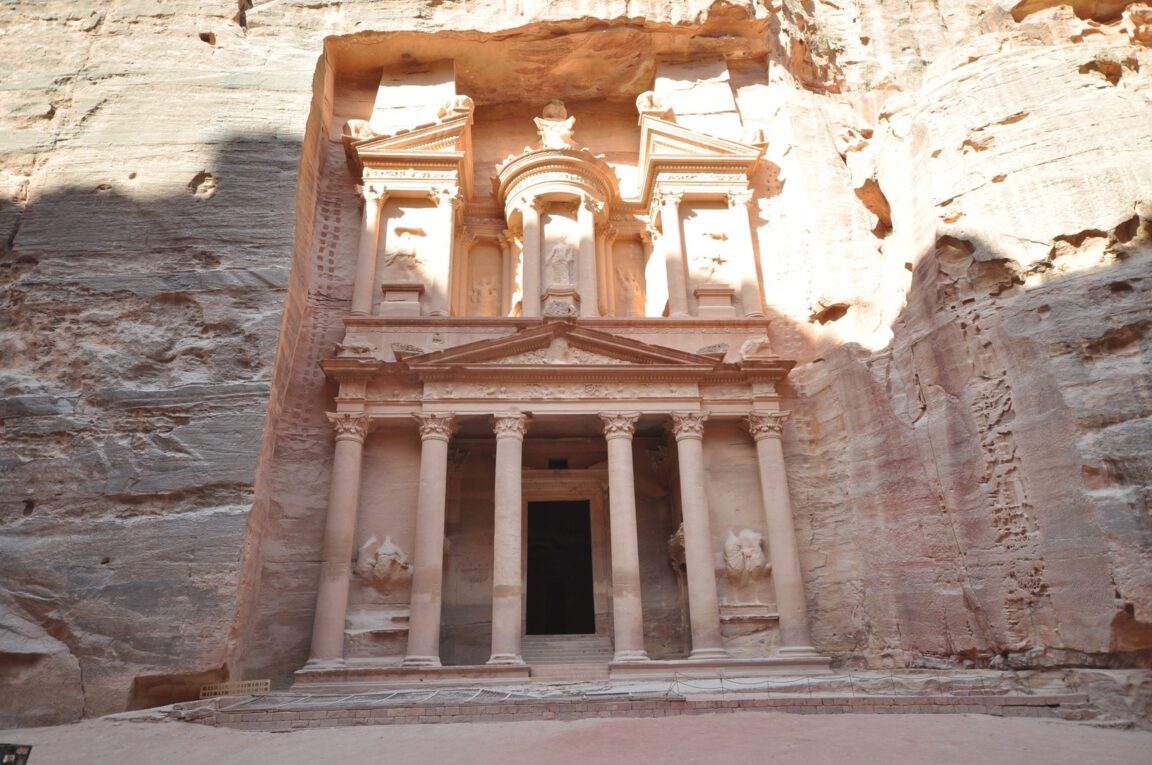
At the end, the gorge frames a sliver of sunlit facade, and the sliver widens into the Treasury, Al Khazneh, a towering carved tomb facade roughly 40 metres high. The reveal works because the Siq controls it so completely. Give the Treasury real time rather than treating it as a photo stop. The plaza fills quickly, so an early arrival is the difference between a hushed first look and a crowd scene. Camels rest in front of the facade, handlers will offer rides and photographs throughout the site, and a polite, firm no is sufficient if you are not interested.
Respect the rules that protect the carvings. Climbing on monuments is prohibited, and visitors should stay off facades, tombs and fragile structures even where a viewpoint looks tempting. Drones are also prohibited at Petra without special authorization, so leave the drone at the hotel rather than testing enforcement at the gate.
What should you see beyond the Treasury?
Beyond the Treasury the Outer Siq opens into the Street of Facades, then the theatre, carved into rock and expanded under Roman rule, and the Royal Tombs set into the cliff, the Urn Tomb, Silk Tomb, Corinthian Tomb and Palace Tomb. Below them runs the colonnaded street of the city center, with the Great Temple, the Nymphaeum fountain and Qasr al Bint, one of Petra’s few free standing buildings and one of its most important temples. This basin is where most one day visitors turn around, usually because distance and heat have caught up with them, not because the city has run out.
The Monastery, Ad Deir, is the second great facade and the argument for the second day. It sits high above the basin at the end of a climb of about 850 steps, and it is larger and quieter than the Treasury, with views opening across the Wadi Araba. Go early on your Monastery day, carry water for the whole climb, and rest at the top rather than racing down. Tea stalls line the route, prices rise with altitude, and the descent in full afternoon heat is the part of Petra that punishes poor planning.
Little Petra, Siq al Barid, a short drive from Wadi Musa, is a narrower, smaller gorge complex that served as a suburb and trading stop. It takes an hour or two, rewards visitors who found the main site overwhelming, and pairs naturally with a Monastery day or a final morning. The Petra Museum by the Visitor Centre, free to enter, is the right final stop for context on Nabataean water engineering, trade and daily life.
Petra pairs well in a longer ancient world itinerary with the region covered in our guide to the Grand Egyptian Museum, and its desert city atmosphere has a North African echo in our 2 days in Marrakech itinerary.
How much time does Petra really take?
One long day, starting at opening, covers the Siq, the Treasury, the theatre, the Royal Tombs from below, the city basin and either the Monastery climb or a closer exploration of the center, not both comfortably. Two days is the sweet spot for most travelers, day one for the Siq, Treasury and basin with the Royal Tombs trail, day two for an early Monastery climb, Little Petra and the museum. Three days suit hikers who want the longer back routes, such as the trail in from Little Petra toward the Monastery, and photographers who want both dawn and late light in the Siq.
Hours run roughly from 06:00 to 18:00 in summer and close earlier in winter, around 16:00 to 17:00, with exact times varying by date and conditions, so confirm at the Visitor Centre. The early start is not a stylistic preference. It is heat management, crowd management and light, all in one decision. By late morning the Siq is a procession and the basin is hot, exposed walking.
Should you do Petra by Night?
Petra by Night runs Sunday to Thursday from 20:30 to 22:30 and costs 30 JOD as a separate ticket, not included in daytime admission or the Jordan Pass, and a valid day ticket is also required. The Siq and the Treasury plaza are lit by candles and a program of music, storytelling and projection accompanies the facade. Opinions divide honestly. On a clear night the candlelit gorge is atmospheric and the Treasury by candlelight is genuinely memorable. It is also a single file walk with a crowd, at the end of a long walking day, on top of the 30 JOD cost.
Do it if you have two or more days, an evening to spare and energy in reserve. Skip it without regret if you have one day in Petra, because an early night and a dawn start will give you more of the site itself.
Where should you stay, and what should you pack?
Base in Wadi Musa, the town built around Petra tourism on the hills above the Visitor Centre. Staying within walking distance of the entrance is worth more than a marginally better room across town, because every minute saved in the morning becomes time in an empty Siq. Wadi Musa has the full range from simple family hotels to international properties near the gate, plus restaurants along its main street for the large, early dinners that Petra days demand.
Pack for a desert hike, not a museum visit. Broken in walking shoes with grip, a hat, sun protection, a refillable water bottle with at least a litre and a half of capacity, salty snacks, a light layer for early mornings and winter afternoons, and cash in dinars for stalls, tips and small purchases. Distances are long and shade is scarce outside the Siq. Visitors are routinely surprised less by any single climb than by the cumulative kilometres of a full Petra day.
Frequently Asked Questions
How many days do you need in Petra?
Two days is right for most visitors. One day covers the Siq, the Treasury and the city basin in a rush, while two days add the Monastery climb, the Royal Tombs trails and Little Petra at a humane pace.
Is the Jordan Pass worth buying for Petra?
Usually yes for a wider Jordan trip. Explorer at 75 JOD, with two days in Petra and a visa fee waiver when conditions are met, costs less than a 40 JOD visa plus a 55 JOD two day ticket bought separately. Buy it before arrival from the official site and check the minimum stay conditions.
How much is Petra by Night?
30 JOD per person, Sunday to Thursday, 20:30 to 22:30. It is a separate purchase, is not included in the Jordan Pass, and requires a valid daytime ticket as well.
How long is the Siq, and how hard is the Monastery climb?
The Siq is about 1.2 km of mostly level, shaded walking. The Monastery climb is about 850 steps on a clear path, strenuous in heat but not technical. Start it early and carry water.
Can you climb on the monuments or fly a drone?
No. Climbing on facades and monuments is prohibited, and drones are prohibited without special authorization. Stay on marked paths and view the carvings from ground level.
When is the best time of day to visit?
At opening, around 06:00 in summer. The Siq is cool and quiet, the Treasury plaza is still emptying of shadow, and you gain hours before heat and crowds peak in the basin.
Ticket prices, Jordan Pass tiers and Petra by Night details checked against official visitor information on 10 November 2026. Confirm current hours and conditions before traveling, as schedules change seasonally.