 James Wolfe
Two days in Marrakech is enough for a strong first visit if you group sights by neighbourhood: spend day one inside the medina, moving from Jemaa el-Fnaa through the souks to the Ben Youssef quarter and the palaces of the south medina, and spend day two in Gueliz at Jardin Majorelle and the Yves Saint Laurent Museum before a slower final afternoon. The medina has been a UNESCO World Heritage Site since 1985, and almost everything in this itinerary is walkable once you accept that the lanes were never designed for maps. Book Jardin Majorelle tickets online in advance, start early to beat the heat, and keep small dirham notes ready for taxis and tips.
Quick Facts
- Best base: A riad inside the medina for atmosphere, or a hotel in Gueliz or Hivernage for pools, parking and easier taxi access.
- Headline sights: Jemaa el-Fnaa, the souks, Koutoubia Mosque, Ben Youssef Madrasa, Bahia Palace, Jardin Majorelle and the Yves Saint Laurent Museum.
- Jardin Majorelle tickets: Sold online only through the official ticket site, tickets.jardinmajorelle.com, for a set date and time slot. There is no ticket desk at the gate.
- Garden hours: Jardin Majorelle opens daily at 8:00 am. Closing times vary by season, so check the official site for your date. The Yves Saint Laurent Museum opens at 10:00 am and is closed on Wednesdays.
- Koutoubia minaret: 77 metres high, the landmark of the medina. Non-Muslim visitors view the mosque from outside.
- Currency and haggling: Moroccan dirham. Bargaining is expected in the souks for most goods, less so for fixed-price shops and food.
- Getting around: Walk inside the medina, use metered taxis or agree a price before riding between districts, and allow extra time because medina lanes do not run straight.
Where should you stay for a two day first visit?
Choose based on the trip you want. A medina riad puts you minutes from Jemaa el-Fnaa and the souks, with courtyard calm behind heavy doors, but cars cannot reach most riad doors, so you will walk the last stretch with your luggage and should arrange the riad transfer on arrival day. Gueliz, the newer district built under the French protectorate, has wider streets, cafes and easier taxis, and it is where Jardin Majorelle sits. Hivernage, between the medina and Gueliz, holds many of the larger hotels with gardens and pools. For a two day stay the medina wins for most first timers, because evenings in Marrakech are half the experience and you can walk home from dinner. Travellers who value a pool and a quiet night often prefer Gueliz or Hivernage and taxi in. If a private villa outside the centre appeals, read our guide to a Marrakech escape at Dar El Sadaka villa for how that style of stay works.
Day 1 morning: Jemaa el-Fnaa, Koutoubia and into the souks
Start at Jemaa el-Fnaa in the relative calm of the morning, when juice stalls are setting up and the square is still a working space for locals rather than the full evening spectacle. UNESCO lists the cultural space of Jemaa el-Fnaa as intangible heritage, recognising the storytellers, musicians and food stalls that have gathered here for centuries. Walk the short distance to the Koutoubia Mosque and admire the 77 metre minaret from the gardens around it. The Moroccan National Tourist Office notes that its design influenced both the Hassan Tower in Rabat and the Giralda in Seville. Non-Muslim visitors cannot enter the mosque itself, so treat this as an exterior landmark and orientation point: the minaret is visible from much of the medina and is the easiest way to reorient yourself when the lanes confuse you.
From the square, enter the souks on its northern side and follow the main lane of Souk Semmarine, the covered arcade that runs north through the market district. The souks are organised by trade, a structure that still holds today: textiles and kaftans near the entrance, then lanes for leather goods, slippers, metalwork and lanterns, carpets, and spices around Rahba Kedima square, where piles of pigments and herbs fill open fronted shops. You do not need a shopping list to enjoy the souks, but you do need a method. Decide a maximum price before you ask, expect the first price to be an opening position rather than a valuation, counter politely, and be ready to walk away with a smile. The walk away is where most fair prices are agreed. Photograph stalls only after asking, and keep your phone and wallet in a zipped bag in the densest lanes.
Day 1 afternoon: Ben Youssef Madrasa and the northern medina
Continue north to the Ben Youssef quarter, the historic heart of the old city. The Ben Youssef Madrasa, a former Quranic school, is one of the finest buildings in Marrakech, with carved cedar, zellige tilework and stucco arranged around a central courtyard and student cells on the upper floor. Its official site currently lists daily opening from 9:00 am to 7:00 pm, with shorter hours during Ramadan, and tickets are sold at the entrance while its online system is under maintenance, so carry cash and recheck hours before you go. Nearby, the Musee de Marrakech and the Koubba el Barudiyyin fill out the same cluster, and the lanes of the Mouassine district on the walk back south hold some of the medina’s most respected craft shops and the Le Jardin Secret garden, a restored palace garden that makes a calm pause before evening.
Day 1 evening: the square at night and dinner in the medina
Return to Jemaa el-Fnaa before sunset and watch the square transform. As the light drops, rows of grill stalls set up in the centre, drummers and performers form circles, and the call to prayer rolls over the rooftops. A rooftop cafe on the square’s edge is the classic way to take in the changeover with a mint tea, after which you can descend and eat at the stalls, pointing at what looks good and confirming prices before you sit down, or book a medina restaurant for a seated dinner of tagines, tangia, the slow cooked beef speciality of Marrakech, and pastilla. Keep the evening unhurried: the square after dark is the single most memorable hour of a short trip.
Day 2 morning: Jardin Majorelle and the Yves Saint Laurent Museum
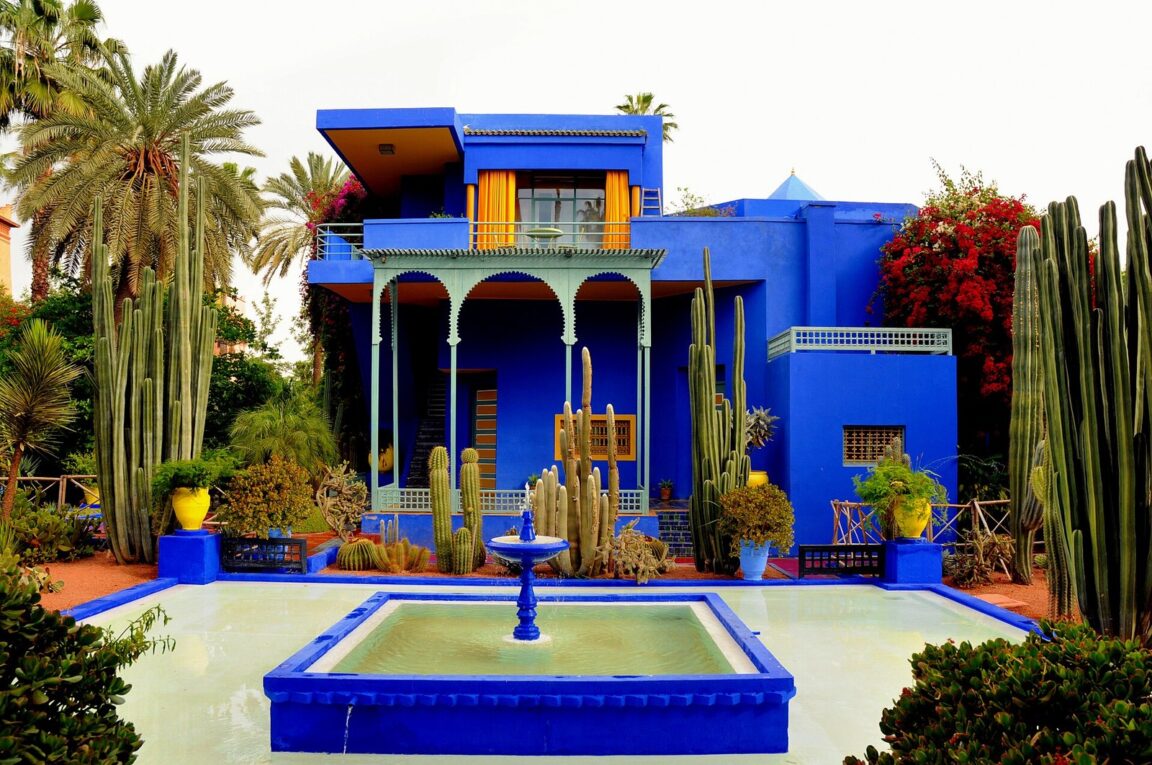
Take a taxi to Gueliz and Rue Yves Saint Laurent for an early slot at Jardin Majorelle. The garden was created by the French painter Jacques Majorelle, who bought a palm grove here in 1923 and spent decades planting species collected on his travels. In 1937 he introduced the intense cobalt shade now known as Majorelle blue across the garden’s walls and structures, and he opened the garden to the public in 1947. After a period of decline it was bought in 1980 by Yves Saint Laurent and Pierre Berge, who restored it. The painter’s studio now houses the Pierre Berge Museum of Berber Arts. Arrive for the first entry of the day if you can: the paths are quieter, the light on the blue is at its best, and you will have the bamboo groves and the long basin largely to yourself. Remember that tickets are sold online only, for a chosen date and time, through the foundation’s official ticket site, and that tickets bought from other websites may not be accepted at the gate.
Next door, the Musee Yves Saint Laurent Marrakech, which opens at 10:00 am and closes on Wednesdays, shows the designer’s work in a building of brick and stone a short walk from the garden. If your two days fall over a Wednesday, swap the order of your days so the museum and garden pairing still works, or use Wednesday for the palaces instead. Allow roughly half a day for the garden, the Berber museum and the YSL museum together, including the cafe stop inside the garden.
Day 2 afternoon: Bahia Palace, the Mellah and the Saadian Tombs
Head back to the southern medina for the palace cluster. Bahia Palace, a 19th century palace of painted ceilings, courtyards and tilework, shows how Marrakech’s elite lived and is at its best in the early afternoon light once morning groups have moved on. From Bahia, walk into the Mellah, the historic Jewish quarter, where the spice market and the Lazama Synagogue give a different texture to the medina, then continue to the Kasbah district for the Saadian Tombs, the ornate burial chambers of the Saadian sultans that were sealed for centuries and rediscovered in the early 20th century. El Badi Palace, the vast ruined palace near the tombs, suits travellers who like scale and storks nesting on the walls. Entry fees for medina monuments are modest and are paid at each site; because fees and hours change, check the board at each entrance rather than relying on a figure printed in any guide, including this one.
Finish with a hammam if that tradition appeals (book a reputable medina or Gueliz hammam and allow two hours), or with late shopping in the souks, when you now know the lanes and your bargaining benchmarks. Travellers building longer Morocco itineraries often pair Marrakech with the coast or the Atlas foothills; the same grouping logic used in our 3 days in Lisbon itinerary, one district per half day, works just as well here.
What mistakes do first timers make in Marrakech?
Accepting unofficial guiding in the lanes
Young men offering directions, often with the line that a street is closed or that they work at your riad, expect payment and may lead you to a shop first. Decline politely, keep walking, and navigate by landmarks such as the Koutoubia minaret and Jemaa el-Fnaa, or ask a shopkeeper inside a fixed shop.
Leaving Majorelle tickets to chance
The garden sells timed tickets online only and popular morning slots sell out. Buying from reseller sites risks refusal at the gate. Book on the official ticket site as soon as your dates are fixed, and screenshot the QR code in case your connection is weak at the entrance.
Trying to see everything in the heat of the day
Marrakech rewards an early start, a long shaded lunch and a second outing from late afternoon. In the hotter months the midday hours are for courtyards, museums and pools, not for crossing the medina. Carry water, and build the rhythm into your two days rather than fighting it.
Getting in a taxi without agreeing the fare
Ask for the meter, called the compteur, or agree the full price before the car moves. Keep small notes, because drivers rarely carry change for large bills, and have your destination written in French or Arabic if it is a riad deep in the medina; drivers will drop you at the nearest gate, which is normal.
Frequently asked questions
Is two days enough for Marrakech?
Two full days cover the medina core, the souks, one or two palaces, the Ben Youssef Madrasa and Jardin Majorelle with the YSL Museum. It is a highlights trip rather than a deep exploration, and a third day would let you add the Atlas foothills or a slower second pass through the souks. This itinerary assumes two full days on the ground, not travel days.
How do I buy Jardin Majorelle tickets?
Buy online only through the official ticket site, tickets.jardinmajorelle.com, choosing a date and entry time. The foundation states that this is its only official ticket site and that tickets sold elsewhere may not give access. There is no ticket desk at the gate, so do not arrive expecting to pay in person.
Can visitors enter the Koutoubia Mosque?
No. Marrakech’s official tourism guidance notes that non-Muslim visitors cannot enter the Koutoubia Mosque. You can walk around the building and its gardens and see the 77 metre minaret, which is the city’s defining landmark, from streets across the medina.
What should I wear in the medina?
Marrakech is used to visitors, but modest dress that covers shoulders and knees draws less attention and is required inside religious and some historic sites. Light, loose fabrics handle the heat best. Women are not required to cover their hair as visitors in the city, though a light scarf is useful for sun and for conservative moments.
Is haggling in the souks expected?
Yes, for most souk goods bargaining is part of the transaction and both sides treat it as a social exchange. Start well below the asking price, move in small steps, stay friendly, and be willing to walk away. Shops that display fixed prices, and food and drink, are not haggled over.
When is the best time of year for this itinerary?
Spring and autumn bring the most comfortable temperatures for full days of walking, with winter also pleasant in the daytime and cooler at night. Summer heat is intense at midday and this itinerary then needs earlier starts and longer midday breaks. Check Ramadan dates for your year, because site hours and restaurant patterns change during the holy month.
Facts checked on 9 November 2026 against the official Jardin Majorelle and Ben Youssef Madrasa information, Visit Morocco and UNESCO listings. Hours and ticket rules can change; recheck the official sites before you travel.