 Camille Baptiste
To eat well in Lyon, start with the bouchon: a small, checked tablecloth restaurant serving the city’s traditional cooking, salade lyonnaise with a poached egg, pike quenelles in crayfish rich Nantua sauce, tablier de sapeur, andouillette, cervelle de canut cheese, and a slice of pink praline tart, washed down with a pot of Beaujolais or Cotes du Rhone. Lyon, set between the Rhone and Saone rivers and long supplied by France’s farms, rivers, and vineyards, built a restaurant culture on two pillars, the generous working class bouchon and the refined cooking of the famous meres lyonnaises and Paul Bocuse, and this guide explains both, dish by dish, so a first visitor can order with confidence and choose between a bouchon lunch and a Michelin listed splurge.
Quick Facts: Eating in Lyon at a Glance
- Where: Lyon, France, at the confluence of the Rhone and Saone, with the old town, Vieux Lyon, on the west bank of the Saone and the Presqu’ile between the rivers
- The institution: The bouchon, Lyon’s traditional small restaurant, certified examples carrying the Bouchon Lyonnais labels awarded for authentic Lyon cooking
- Signature dish: Quenelle de brochet, a light pike dumpling, classically served gratinated in sauce Nantua, a crayfish based sauce
- Other essentials: Salade lyonnaise, tablier de sapeur, andouillette, cervelle de canut, tarte aux pralines, and pate en croute
- The fine dining pole: The tradition of the meres lyonnaises and of Paul Bocuse, whose restaurant at Collonges au Mont d’Or, just north of Lyon, defined French haute cuisine for a generation
- Market hall: Les Halles de Lyon Paul Bocuse, the city’s covered food hall, named for the chef, in the Part Dieu district
- Last checked: November 11, 2026
Why is Lyon called France’s food capital?
The title is old and earned. In 1935 the food writer Curnonsky called Lyon the capital of world gastronomy, and the geography explains much of it: Bresse chickens, Charolais beef, Rhone valley wines and Beaujolais at the door, river fish, market gardens, and the roads to the Alps, Provence, and Burgundy all meeting in one trading city. Onto that supply came two human inventions. The first was the meres, the mothers, women cooks, many of them former cooks in bourgeois households, who opened their own restaurants in the late 19th and early 20th centuries and raised Lyon cooking to an art: Eugenie Brazier, who founded La Mere Brazier in 1921, became the first chef to hold six Michelin stars across two restaurants, and trained a generation that included the young Paul Bocuse. The second was Bocuse himself, the chef most associated with nouvelle cuisine, whose restaurant north of the city held three Michelin stars for over half a century and whose name now sits on the city’s great food hall and its culinary institute. A first timer does not need the history to enjoy lunch, but it explains why Lyon takes both its bouchons and its tasting menus unusually seriously.
What exactly is a bouchon?
A bouchon is to Lyon what a trattoria is to an Italian city, except that the menu is narrower, older, and prouder. The classic bouchon grew up feeding the canuts, Lyon’s silk workers, hearty, inexpensive meals in convivial rooms, and its modern form keeps the essentials: a short menu of Lyon specialities, generous portions, wine served by the pot, a Lyon measure, checked cloths or bare wood, close tables, and a patron who treats the room as a stage. Because the word became fashionable, authenticity is now guarded: labels for authentique bouchons are awarded to restaurants that cook the traditional repertoire properly, and the safest first booking is a certified or Michelin Guide listed bouchon rather than any room in the old town using the word on its awning. Expect offal without apology, sauces built on butter, cream, and wine, and a bill that, by French big city standards, remains humane.
The dishes to know, in the order they arrive
Salade lyonnaise and the starters
Almost every bouchon meal opens with a choice among a small canon. Salade lyonnaise is the emblem: bitter frisee lettuce, crisp lardons of bacon, croutons, and a poached egg, dressed warm so the yolk becomes part of the sauce. Alongside it sit oeufs en meurette, eggs poached in red wine sauce, herrings with potatoes in oil, lentil salads, and pate en croute, meat and pastry pie that Lyon treats as a competitive sport, with a world championship held in the city and versions, most famously those of Joseph Viola at Daniel et Denise, that are destinations in themselves. Order one starter, not three: bouchon portions assume a working appetite and a main course still to come.
Quenelles, the dish that defines the city
The quenelle de brochet is Lyon’s signature plate and the one dish no first visit should skip. A quenelle is a delicate dumpling of pike flesh worked with a panade and cream into something closer to a souffle than a fishcake, poached, then baked in sauce until it swells and browns. The classic sauce is Nantua, made from crayfish, named for the lake town east of Lyon, and the combination, pale, rich, and deeply savoury, is the taste most Lyonnais would choose to represent home. The Michelin Guide’s entry for Daniel et Denise Saint Jean, the bouchon by chef Joseph Viola, Meilleur Ouvrier de France in 2004, highlights exactly this plate, pike quenelle with Nantua sauce, alongside gratin of andouillette, which is as good a definition of the repertoire as any single menu offers.
Tablier de sapeur, andouillette, and the offal canon
The main courses divide the curious from the committed. Tablier de sapeur, the fireman’s apron, is beef tripe marinated, crumbed, and fried crisp, served with a sharp sauce, and it is far better than its description sounds. Andouillette is a coarse sausage of pork intestines with a flavour that devotees love and first timers should approach knowingly, in a bouchon it often arrives gratinated or in mustard or white wine sauce. Tete de veau, calf’s head, boudin noir with apples, kidneys, and grattons, fried pork cracklings, complete the traditional list, while every bouchon also keeps safer ground in roast chicken, beef dishes, and the catch of the day for the offal shy. There is no shame in that choice: the quenelle alone justifies the visit.
Cervelle de canut and the pink desserts
The cheese course in Lyon is often a dish with a joke in its name. Cervelle de canut, silk worker’s brains, contains no brains at all: it is fresh white cheese beaten with herbs, shallot, garlic, oil, and vinegar, eaten with bread or potatoes, named with the dry humour of the canuts whose other dishes it accompanied. Dessert runs pink. Tarte aux pralines is the city’s colour made edible, a tart of crushed pink sugar coated almonds and cream, intensely sweet and best in a small slice, and the same pralines roses fill brioches, notably the brioche aux pralines associated with Saint Genix, sold in bakeries across the city. Bugnes, light fried pastries dusted with sugar, are the carnival season alternative. Finish, as the bouchon intends, with coffee and no hurry.
Where should a first timer actually eat?
The bouchon shortlist, by the signals that matter
Use the Michelin Guide’s Lyon listings as the discovery signal and book from there, as this programme does for every food city. Daniel et Denise, chef Joseph Viola’s group of bouchons including the Saint Jean address in Vieux Lyon at 36 rue Tramassac and the original Crequi address, is the benchmark recommendation for a first bouchon: a Meilleur Ouvrier de France cooking the full traditional repertoire, pike quenelle, calf’s head, and his celebrated pate en croute, with a Bib Gourmand level value signal in the Guide’s listings for the group. Cafe Comptoir Abel, on rue Guynemer in the Presqu’ile and among the city’s oldest bouchons, is the atmospheric alternative, known for its cardoon gratin with marrow and its quenelle. Le Cafe des Federations, on rue Major Martin, is the archetype often cited for a classic, convivial first experience. In every case, reserve: the good bouchons are small, popular with Lyonnais themselves, and frequently full at both lunch and dinner.
The splurge, and the market hall morning
For one refined meal, the Guide’s starred Lyon tables carry the meres and Bocuse inheritance into contemporary cooking, and La Mere Brazier itself, the 1921 foundation on rue Royale, remains the historic splurge, a two star dining room cooking the classics of its founder at the highest level. North of the city at Collonges au Mont d’Or, the Bocuse restaurant, L’Auberge du Pont de Collonges, is the pilgrimage booking, to be made well ahead and treated as an excursion. Balance either with a morning at Les Halles de Lyon Paul Bocuse, the covered hall in Part Dieu where the city’s great suppliers, cheese affineurs, charcutiers, fishmongers, and bakers, sell under one roof alongside small counters for oysters, quenelles, and a glass of white wine at hours Paris would consider breakfast. It is the single best hour a food traveler can spend in Lyon, and the place to buy pralines, cervelle de canut, and picnic supplies for the train.
How does a Lyon food day fit together?
Build the day the Lyonnais way: a market morning at Les Halles or in the Croix Rousse, a full bouchon lunch, since lunch is the traditional main meal and many bouchons serve their best value menu then, a light afternoon in Vieux Lyon or up at Fourviere, and either a second, smaller bouchon dinner or the one starred splurge of the trip. Wine needs no expertise here: order the pot of house Beaujolais or Cotes du Rhone, the local reds the repertoire was built around. Travelers who plan trips around a single great food city will recognise the rhythm from our guide to what to eat in Istanbul, a different cuisine with the same market first, signature dish always, logic, and from the pintxos crawl structure of what to eat in San Sebastian, Lyon’s closest rival for the title of Europe’s most food obsessed city.
Practical notes: booking, budgets, and bouchon manners
Reserve bouchon tables, especially for dinner and weekends, and arrive on time: small rooms turn tables on a schedule. Lunch menus are the value play across the city, with the traditional repertoire offered in set menus well below evening a la carte totals, while starred rooms should be booked as far ahead as the trip allows. Dress is simpler than the cooking: smart casual is right everywhere except the grandest rooms. Vegetarians should plan rather than improvise, since the traditional bouchon menu is built on pork, offal, butter, and cream, though the market hall, the city’s bakeries, and its modern restaurants give a Lyon trip plenty of range. Finally, do not rush: a bouchon meal is a social institution as much as a feeding stop, service follows the room’s rhythm, and the pink tart at the end is worth the wait.
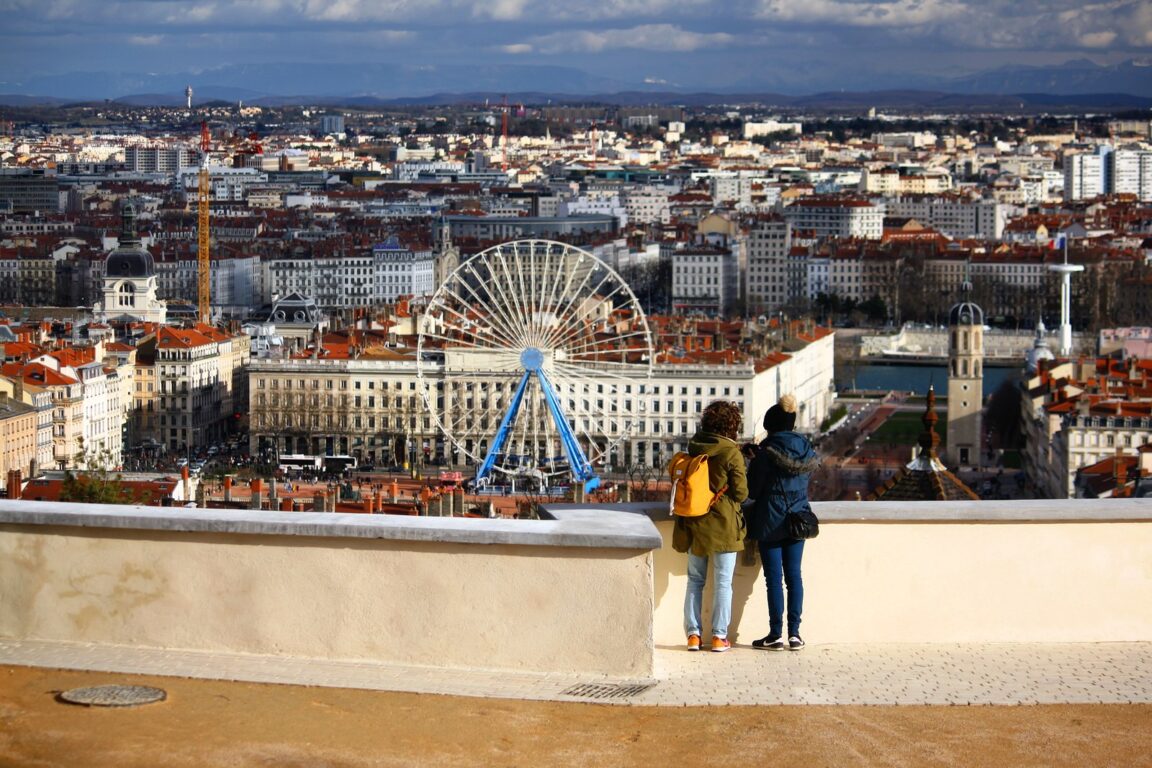
Image: Lyon, France, the city at the confluence of the Rhone and Saone, photographed from across the river. Facts checked against the Michelin Guide’s Lyon listings and Lyon tourism sources in November 2026. No meal is claimed as eaten by the author: recommendations are drawn from the Guide and the city’s documented culinary institutions.