 James Wolfe
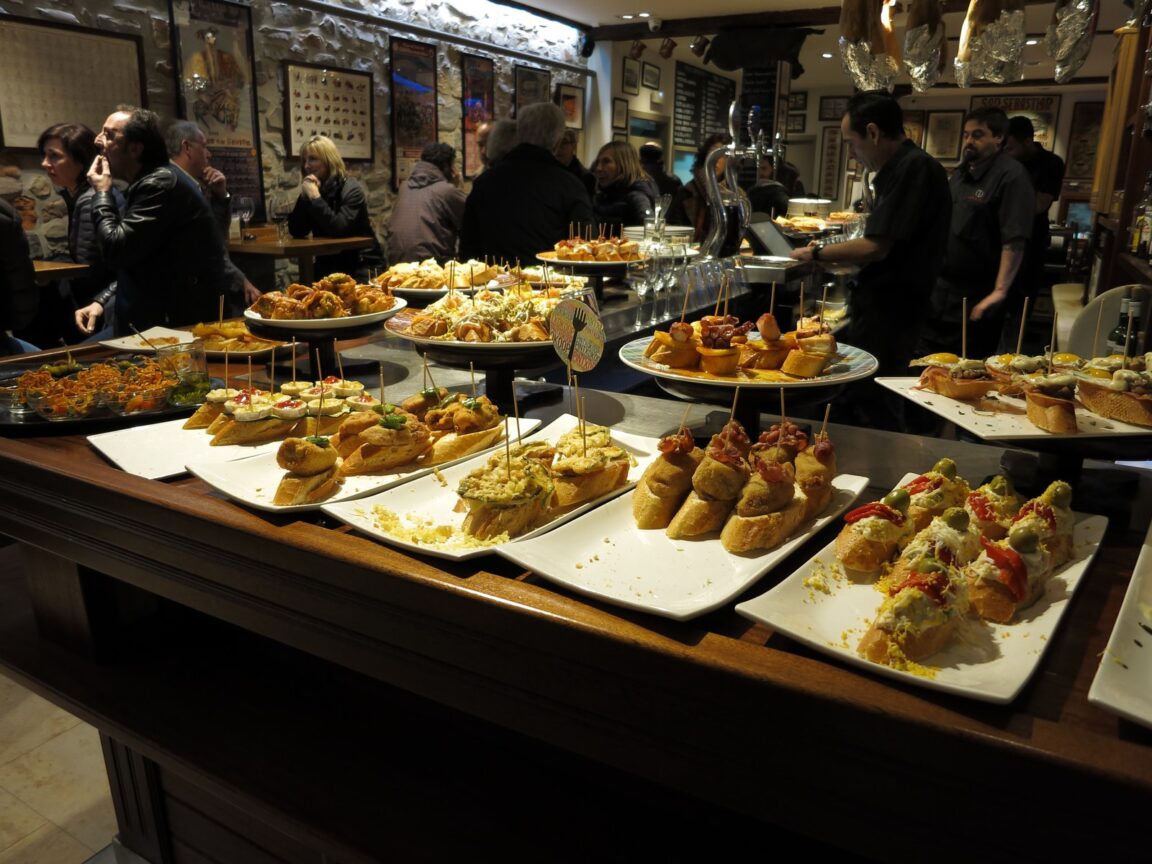
The best way to eat in San Sebastian is standing up, one or two small plates at a time, in the Parte Vieja, the Old Town grid at the foot of Mount Urgull between the port and the Urumea River. Order what each bar does best, drink a small glass of txakoli or a zurito, pay, and move on. That moving meal, bar by bar, is the pintxos crawl, and this guide maps it street by street so a first visit does not waste stops on the wrong counter.
Quick Facts
- Where: The Parte Vieja (Old Town) of Donostia-San Sebastian, in Spain’s Basque Country, holds the city’s greatest concentration of pintxos bars, according to San Sebastian Turismo.
- How it works: Cold pintxos sit on the counter; hot pintxos are ordered from the kitchen or a blackboard and cooked to order. Eat one or two per bar, then move.
- What to drink: Txakoli, the local lightly sparkling white wine, poured from a height, or a zurito, a small beer.
- The classic bite: The Gilda, an olive, a guindilla pepper and an anchovy on a skewer.
- The wider picture: San Sebastian Turismo counts 19 Michelin stars within 25 kilometres of City Hall, including three-star Arzak, Akelarre and Martin Berasategui.
- Last updated: 9 November 2026. Menus, opening days and prices change often, so confirm with each bar before a special trip.
What exactly is a pintxo, and how is it different from a tapa?
A pintxo is a small snack, traditionally served in bars in the Basque Country and often, though not always, presented on a slice of bread and held together with a skewer. The name comes from that spike. In practice the category now runs from a single anchovy preparation to miniature hot dishes that look like tasting-menu courses in two bites: seared foie gras, slow-cooked beef cheek, mushrooms with egg yolk, and gratinated scallops all appear on Old Town counters and blackboards.
The social format matters as much as the food. Going out for pintxos is described by the city’s own tourism office as a local tradition, not a tourist invention. Groups move together, stand at the counter or spill onto the street, and treat each bar as one course. A crawl is therefore not a search for the single best bar. It is a sequence, and sequencing it well, traditional counters first, cooked-to-order bars when you are ready to wait, dessert last, is what separates a good night from a random one.
How do you order without getting it wrong?
Start by looking. Cold pintxos are displayed on the bar, so a slow pass along the counter is the menu. Point to what you want, keep the skewers if the bar counts them, and ask what is hot. In the best bars the blackboard of cooked-to-order dishes is where the real cooking happens, and regulars often skip the counter display entirely in favour of it.
Keep each stop short. One or two pintxos and one small drink per bar is the rhythm that lets you cover six or seven bars in an evening without being full after the second. Pay at each bar before you leave rather than running a tab across the night, carry small notes and coins for busy counters, and do not be put off by a crowded bar: in the Parte Vieja, a crowd at the counter is usually information, not a warning.
Stop one: anchovies done properly at Bar Txepetxa
On Calle Pescaderia, Bar Txepetxa builds its reputation on a single ingredient: anchovies from the Bay of Biscay, prepared in a long list of variations with different toppings and marinades. It is the clearest lesson in how San Sebastian pintxos work. One excellent raw material, handled with restraint, presented in enough variations to fill a counter. Order the anchovy preparation that sounds simplest first, then one of the more composed versions, and notice how little the kitchen needs to add when the fish itself is this good.
Stop two: mushrooms and the counter classics at Ganbara
Ganbara, on San Jeronimo, combines a pintxos bar with a restaurant below and is included in the city’s official guide to places for pintxos. It is known for seasonal produce, above all wild mushrooms, and for counter classics built on careful sourcing rather than technique for its own sake. This is a good second or third stop, once you have calibrated your appetite, because the portions reward attention. If mushrooms are on, order them. The bar is also a useful reminder that the Old Town is not only about novelty: some of its most respected counters are the ones doing traditional things at a very high standard, every service.
Stop three: cooked to order at La Cuchara de San Telmo and Borda Berri
La Cuchara de San Telmo, on Calle 31 de Agosto, works differently from the counter bars. There is little to point at, because dishes are cooked to order from a short menu, which means a short wait and food that arrives hot from the kitchen rather than assembled at the bar. Rich, slow dishes are the house style, the kind of miniature cooking that helped redefine what a pintxo could be. Nearby Borda Berri works in a similar cooked-to-order spirit and is a natural pairing on the same street run. Choose one hot dish at each rather than two at one bar. The crawl rewards breadth.
Stop four: the tortilla problem at Bar Nestor
Bar Nestor, also on Calle Pescaderia, is the exception that proves the crawl rule, because it barely does pintxos at all. Its fame rests on a short list: a potato tortilla made in very limited quantities, a tomato salad, blistered peppers and a grilled txuleta steak. The tortilla is the famous problem. Supply is tiny, demand is not, and hopeful visitors are routinely turned away. Treat Nestor as a planned detour rather than a casual crawl stop: ask early in the day how the tortilla list works, accept the answer gracefully, and if steak is the plan, come here instead of grazing first, because one txuleta is a meal, not a snack.
Stop five: something sweet at La Vina
End on Calle 31 de Agosto at La Vina, the bar whose Basque cheesecake became so famous that versions of it are now baked on every continent. The original is deliberately scorched on top, soft in the middle and served by the slice in a working bar, not a patisserie. It is the right final stop for two reasons. It gives the crawl a proper ending, and it demonstrates the range of the Old Town in a single evening, from a one-bite Gilda to a dessert that changed global menus, within a few hundred metres.
What about the Michelin-starred end of the city?
A pintxos crawl and a tasting menu are different trips, and San Sebastian is unusual because both are world class in the same small city. The Michelin Guide’s current selection gives three stars to Arzak, where Juan Mari Arzak and his daughter Elena have held three stars since 1989, and to Akelarre, Pedro Subijana’s restaurant on Mount Igeldo. Mugaritz, in nearby Errenteria, holds two stars. Inside the Old Town itself, Kokotxa, on Calle del Campanario between the port and the Basilica of Santa Maria del Coro, holds one star and serves contemporary Basque cooking built on market produce, which makes it the easiest starred table to combine with an Old Town stay. Book any of these directly with the restaurant, well ahead, and do not try to do a starred tasting menu and a serious crawl on the same night.
For a longer Spanish trip that pairs food cities with great stays, see our guide to the Hotel Marques de Riscal in Elciego, in the Rioja wine country south of the Basque hills. Readers building a food-first itinerary may also enjoy our companion piece on what to eat in New Orleans, another city where the best meal is a sequence of small, specific stops.
How many bars, how long, and when should you go?
Five to seven bars over two to three hours is a complete crawl for most visitors. Lunch crawls are calmer and suit cooked-to-order bars; evening crawls have the full atmosphere but the busiest counters. Go a little earlier than the peak if a particular bar matters to you, especially for limited dishes like the Nestor tortilla, and build in one unplanned stop. The bar you did not research, with a counter you cannot identify and a crowd of neighbours, is often the one you describe when you get home. That is not a failure of the plan. In San Sebastian, it is the plan working.
Frequently Asked Questions
How much does a pintxos crawl cost?
Prices vary by bar and by dish, and they change often enough that any fixed budget printed in a guide goes stale quickly. A practical approach is to set a per-bar limit, order one or two pieces and one small drink at each stop, and expect hot, cooked-to-order pintxos and premium ingredients such as foie gras or turbot to cost more than counter classics.
Do you need to book pintxos bars in San Sebastian?
Traditional pintxos bars are generally walk-in, stand-at-the-counter places rather than reservation restaurants. The starred restaurants, including Arzak, Akelarre and Kokotxa, are the opposite: book directly and well in advance. Limited dishes at popular bars, above all the Bar Nestor tortilla, reward asking early in the day.
What is txakoli?
Txakoli is the Basque Country’s lightly sparkling, dry white wine, traditionally poured from a height into a flat-bottomed glass to aerate it. It is the classic pintxos pour, alongside a zurito, which is a small beer, and Basque cider in season.
What is a Gilda?
A Gilda is the emblematic San Sebastian pintxo: a green olive, a pickled guindilla pepper and an anchovy threaded on one skewer. It is salty, sharp and hot in a single bite, usually credited to the 1940s, and it remains the standard first order for visitors who want to understand the format.
Can vegetarians do a pintxos crawl?
Yes, with a little steering. Mushroom dishes, tortilla, tomato salads, peppers, cheese pintxos and vegetable dishes appear across Old Town bars, and cooked-to-order kitchens can often adapt. The format is heavily built on seafood and cured meats, so a vegetarian crawl works best by choosing bars for specific dishes, as this guide does, rather than grazing at random.
Is the Old Town the only place for pintxos?
No. The Parte Vieja has the greatest concentration and is the right starting point, but the Gros district, across the Urumea River, and the Centro area both have respected bars, including long-running names on and around the main shopping streets. Do the Old Town first, then cross the river on a second night.