 LeVar Thomas
Edinburgh in August is not one festival but several running at once, and a first-timer survives it by understanding that simple fact on day one. The Edinburgh Festival Fringe, the Edinburgh International Festival, the Royal Edinburgh Military Tattoo, the Edinburgh International Book Festival and the Edinburgh Art Festival all overlap in the same few weeks, in the same compact city centre. Plan around the overlap instead of fighting it, book accommodation before anything else, see fewer shows per day than you want to, and the city in festival mode becomes what it should be: the best first festival trip in the world.
Quick Facts
- Fringe dates, 2026: 7 to 31 August 2026, confirmed by the Edinburgh Festival Fringe Society. The Fringe is open access, meaning anyone who finds a venue can register a show.
- Fringe scale, 2026: 4,206 shows across 299 venues at the official opening, according to the Fringe Society.
- International Festival, 2026: 7 to 30 August 2026, with 147 performances across 24 days, curated and invited, under Festival Director Nicola Benedetti.
- Military Tattoo, 2026: 7 to 29 August 2026 on Edinburgh Castle Esplanade, with the production titled A Call to Gather.
- Book Festival, 2026: 15 to 30 August 2026 at Edinburgh Futures Institute, 1 Lauriston Place.
- Art Festival, 2026: 14 to 30 August 2026.
- First rule: Dates for the next edition are published by each festival separately. Always confirm the current year’s dates on each festival’s own site before booking travel.
What is actually on in Edinburgh in August?
The Fringe began in 1947, when companies that had not been invited to the first Edinburgh International Festival turned up and performed anyway, on the fringe of the official programme. That origin explains the two festivals’ opposite characters, which still define an August visit. The International Festival is curated: a selected programme of opera, music, theatre and dance at the city’s major venues. The Fringe is open access: thousands of shows in hundreds of spaces, from concert halls to pub back rooms, university lecture theatres, tents and shipping containers, with no selection panel deciding what qualifies.
Around those two sit the others. The Tattoo is a fixed nightly spectacle of massed pipes and drums and military bands on the Castle Esplanade. The Book Festival is a calmer, seated, daytime-friendly programme of author talks at Edinburgh Futures Institute. The Art Festival spreads exhibitions across the city’s galleries. A good first visit samples all of them rather than doing only Fringe comedy for five straight nights, because the contrast is the experience, and because the non-Fringe events give tired legs and overloaded brains somewhere structured to recover.
How many shows a day is realistic?
Three ticketed shows a day is a full, sustainable Fringe day for a first-timer. Four is possible if start times and venues line up. Five is the classic beginner error: it turns the day into a series of sprints between venues, leaves no time to eat, and guarantees you will sit in the evening show thinking about the next one instead of watching it. Build the day the other way round. Choose one anchor show you care about, add one researched recommendation, and leave one slot deliberately empty for a flyer, a review, a queue conversation or a street performance that earns it.
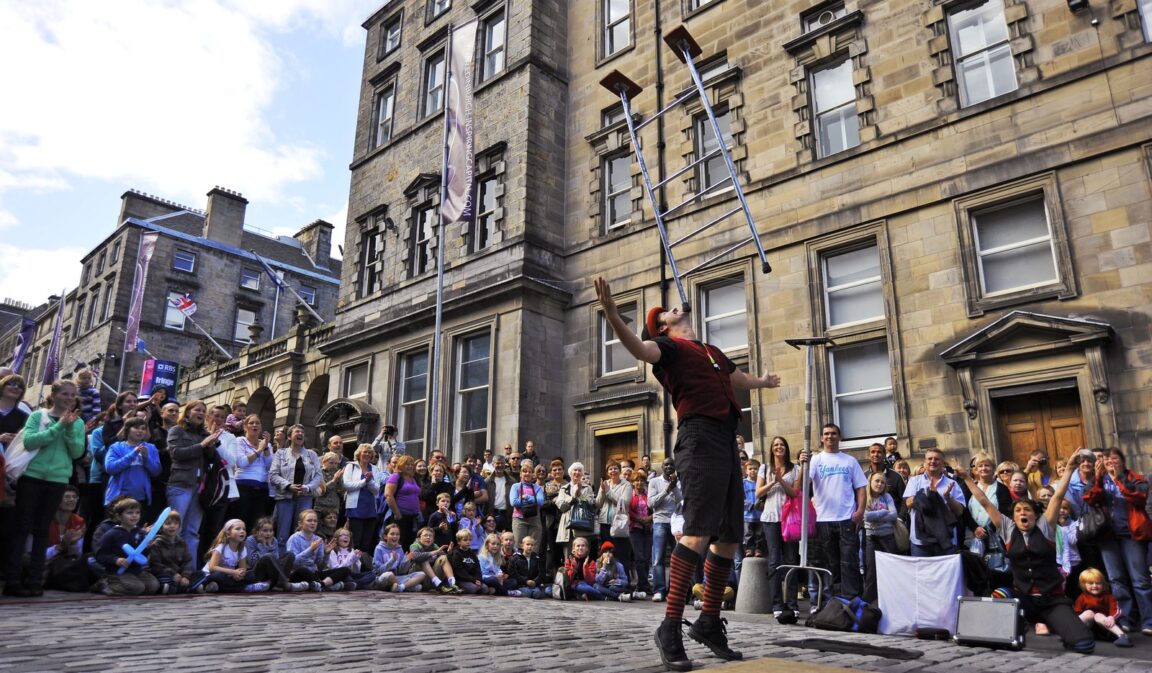
Leave gaps for the city itself. The Fringe Street Events programme runs daily on the Royal Mile and the Mound Precinct, where performers showcase excerpts and full street acts for free, with a hat passed at the end. For many first-timers the Royal Mile in the afternoon, dense with casts in costume handing out flyers and performing scenes on the cobbles, is the single most memorable part of the trip. It costs nothing except time, which is exactly why it disappears from over-scheduled days.
Where should a first-timer stay?
Stay as central as your budget allows, and book as early as you possibly can. August is Edinburgh’s peak by a wide margin, prices rise accordingly, and the best-located rooms go first. The Old Town puts you inside the Fringe’s densest venue cluster, along and around the Royal Mile, George IV Bridge and the Cowgate. The New Town, across the valley, is quieter at night and still an easy walk to most venues. Southside, around the university, is the other natural base, close to several of the largest Fringe venue hubs.
If central prices rule themselves out, stay on a tram or frequent bus route and treat the journey as part of the plan rather than a daily defeat. What matters most is not a prestigious address. It is a bed you can reach easily after a show that ends near midnight, in a city where venue clusters are walkable but hills, cobbles and crowds make every distance slower than the map suggests.
How does booking actually work?
Each festival runs its own box office, which is the detail that catches first-timers out. Fringe tickets are sold centrally through the Fringe Society at edfringe.com and its app, and also by venues. International Festival tickets come from eif.co.uk. Tattoo tickets come from the Tattoo’s own site, and Book Festival tickets from edbookfest.co.uk. There is no single pass that covers August, so build your own programme across the sites, keep confirmations in one place, and check running times and venue locations before stacking shows back to back.
Book the certainties early: accommodation, Tattoo seats if the Tattoo is on your list, International Festival performances you care about, and any Fringe show with a short run, a tiny venue or strong advance word. Leave the rest open. Part of the Fringe’s design is discovery in the room, reviews appear through the run, word of mouth moves fast, and a show nobody had heard of in week one can be the hottest ticket in the city by week three. A programme that is 100 percent fixed before you arrive wastes the festival’s best feature.
For broader festival planning across the year, see our round-up of cultural festivals worth traveling for in 2026. Travellers combining Edinburgh with a second European city in the same trip may also find our 3 days in Lisbon itinerary a useful contrast in pacing: one city at festival intensity, one at walking pace.
How do you survive the crowds, hills and weather?
Edinburgh in August is busy in a way that rewards route planning. The Royal Mile between the Castle and the Fringe’s busiest stretch can slow to a shuffle at peak hours, so allow more time than feels reasonable to cross the Old Town, and use parallel streets when you are cutting it fine for a start time. Wear shoes you have already walked miles in. The city is steep, the Old Town is cobbled, and festival days routinely reach step counts that surprise people.
Scottish August weather is a planning input, not small talk. Pack a waterproof layer you will actually carry, expect sun and rain in the same afternoon, and remember that evening shows end into a cool night even after a warm day. Indoor venues vary from grand theatres to small rooms that get hot when full, so layers beat one heavy outfit. None of this is hardship. It is simply a festival that takes place in a northern capital, outdoors as much as in, and the visitors who enjoy it most are the ones dressed for the city they are in.
What should a first-timer actually prioritise?
Prioritise variety, sleep and one unplanned day. Mix one International Festival performance, ideally music or opera in a major hall, with Fringe theatre, comedy and something you cannot categorise. Add the Tattoo on an evening when you are not doubling up late shows, because the Esplanade at night is its own event. Spend one daytime session at the Book Festival, where the pace drops and the city’s other August personality, literary and unhurried, takes over. Then leave a day with nothing booked before noon. Edinburgh rewards the rested visitor, and the shows are better when you are awake for them.
Frequently Asked Questions
When is the Edinburgh Fringe in 2026?
The Edinburgh Festival Fringe Society confirmed the 2026 Fringe for 7 to 31 August 2026, opening with 4,206 shows across 299 venues. Dates shift slightly each year, so check edfringe.com for the edition you are planning.
What is the difference between the Fringe and the International Festival?
The International Festival is curated and invited, presenting a selected programme of opera, music, theatre and dance. The Fringe is open access: anyone who can secure a venue can register a show, which is why it runs to thousands of productions across every genre and budget. Most visitors attend both.
How far ahead should you book accommodation for August?
As early as you can. August is the city’s peak period, several major festivals overlap, and well-located rooms at reasonable prices are the first thing to disappear. Accommodation, not show tickets, is the booking that should happen first.
Are there free things to do at the festivals?
Yes. The Fringe Street Events programme on the Royal Mile and the Mound Precinct is free to watch, with performers passing a hat, and the Fringe programme itself includes free and pay-what-you-can shows alongside ticketed ones. Galleries in the Art Festival programme and the general festival atmosphere across the Old Town also cost nothing.
How many days do you need for a first visit?
Three full days is a workable minimum that allows a mix of Fringe shows, one International Festival or Tattoo evening and time on the Royal Mile. Four or five days is better, because it allows a slower pace, a Book Festival session and a rest morning, which materially improves the shows you do see.
Is Edinburgh in August suitable for families?
Yes, with daytime planning. The Fringe programme includes a dedicated children’s shows section, the Book Festival runs an extensive children’s programme, and street events are family friendly. Evening comedy and cabaret skew adult, so families do best building days around morning and afternoon performances.