 Sofia Rossi
Yes, Gdansk rewards a full two to three days, and it works on two levels at once. The first is the Main Town, a Hanseatic port rebuilt so faithfully after 1945 that you have to remind yourself almost every gabled facade on the Long Market is younger than the people who restored it. The second is the working waterfront a short walk north, where the Second World War began in 1939 and where shipyard strikes in 1980 started the chain of events that ended communist rule in Poland. Plan for both halves and Gdansk becomes one of the most complete city breaks in northern Europe.
Quick Facts
- Best for: Travelers who want a walkable old town with serious twentieth century history attached, plus amber, Baltic food and an easy beach side trip
- How long: Two full days for the Main Town and the two big history museums, three days to add Westerplatte or a beach day in Sopot without rushing
- The rebuild: Around 90 percent of the historic centre was destroyed in 1945. The Main Town was reconstructed over the following decades, largely to its Hanseatic era appearance
- The two anchors: The Museum of the Second World War and the European Solidarity Centre sit a short walk apart north of the Main Town and explain the century between them
- The amber story: Gdansk has worked and traded Baltic amber for centuries, and the Amber Museum and the workshops of Mariacka Street are the places to see it properly
- Airport: Gdansk Lech Walesa Airport, code GDN, is about 12 kilometres northwest of the centre
- Tricity: Gdansk forms the Tricity with the resort town of Sopot and the port of Gdynia, linked by frequent SKM commuter trains
Why does so much of Gdansk look rebuilt?
Because it is, and the city does not hide it. In March 1945, fighting between the German garrison and the advancing Red Army, followed by fires and deliberate destruction, left the historic core in ruins. The postwar Polish authorities made a notable choice: rather than rebuilding in the socialist style of the time, they reconstructed the Main Town as it had looked in its trading prime, working from paintings, photographs and surviving fragments. Church towers, the town hall spire and the merchant houses of the Long Market all rose again, block by block, over decades.
That history changes how you should look at the place. The facades are authentic in form and craft even where the fabric is new, and the reconstruction itself is part of the story, a statement about a city passed between Poland and Germany for centuries deciding which version of itself to restore.
How should the Main Town be walked?
The Royal Way and the Long Market
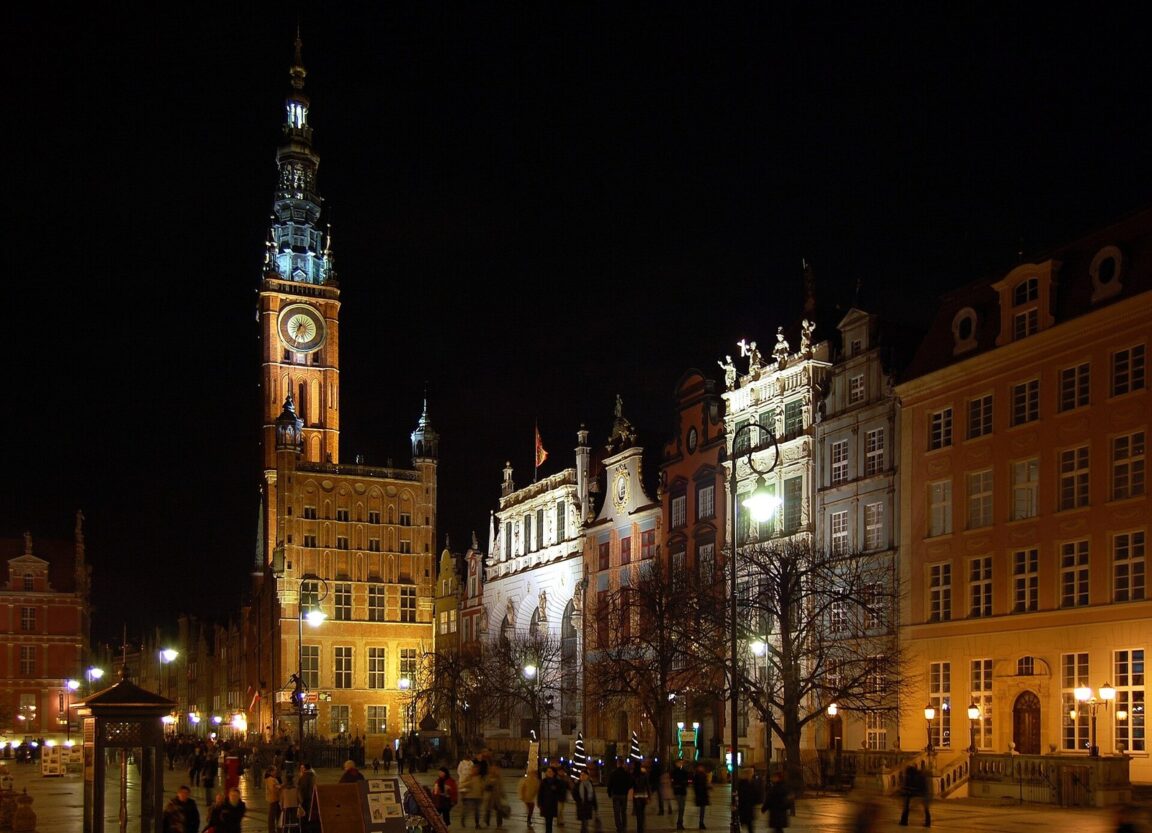
Start at the Upland Gate and walk the Royal Way, the short ceremonial route Polish kings used on visits to the city. It passes through the Golden Gate onto Dluga Street and opens into Dlugi Targ, the Long Market, a broad, gently widening square lined with the tall, narrow, richly decorated houses that define Gdansk postcards. Take it slowly. The detail is in the gables, the painted facades, the stoops and the carved stonework, and almost every house carries the mark of the wealthy merchant family that built the original.
At the centre of the Long Market stands the Neptune Fountain, cast in the early seventeenth century and long treated as the city’s symbol, in front of the Artus Court, the merchants’ meeting hall. Behind them rises the Main Town Hall, whose tower carries one of the best viewpoints in the city. The square ends at the Green Gate, which opens onto the Motlawa river embankment.
The Motlawa embankment and the great crane
The embankment along the Motlawa is where Gdansk’s port past becomes physical. The landmark is the Zuraw, the great medieval crane built in the 1440s, one of the largest port cranes of its age in Europe, which loaded cargo, stepped masts and doubled as a city gate. The restored granaries on the opposite bank, on Ołowianka and Granary Island, now hold museums, hotels and restaurants, and from the footbridges between them the layout of a Baltic trading port makes complete sense.
Mariacka Street and the amber trade
Turn back into the old streets for Mariacka, the most atmospheric lane in the Main Town, lined with the raised stone terraces called przedproza and given over almost entirely to amber. Gdansk has been a working centre of the Baltic amber trade for centuries, and the shops here sell everything from raw lumps and simple beads to serious jewellery. Buy from established workshops, ask about origin and treatment, and treat very cheap, very perfect pieces with suspicion. The Amber Museum, housed in the Great Mill, one of the largest mills of medieval Europe, gives the full story, from fossil resin formed in ancient forests to the celebrated amber chambers and contemporary design work.
St Marys Church
St Marys, the vast brick basilica a few streets from the Long Market, is among the largest brick churches in the world and took roughly 150 years to complete. The interior is deliberately plain, white and enormous, which makes its treasures easy to find: a fifteenth century astronomical clock, fine carved altarpieces and a floor of hundreds of tombstones. Climb the tower if the weather is clear for the single best orientation view in the city: the whole Main Town, the Motlawa, the shipyard cranes and, on a good day, the Baltic itself.
What do the two big history museums do differently?
They bookend the twentieth century, and visiting both, in the right order, is the core intellectual experience of a Gdansk trip. Start with the Museum of the Second World War, opened in 2017 in a striking tilted tower a short walk north of the Main Town. Its main exhibition begins underground with the causes of the war and gives the Polish and civilian experience unusual weight, mixing grand narrative with the small evidence of ordinary lives: a reconstructed street, a tank in a ruined square, keys left behind by deported families. Allow three hours at minimum. A normal ticket costs PLN 33, reduced PLN 23, with a family ticket at PLN 72 and an audioguide at PLN 12, and admission is free on Tuesdays, when tickets are collected at the box office and a daily visitor limit applies, according to the museum’s official tickets and prices page. The museum closes on Mondays, and it is worth checking the site for phased renovation closures before you fix a date.
Then walk ten minutes to the European Solidarity Centre, the rust coloured complex beside the gates of the former Lenin Shipyard, and take the story from occupation to liberation. The permanent exhibition tells how the strikes of August 1980, led by shipyard workers including Lech Walesa, forced the communist authorities to legalise Solidarity, the first independent trade union in the Soviet bloc, and how that crack in the system widened until 1989. The audioguide is included in the ticket, which the centre’s official price list sets at PLN 40 for adults and PLN 35 reduced. Note the planning trap: the exhibitions close on Tuesdays in the low season, the opposite pattern to the war museum’s free day, so the two museums belong on different days of a short trip. Outside the centre stand the three great crosses of the Monument of the Fallen Shipyard Workers and Gate No. 2, where the strike began.
Should you go out to Westerplatte?
If the war story matters to you, yes. Westerplatte is the wooded peninsula at the harbour entrance where, in the early hours of 1 September 1939, the German battleship Schleswig Holstein opened fire on the small Polish garrison, the first shots of the Second World War in Europe. The garrison held out for seven days against overwhelming odds, and the site is now an open air memorial: ruined barracks, a guardhouse museum and a monumental obelisk above the bay, reached by bus or, in season, by boat from the Main Town embankment. Pair it with the war museum on the same day and expect the combination to be heavy. It is supposed to be.
Where should you eat?
Gdansk now has the strongest restaurant scene on the Polish Baltic coast, confirmed when the Michelin Guide added the Pomorskie region in 2024. In the guide’s 2025 selection, Arco by Paco Perez retained the city’s one Michelin Star, Eliksir kept the Green Star it won as the first restaurant in Poland to receive one, and Hewelke and Treinta y Tres held their Bib Gourmand awards for good value, as set out in the Michelin Guide Poland 2025 announcement. Book the starred tables ahead; the Bib Gourmand pair are the sweet spot for most visitors.
Below that level, eat Polish and eat seasonally. Look for pierogi with seasonal fillings, Zur sour rye soup served in a bread bowl, Baltic herring in its many preparations, duck with apples, and wild mushroom dishes in autumn. The old style milk bars, bar mleczny, still serve much of this cooking at canteen prices and are as much a cultural stop as a meal.
Where should you stay, and how does the Tricity fit in?
Stay in or beside the Main Town for a first visit. The museums, restaurants and embankment are all walkable, the main railway station is at the western edge, and the shipyard sights are a short tram ride north. The converted granaries on Granary Island make a good middle ground, a few minutes from the Long Market with river views. Build in the coastal train ride at least once: the SKM commuter line runs frequently to Sopot, the genteel resort with its long wooden pier and beach, and on to modernist Gdynia. In summer, a Sopot beach afternoon is the natural counterweight to two days of museums. If you are stringing Gdansk into a wider Central Europe trip, the pacing lesson from the guide to three days in Vienna applies here too: one heavyweight museum per day, not two, and leave the last evening unscheduled.
When is the best time to go?
Late spring and early autumn are the sweet spots, with May, June and September offering long days, open terraces and thinner crowds. July and August are busiest, when the St Dominics Fair, a trading fair with roots in the thirteenth century, fills the Main Town streets for three weeks and the beaches draw half the country. Winter is cold and dark early but genuinely atmospheric: the Christmas market around the Coal Market square is one of Poland’s best, the museums are quiet, and the rebuilt streets under lights make the case for a December weekend. Whatever the season, the Baltic wind is real, so pack layers you would not need the same week inland, a contrast the guide to Budapest’s thermal baths makes from the other direction, since Gdansk’s equivalent comfort stop is a long museum cafe afternoon rather than a hot pool.
Frequently Asked Questions
How many days does Gdansk need?
Two full days is the working minimum: one for the Main Town, the Long Market, St Marys and the Amber Museum, and one split between the Museum of the Second World War and the European Solidarity Centre. A third day adds Westerplatte or a Sopot beach trip and takes the pressure off the museum day.
Is the Main Town fake?
No, though the question is fair. The street plan, plot shapes and architectural forms are historical, the craftsmanship of the reconstruction is real, and many buildings incorporate surviving original fabric. What you are seeing is a mid twentieth century act of restoration, now itself more than half a century old, rather than a theme park copy.
Which museum should you choose if there is only time for one?
The Museum of the Second World War for a first visit, because its scope covers the whole conflict and the city where it began. Choose the European Solidarity Centre instead if your interest is specifically in how communism fell, and remember the two have opposite closing patterns, with the war museum shut on Mondays and free on Tuesdays while the Solidarity exhibitions close on Tuesdays in low season.
Do you need to book museum tickets ahead?
For the war museum, yes in summer and on free Tuesdays, when a daily limit applies and box office queues build. Online tickets are sold only through the museum’s own system. The Solidarity Centre also caps admission and advises buying at least a day ahead in busy periods.
Is Gdansk expensive?
By Western European standards, no. Museum tickets sit in the PLN 33 to 40 range, milk bar lunches cost less than a coffee in many capitals, and the main premium is on Long Market terrace restaurants and starred tables.
Can Gdansk be a base for the Baltic coast?
Yes. Sopot is about 20 minutes by SKM train, Gdynia about 35, and the Hel Peninsula is reachable by train or seasonal boat. The Slowinski dunes near Leba are a longer day trip by car. Keep the city days and beach days separate rather than commuting back and forth twice in one day.