 Maya Chen
Yes, Ipoh deserves two days, and it is the easiest high reward side trip in Peninsular Malaysia. This was one of the richest tin mining towns on earth a century ago, and the money built a handsome old town of shophouses, clock towers and club buildings at the foot of sheer limestone hills. The tin ran out, the city went quiet for decades, and then Malaysians rediscovered it as a food pilgrimage: white coffee, bean sprout chicken and dim sum worth travelling for, plus cave temples set inside the limestone and a cafe scene colonising the old lanes. Come hungry, walk the old town in the cool of the morning, and give the caves an afternoon.
Quick Facts
- Best for: Food focused travelers, heritage walkers and anyone breaking the Kuala Lumpur to Penang journey in the best possible place
- How long: Two days covers the old town, the food circuit and two or three cave temples. One very full day works if you arrive early and skip the side trips
- Setting: Ipoh is the capital of Perak state, set in the Kinta Valley about 200 kilometres north of Kuala Lumpur and ringed by limestone hills riddled with caves
- Getting there: KTMB ETS electric trains run from KL Sentral roughly hourly through the day, taking between about 2 hours and 2 hours 35 minutes depending on the service
- The coffee claim: Ipoh white coffee, beans roasted with palm oil margarine and served with condensed milk, was created in the old town kopitiams and is now famous across Malaysia
- The tin story: The Kinta Valley held some of the richest tin deposits ever worked, and the old town’s grand buildings date from the boom years of the late nineteenth and early twentieth centuries
- Layout: The compact old town sits west of the Kinta River around the railway station, with the newer commercial city and most cave temples spread around its edges
Why did tin build this city, and where did it go?
The Kinta Valley around Ipoh turned out to hold extraordinary alluvial tin deposits, close to the surface and easy to work, and from the 1880s the rush was on. Chinese miners and merchants arrived in huge numbers, European mining companies followed, and by the early twentieth century the district was producing a large share of the world’s tin. The money shows in the old town fabric: the grand railway station and town hall, the Birch Memorial Clock Tower of 1909, rows of ornate shophouses, clan associations, theatres and clubs, all built for a city that expected to stay rich.
It did not. Tin prices collapsed in the 1980s, the mines closed, and Ipoh settled into a long, sleepy afterlife as a retirement city with beautiful bones and cheap rent. That pause, it turns out, saved the old town. With no development pressure, the shophouses survived intact, and when Malaysian food culture and domestic tourism came looking for heritage in the 2010s, Ipoh was waiting, complete with the kopitiams that had never closed. The revival is still food led and pleasingly local in feel: on weekends the old town fills with day trippers from Kuala Lumpur eating their way down a checklist, and by Monday morning it belongs to residents again.
How should the old town be walked?
Start at the station and the civic square
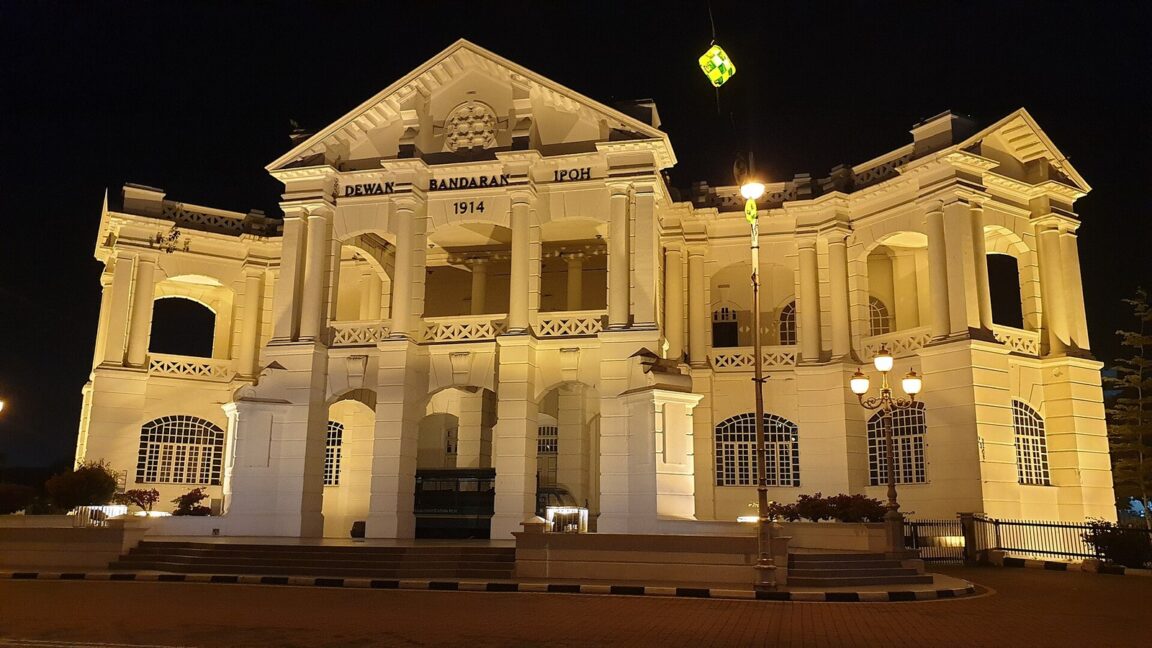
Arrive by train if you can, because Ipoh Railway Station is the right overture: a grand white colonial building completed in 1917, all arches and domes, nicknamed the Taj Mahal of Ipoh. Across the square stands the Town Hall and Old Post Office building from the same era, and a short walk away the Birch Memorial Clock Tower, raised in 1909 to a British official whose assassination in Perak made him the most controversial name in the state’s colonial history. The square between them is the natural orientation point, with the old town lanes running south and east.
Concubine Lane and the heritage lanes
The lane everyone photographs is Concubine Lane, Lorong Panglima, a narrow old town passage of restored shophouses now filled with dessert stalls, craft shops, cafes and snack vendors. Local lore says the lane was where a tin tycoon kept a mistress, with neighbouring lanes assigned, in the telling, to the wife and another concubine, and the names stuck. It is touristy and fun in equal measure, busiest on weekend afternoons. Work outward from it: Market Lane and the surrounding streets carry the quieter version of the same revival, plus a trail of large wall murals painted across old town walls, including works by Ernest Zacharevic, the artist behind Penang’s famous street art, commissioned here by a local coffee company.
The kopitiam circuit
Build eating into the walk rather than around it, because the old town’s kopitiams are sights in themselves. Thean Chun, on Jalan Bandar Timah, is the classic stop, a decades old coffee shop famous for kai see hor fun, silky flat rice noodles in a prawn and chicken broth, and for egg custard with a wobble that locals defend fiercely. Order white coffee wherever you sit down: the beans are roasted with palm oil margarine, giving a caramelised, less bitter cup, brewed strong and served with condensed milk, hot or over ice. The OldTown White Coffee chain, now found across Asia, started in Ipoh in 1999, but the original kopitiams are the real exhibit.
What are the cave temples actually like?
The limestone hills around Ipoh are hollow, and Chinese temple communities have been building inside them for well over a century. Each cave temple has a different character, so choose by mood rather than trying to see them all. Kek Lok Tong, set in a residential suburb south of the centre, is the serene one: a vast, cool cave hall opening at the back onto a landscaped garden with ponds and limestone peaks behind, more Zen garden than shrine. Sam Poh Tong, in the same southern cluster, runs through its cave to a hidden garden and a tortoise pond where visitors feed the residents. Perak Tong, north of town, is the energetic option, with murals inside the cave and a long stair climb up the hill behind the altar to viewpoints over the Kinta Valley; go early, carry water and count it as your exercise for the day. Ling Sen Tong, with its colourful statues and garden figures, makes an easy short stop paired with Sam Poh Tong. Most caves open in the morning and close by late afternoon, and entry is free or by donation, so a half day loop by taxi or ride hailing car covers three comfortably.
What should you eat beyond the coffee?
The dish Ipoh argues about most is bean sprout chicken, ayam taugeh: poached chicken served with a plate of bean sprouts that are famously short, fat and crunchy, a quality locals attribute to the mineral rich limestone water used to grow them. The two best known restaurants serving it sit facing each other across Jalan Yau Tet Shin and have split families for decades; the honest answer is to try both. In the morning, join the dim sum halls along Jalan Leong Sin Nam, where trolleys and steam baskets move fast and breakfast is a serious social event. Add salted chicken, yim kok kai, baked whole in salt and herbs and sold wrapped for takeaway, heong peng flaky pastries from the old bakeries, and pomelos from Tambun on the city’s edge, where the limestone soil produces Malaysia’s most prized version of the fruit. Ipoh portions are modest and prices are low by capital standards, which is precisely why Malaysians graze here: four small meals beat one big one.
What are the easy side trips?
Two stand out. Tasik Cermin, the mirror lake, is a still quarry lake sealed inside limestone walls and reached through a short tunnel cut in the rock; on a calm morning the reflections double the cliffs, and it sits close enough to the southern cave temples to pair in one trip. Further out, about half an hour’s drive south near Batu Gajah, Kellie’s Castle is the great eccentric ruin of the tin era, a sprawling Moorish influenced mansion begun in 1915 by Scottish planter William Kellie Smith and never finished, its tower and roofless halls now open to visitors. Both reward an early start, and both are easiest by hired car or ride hailing with the return agreed in advance. Travelers planning a wider Malaysia loop can pair Ipoh with the capital using the structure in the guide to three days in Kuala Lumpur, and anyone flying in should settle the entry form rules first with the guide to Malaysia’s MDAC entry form.
Where should you stay, and when should you go?
Stay in or near the old town. Heritage shophouse hotels and small boutique properties put the kopitiams, lanes and station within a short walk, which matters in a city where the best hours are early. The newer commercial districts across the river and around Jalan Sultan Abdul Jalil have larger hotels and malls but little atmosphere. Ipoh is hot and humid year round, with rain possible in any month and heavier falls typically in the October to December period; the practical response is scheduling rather than season picking. Walk and climb in the morning, retreat to kopitiams and caves in the midday heat, and return to the lanes in the evening. Weekends bring the full food scene and the crowds that come with it; weekdays are calmer and cheaper. For getting in, the ETS trains are the default: KTMB runs around 18 services a day each way between KL Sentral and Ipoh on the current timetable, with flexible fares that reward booking ahead through KTMB rather than at the station, as detailed in this guide to ETS trains and Malaysian transport.
Frequently Asked Questions
Can Ipoh be done as a day trip from Kuala Lumpur?
Yes, and many people do exactly that: an early ETS train up, a long eating morning in the old town, one cave temple, and an evening train back. But an overnight stay is better value. The old town at 8 in the morning, before the day trippers arrive, and a second morning for the caves change the trip completely, and hotel prices are low.
How do you book the ETS train to Ipoh?
Book on KTMB’s website or the KTMB Mobile app with a KITS account, or at station counters and machines. Services between KL Sentral and Ipoh run roughly hourly, the fastest take about two hours, and weekend and holiday trains sell out, so book a few days ahead for Friday and Sunday travel.
Is Ipoh white coffee really from Ipoh?
Yes. The style was developed in Ipoh’s kopitiams: coffee beans roasted with palm oil margarine for a smoother, caramelised flavour, then brewed and served with condensed milk. The OldTown White Coffee company founded in Ipoh in 1999 took the name national, but the old town coffee shops remain the original source.
How many cave temples should you visit?
Two or three in a half day is the right number. Pair Kek Lok Tong for calm with Sam Poh Tong nearby, and add Perak Tong on a separate morning if you want the climb and the valley view. More than that and the shrines blur together; the gardens and settings differ more than the altars do.
Is Ipoh worth it if you are already going to Penang?
Yes, because it is not a lesser version of George Town. Penang is a port city with a hawker scene; Ipoh is an inland mining city with kopitiam cooking, cave temples and limestone scenery, and the ETS stops at both, so the train makes combining them simple. One night in Ipoh on the way north is the classic move.
What is the best souvenir to bring back?
Heong peng pastries and white coffee from the old town shops travel well and are what Malaysians themselves carry home. Tambun pomelos are the prestige gift in season but are heavy, fragile and subject to fruit rules if you are crossing borders afterwards.