 Sofia Rossi
Three days in Vienna is enough to do the city properly if you sequence it well: one day for the imperial centre and the Hofburg, one day for Schönbrunn Palace and its gardens, and one slower day for coffee houses, museums and neighbourhood wandering. Vienna rewards structure. The big sights cluster tightly, the U-Bahn is fast, and the classic mistake is trying to see every palace interior in a single exhausting push. This itinerary spreads the heavyweights across three days, builds in the coffee house ritual that is half the point of coming, and leaves evenings free for music, heuriger wine taverns or a long dinner.
Quick Facts
- Best base: Innere Stadt (1st district) for first-timers, Mariahilf or Neubau for better value and local life
- Airport transfer: Vienna International Airport to the centre in about 20 to 30 minutes by train or S-Bahn
- Getting around: U-Bahn, trams and walking cover almost everything in this itinerary
- Palace strategy: Book Schönbrunn entry in advance with a timed slot and go early in the day
- Coffee house rule: One coffee buys you the table for as long as you like; nobody rushes you
- Prices checked: 10 November 2026; always confirm palace tickets on the official palace sites before you travel
Day 1: How do you cover the imperial centre and the Hofburg?
Start at Stephansplatz and St Stephen’s Cathedral, the Gothic landmark at the exact centre of the old town. Go early, before the square fills, and climb the south tower if the weather is clear for a first orientation over the rooftops. From there, walk the Graben and Kohlmarkt, the two grand shopping streets that lead directly to the Hofburg, the Habsburgs’ winter palace and the political heart of the empire for more than six centuries.
The Hofburg is not one museum but a complex of them, so choose rather than accumulate. The Sisi Museum and Imperial Apartments give the essential story: the private rooms of Emperor Franz Joseph and Empress Elisabeth, presented with unusual honesty about how constrained imperial life actually was. The Spanish Riding School, where Lipizzaner stallions train in a baroque hall, sits inside the same complex; morning training sessions are easier to book than the full performances and are hypnotic in their own right.
After lunch, cross to the MuseumsQuartier or walk the Ringstrasse, the boulevard built where the city walls stood, passing the State Opera, the Parliament and the Rathaus. End the afternoon the Viennese way, in a coffee house. Café Central, under its vaulted arcade on Herrengasse, is the famous one and worth the short queue at off-peak hours. Order a Melange, Vienna’s answer to a cappuccino, and a slice of something with apricot or poppy seed, then sit. Sitting is the activity.
Day 2: What is the smart way to do Schönbrunn Palace?
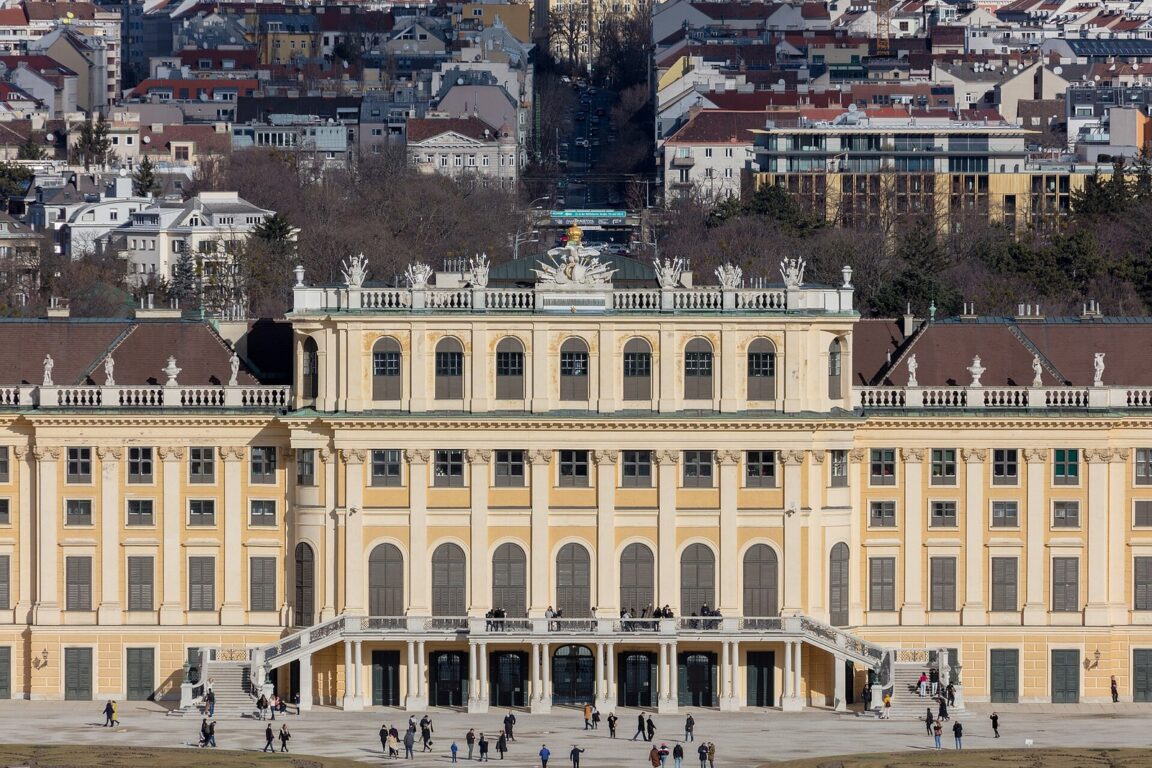
Schönbrunn, the Habsburgs’ summer residence in the west of the city, is the single biggest sight in Vienna and deserves the best part of a day. The palace has 1,441 rooms in total, of which the main tours show a curated selection that includes the state rooms of Maria Theresa and the apartments of Franz Joseph and Elisabeth. Book the longest tour your interest supports and take the earliest slot you can; by late morning the state rooms are at their busiest and the experience thins out.
The gardens matter as much as the interiors. They are free to enter and vast: walk the parterre up to the Neptune Fountain, then climb the hill to the Gloriette, the colonnaded pavilion built in 1775, for the definitive view back over the palace to the city. The grounds also hold the Palm House, a maze, and the Tiergarten, founded in 1752 and often described as the world’s oldest zoo still in operation. With only three days in the city, treat the zoo as optional and protect your time for the palace and gardens themselves.
Come back into town for the evening. If music is on your list, this is the night for it: the Vienna State Opera and the Musikverein both sit near the Ring, and standing tickets, sold shortly before performances, are one of Europe’s great cultural bargains when available. Check both houses’ official sites for the exact release process on your dates rather than buying from resale platforms.
Day 3: Which museums and neighbourhoods fill a perfect final day?
Spend the morning in the Belvedere, Prince Eugene of Savoy’s summer palace, now home to the world’s largest collection of Gustav Klimt paintings, including The Kiss. The Upper Belvedere holds the art; the gardens sloping down to the Lower Belvedere hold the view. Book a timed ticket in advance in busy months, and go at opening to have the Klimt rooms at their calmest.
Then slow down. Walk the Naschmarkt, Vienna’s largest market, for a grazing lunch among the stalls, and drift into Neubau, the 7th district, for design shops and independent boutiques. Cross the Danube Canal to Leopoldstadt if you want the Prater, Vienna’s great public park, and a ride on the Riesenrad, the giant Ferris wheel turning since 1897. Finish with a final coffee house, perhaps Café Landtmann on the Ring, a grand and civilised room that has served everyone from Freud onwards, and where the ritual of coffee, cake and a tray of newspapers still runs exactly as it should.
Where should you stay in Vienna on a first trip?
Innere Stadt (1st district) puts the Hofburg, the cathedral and the great coffee houses on your doorstep and commands the highest prices. It is the right choice for a short first trip when time matters more than money. Mariahilf and Neubau (6th and 7th districts), just west of the centre along Mariahilfer Strasse, offer better value, strong tram and U-Bahn links, and the city’s best independent shopping and cafe scene. Leopoldstadt (2nd district), across the canal, is greener and quieter, anchored by the Prater and increasingly home to good mid-range hotels. Wherever you base, check that your nearest U-Bahn station serves the U4 line if Schönbrunn is a priority, since that line runs directly to the palace.
What should you eat and drink beyond the coffee houses?
Vienna’s food canon is concise and worth working through methodically. Wiener Schnitzel, properly made from veal and served with lemon and parsley potatoes, is the headline; Tafelspitz, boiled beef served with horseradish and apple, was Franz Joseph’s favourite and is the connoisseur’s order. In the coffee houses, work through Sachertorte, dense chocolate cake with apricot jam, and Apfelstrudel, ideally watched being stretched paper-thin at a strudel demonstration. For an evening out of the centre, the heuriger wine taverns of Grinzing and Nussdorf serve the new vintage from Vienna’s own vineyards, one of the few capital cities in the world with serious winemaking inside its limits. If you enjoy planning trips around food, our Mexico City food guide takes the same dish-by-dish approach on another continent.
How does Vienna compare with other classic European capitals on a short trip?
Vienna is more compact and more formal than Paris, and cheaper to do well than London. If this trip is part of a wider European circuit, our 3 days in Lisbon itinerary and our first time in Paris itinerary follow the same day-by-day logic and pair naturally with Vienna in a multi-city route, connected by efficient rail and short flights.
Frequently Asked Questions
Is 3 days enough for Vienna?
Yes, for the essential city: the Hofburg complex, Schönbrunn, the Belvedere and the coffee houses all fit comfortably into three well sequenced days. A fourth day would add the Kunsthistorisches Museum in depth or a day trip to the Wachau Valley, but three days is a complete first visit, not a rushed one.
Do you need to book Schönbrunn tickets in advance?
In busy months, yes. Timed entry sells out for popular slots, and booking ahead on the official Schönbrunn site secures both your tour type and your start time. The gardens are free and unticketed, so even on a sold-out day you can still enjoy the grounds and the Gloriette view.
What is the best month to visit Vienna?
Late spring and early autumn offer the best balance of weather, garden colour and manageable crowds. December is magical for Christmas markets but cold and busy around the markets themselves. January and February are the quietest months for museums and palaces.
How do coffee houses work in Vienna?
You order once, your coffee arrives on a silver tray with a glass of water, and the table is yours indefinitely. There is no expectation of repeat orders or a quick exit. Pay when you are ready to leave, and expect service that is courteous, unhurried and never hovering.
Is Vienna walkable?
The centre is extremely walkable, and most Day 1 and Day 3 sights in this itinerary connect on foot. Schönbrunn sits further west and is reached fastest by the U4 U-Bahn line. A short transport pass covering your stay usually beats single tickets if you ride more than twice a day.
Featured image: Schönbrunn Palace, Vienna. Photo by Diego Delso, CC BY-SA 4.0, via Wikimedia Commons.