 Kwame Mensah
Yes, Windhoek deserves a day of its own. Most safari itineraries treat Namibia’s capital as a runway and a rental-car desk, yet the compact centre packs the country’s whole story into a few walkable streets: a sandstone Lutheran church from the German colonial era, a striking modern museum that tells the road to independence, the parliament gardens, the country’s best craft shopping, and, a short drive north, Katutura, the township whose name still records the forced removals that created it. Add a game-meat dinner and a good night’s sleep at altitude before the long gravel roads begin, and the stopover becomes the introduction that makes the rest of Namibia make sense.
Quick Facts: Windhoek at a Glance
- Where: Capital and largest city of Namibia, near the geographic centre of the country, in the Khomas Highland.
- Altitude: Around 1,700 metres above sea level, which keeps even summer days comparatively mild and the light sharp.
- Airport: Hosea Kutako International Airport, roughly 45 kilometres east of the centre. Eros Airport, closer in, handles smaller and charter flights.
- Core sights: Christuskirche, Independence Memorial Museum, Tintenpalast and Parliament Gardens, Alte Feste, Namibia Craft Centre.
- Do not skip: A guided visit to Katutura, arranged through a local tour company, rather than a self-drive pass-through.
- Best use: One full day and night at the start or end of a Namibia road trip.
- Last checked: November 11, 2026.
Why Do Safari Travelers Rush Through Windhoek?
Namibia sells its emptiness. The dunes at Sossusvlei, the wildlife of Etosha and the Skeleton Coast all sit hours from the capital, and the standard itinerary collects a 4×4 at the airport and points it at the horizon the same afternoon. That logic is understandable and still a waste. Windhoek is where Namibia explains itself. It is the seat of government, the hub of the road network, and the one place where the German colonial period, South African apartheid rule and the independent republic that began on 21 March 1990 all stand within walking distance of each other. Travelers who give it a day arrive at the dunes understanding whose land they are crossing. Travelers who skip it spend two weeks photographing a country they never got introduced to. Anyone sorting entry paperwork first should start with our explainer on Namibia’s visa change for US and other visitors, then plan the capital day around the confirmed arrival.
The Historic Centre: One Morning on Foot
Christuskirche, the church on the traffic island
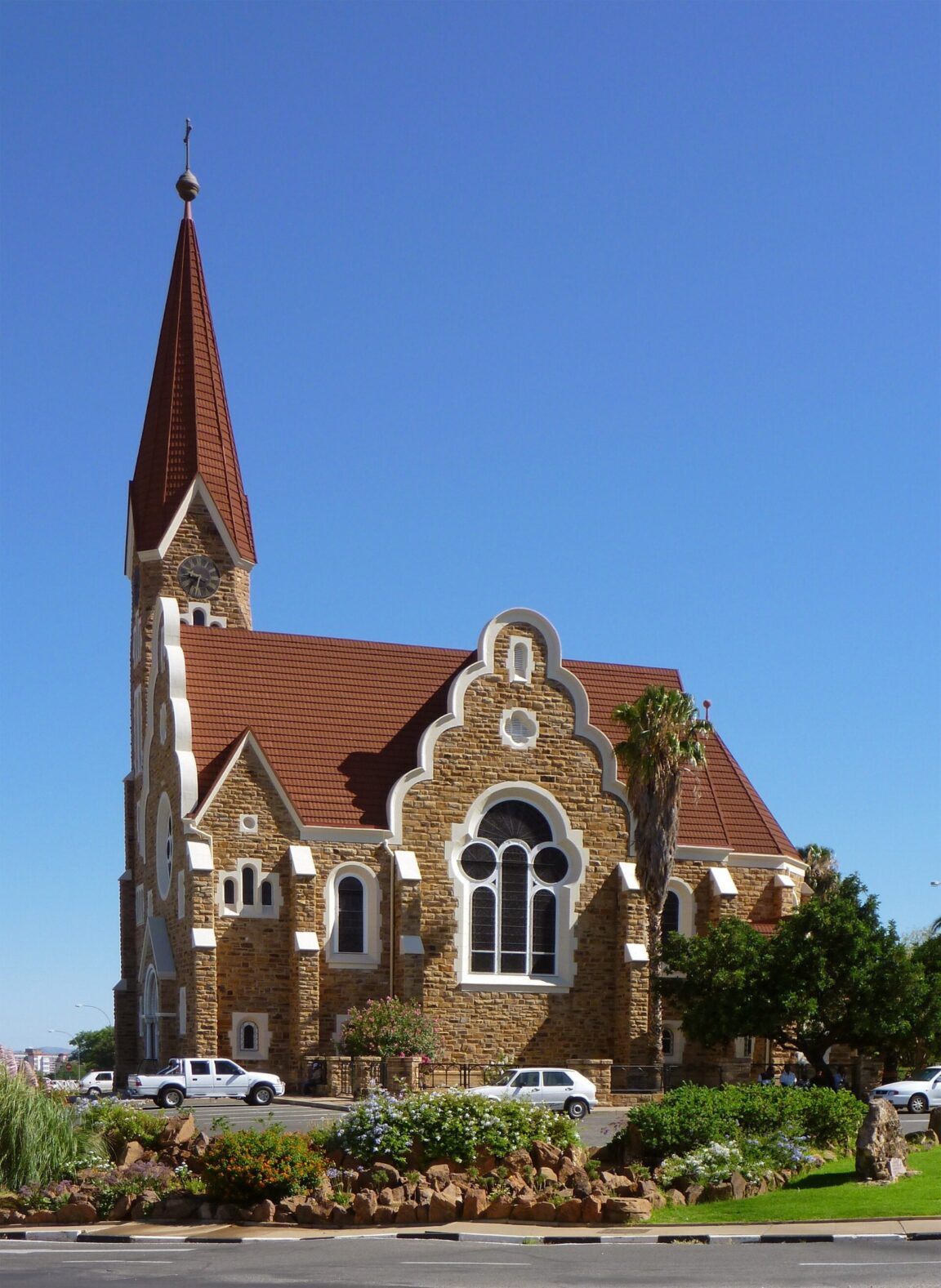
Windhoek’s most photographed building stands alone on a traffic island on Robert Mugabe Avenue: the Christuskirche, a Lutheran church built from local quartz sandstone and designed by architect Gottlieb Redecker. The foundation stone was laid in 1907 and the church was dedicated on 16 October 1910, conceived as a church of peace after the colonial wars against the Herero and Nama. Its mix of neo-Romanesque, Art Nouveau and Gothic Revival elements, and a spire that still anchors the skyline, make it the natural starting point for a centre walk. Interior opening is irregular, so treat any chance to step inside, and to see the stained glass, as a bonus rather than a plan.
The Independence Memorial Museum
Directly nearby, impossible to miss, stands the Independence Memorial Museum, a tall gold-toned glass tower opened in 2014. Inside, floor by floor, the museum works through the pre-colonial societies, the German colonial period including the Herero and Nama genocide of 1904 to 1908, the South African occupation and apartheid years, and the liberation struggle that ended in independence in 1990. Entry is free, the interpretation is in English, and the external glass lift and upper levels give the best orientation view in the city, with the Christuskirche below and the highland hills around the bowl of the city beyond. Give it at least an hour and a half. It is the single most valuable stop in Windhoek, and the context it provides will quietly reframe every memorial, farm boundary and town name seen later in the trip.
Tintenpalast, Parliament Gardens and the Alte Feste
Between the church and the museum sits the Tintenpalast, the colonial-era ink palace that now houses the National Assembly, fronted by the Parliament Gardens, a shaded and carefully kept public garden that is the centre’s best short rest. A few minutes away stands the Alte Feste, the old fortress begun in 1890 and the oldest surviving building in the city, long home to the state museum collection. Opening arrangements for the fort have changed during recent works, so check its status locally on the day rather than building the morning around entry. The three sites together form a loop of a few hundred metres that can be walked comfortably before lunch, which is part of Windhoek’s charm: the monumental layer of the city is genuinely compact.
Katutura: The Other Half of the Story
Northwest of the centre lies Katutura, where a large share of Windhoek’s people live, and no honest account of the city leaves it out. Katutura was created under apartheid in the late 1950s, when the South African administration forcibly moved Black residents from the Old Location near the centre into a segregated township divided by ethnic group. The resistance to those removals turned violent on 10 December 1959, a date now marked nationally, and the name the residents gave the place endures: Katutura is commonly translated from Otjiherero as the place where we do not want to live.
Today Katutura is also markets, shebeens, hair salons, churches and the everyday commercial energy the formal centre loses after office hours. The right way in is with a local guide or a township tour run by residents, which puts the history and the present in the same frame and puts money into the neighbourhood. The wrong way is a slow self-drive with a camera out of the window. Booked properly, a couple of hours in Katutura will be the part of the Windhoek day that gets talked about for the rest of the trip.
What Else Fills a Windhoek Day?
The Namibia Craft Centre, in the converted Old Breweries complex in the centre, gathers dozens of makers and small retailers from across the country under one roof: jewellery, pottery, textiles, baskets, leatherwork and metal sculpture, much of it sold by the producing organisations themselves. For travelers heading out on a self-drive, it doubles as the fairest place to buy gifts at the start of the trip rather than gambling on finding the same quality at the end. Independence Avenue, the main street running the length of the centre, covers the practical layer: banks, outfitters, bookshops and cafes.
Dinner has a Windhoek institution. Joe’s Beerhouse, a sprawling and deliberately eccentric restaurant on the eastern side of the city, is where safari groups have celebrated first and last nights for years, with a menu built around Namibian game meats such as oryx, kudu and springbok alongside German-influenced staples. It is unapologetically hearty and it books out, so reserve. Travelers who prefer a quieter evening will find the Klein Windhoek suburb, around the original hot springs settlement on the eastern hills, calmer, with guesthouses and smaller restaurants suited to an early night before a dawn departure.
How Windhoek Works in Practice
The altitude does quiet favours. At around 1,700 metres, Windhoek is cooler than the desert floor travelers are heading for, but the sun is strong and the air is dry, so water, a hat and sunscreen earn their place even on a city day. The centre is walkable by day around the main sights, and taxis are the sensible default after dark, when the business district empties. Hosea Kutako International sits roughly 45 kilometres east, an easy highway drive that should still be given a full hour in the plan, and most self-drivers either collect the rental vehicle at the airport and overnight in the city, or overnight first and collect in town the next morning after the museum. Either way, the first long driving day, whether north to Etosha or southwest toward the Namib, starts better rested and better briefed for having spent a day in the capital. Travelers building the wider southern Africa route can contrast Windhoek’s highland calm with the walled coastal drama in our Kotor, Montenegro travel guide, a very different one-day city that rewards the same slow approach.
Frequently Asked Questions
How long does Windhoek need?
One full day and a night covers the historic centre, the Independence Memorial Museum, the Craft Centre, a guided Katutura visit and a proper dinner. Two nights suit travelers arriving on a long-haul flight who want the day unhurried before collecting a rental vehicle.
Is the Independence Memorial Museum really free?
Yes, entry is free. Check opening days locally before planning around it, as hours and weekly closures can change, and allow at least 90 minutes for the galleries and the view from the upper levels.
Can Katutura be visited independently?
It can, but a guided tour with a local operator is strongly recommended. A guide provides the history of the forced removals, navigates respectfully, and ensures the visit benefits the community. Treat it as a hosted visit, not a photo drive-through.
How far is the airport from central Windhoek?
Hosea Kutako International Airport is roughly 45 kilometres east of the centre, about an hour by road in normal conditions. Build the transfer into arrival and departure plans rather than assuming a city airport distance.
When is the best time of year for Windhoek?
The dry winter months, roughly May to October, pair mild days with the best wildlife season elsewhere in Namibia. Summer brings heat and the chance of dramatic afternoon rain, softened in the capital by the altitude.