 Elena Vasquez
Choose a small tablao in the centre of Seville, book the first show of the evening, and sit close enough to hear the dancer heels strike the wooden stage. That is the short answer. Flamenco in its Andalusian heartland is not a dinner show backdrop; it is a sung, played and danced conversation built on rhythm, and the venue you pick decides whether you hear that conversation or a cabaret version of it. This guide explains how tablaos work, what the parts of a performance are called, and how to read what is happening on stage once the lights go down.
Quick Facts
- Best for: First time visitors to Seville who want one serious flamenco night and the vocabulary to follow it
- The art form: Flamenco fuses cante (song), toque (guitar) and baile (dance), with palmas handclapping and heelwork setting the rhythm; UNESCO inscribed it in 2010 on the Representative List of the Intangible Cultural Heritage of Humanity
- The heartland: Andalusia is flamenco home ground, and Seville, with the Triana and Alameda districts and its Bienal festival, is one of its defining cities
- The venue types: A tablao is a small dedicated flamenco theatre, named for the wooden boards of its stage; penas are aficionados clubs, and big theatre productions sit at the other end of the scale
- The rhythm key: Most flamenco runs on compas, a repeating cycle of beats, often counted in twelves, which the clapping, guitar and heels all lock onto
- The museum: The Museo del Baile Flamenco in the Santa Cruz quarter, founded by dancer Cristina Hoyos, pairs a museum of the art with intimate courtyard performances
- The etiquette: Silence during the cante, no flash photography, and jaleo, the shouted encouragement of ole and toma, only in the spirit and moments the room itself uses it
What exactly is a tablao?
The word tablao comes from tabla, the board: it means both the wooden stage and the small venue built around it. The classic tablao holds a few dozen to a couple of hundred seats arranged close to a raised platform, often with drinks or dinner service, and presents a cuadro, a small company of a singer or two, a guitarist and one or two dancers, in sets of about an hour. The form descends from the cafes cantantes of the 19th century, the singing cafes where flamenco first became a professional stage art.
Size is the quality signal. In a small room the sound is acoustic, the singer voice fills the space without force, and the dancer zapateado, the heelwork, lands on real boards a few metres from your chair. In a large room with dinner for hundreds, amplification and choreography for the back row change the art into something broader and thinner. Both exist in Seville, and the first timer should start small.
How do you choose between Seville tablaos?
Work through four checks. First, room size and sightlines: choose a venue where every seat is near the stage, and where the stage is wood, raised and bare. Second, the company: a good tablao names its artists in advance, singers and guitarists as prominently as dancers, because in flamenco the cante leads. Third, the programme shape: a traditional set moves between palos, the flamenco forms or styles, rather than running one long choreographed number. Fourth, the audience contract: venues that ask for silence during songs, ban flash and let the performance run without commentary are protecting the art, and that is where you want to be.
Two anchor experiences frame the choice. The Museo del Baile Flamenco in Santa Cruz combines a museum that explains the history and the palos with performances in its courtyard, which makes it the best single first night for anyone who wants context and show in one ticket. Across the river, Triana, the old potters and sailors quarter long associated with flamenco families, has its own smaller rooms and bars where the atmosphere is looser. For the pintxos end of Andalusian and Basque food culture on the same Spain trip, our San Sebastian pintxos guide covers the northern circuit.
What are you actually watching? The parts of a performance
What does the singer do?
The cantaor or cantaora sings cante, verses built on traditional letras, in a voice that is raw, compressed and deliberately strained at the edges. The oldest and deepest forms, cante jondo or deep song, include the siguiriya and the solea, slow, grave palos about grief, fate and dignity. Lighter forms, the alegrias of Cadiz or the buleria party rhythm, carry joy at speed. You do not need the Spanish to follow it: watch the singer face, the guitarist attention, and the room, which goes quiet in a way theatres rarely do.
What does the guitarist do?
The tocaor accompanies, leads transitions and takes solo passages called falsetas. Flamenco guitar is its own technique, percussive, with rasgueado strumming rolled across the strings and the thumb driving the compas. Between singer and guitarist there is constant negotiation, and in a good room you can hear the guitarist breathe with the singer phrasing.
What does the dancer do?
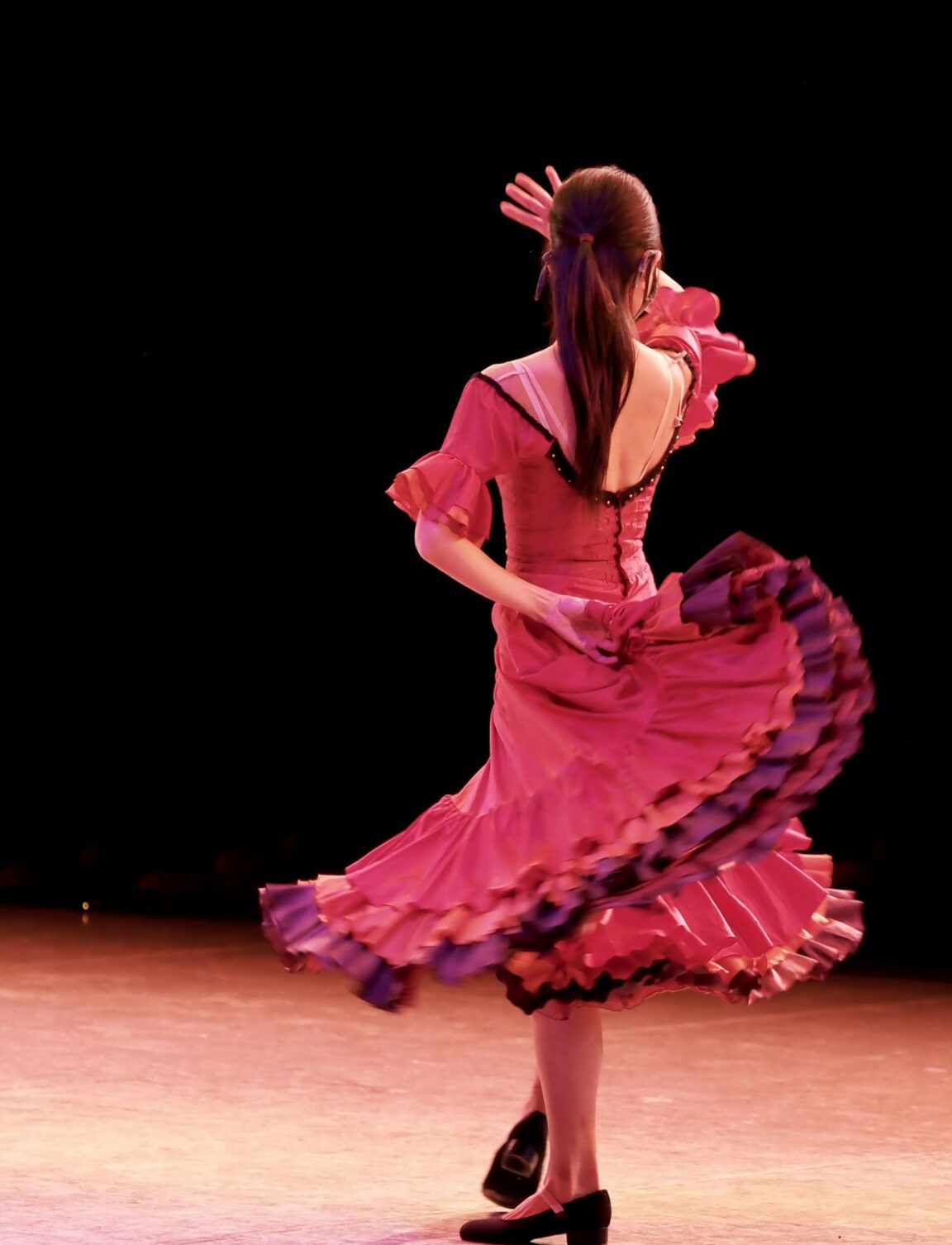
The bailaor or bailaora dances baile: upright torso, arms that carve the air, hands that open and close like flowers, and feet that turn the stage into a drum. A solo usually builds in sections, quiet marcaje marking steps giving way to a llamada, a call that signals a change, then an escobilla, a long accelerating passage of heelwork, and a cierre that closes the number. The dress, the bata de cola long trained skirt in some forms, the shawl and the fan are tools of the dance, not decoration.
How do you read the compas without counting?
Do not count. Listen for the palmas, the handclaps, which come in two textures: sordas, muffled, cupped hand claps that carry the base rhythm, and fuertes, sharp flat claps that accent it. The whole cuadro is locked to a repeating cycle, most famously the twelve beat cycle of solea and buleria, where the accents fall in a pattern your body learns before your head does. When the room claps, when the guitarist leans in, when the dancer holds a pose a fraction longer than expected, that is the compas being played with. Tension in flamenco is rhythmic before it is anything else.
The other word to know is duende, the dark, heightened emotional charge that great performances are said to summon, a term Lorca made famous in his essay on deep song. It cannot be scheduled, but it is more likely in a small room, late, with artists who know each other. That is the practical argument for the intimate tablao over the spectacle, stated in flamenco own terms.
What should a respectful first timer do and avoid?
Arrive on time, because latecomers break the opening cante. Keep phones dark and cameras away unless the venue explicitly allows a final photo moment. Do not clap along; the palmas are an instrument played by the cuadro, and an audience off beat clap is genuinely disruptive. Do shout encouragement only if the room does, softly, and never during a quiet verse. Afterwards, the bar or the street outside is the place to talk about it; the Seville night is young, and the tablao districts, Santa Cruz, the Alameda and Triana, all reward a slow walk home. Travellers continuing from Andalusia to Granada should pair this with our Alhambra visiting guide, because the two cities share the same deep Andalusian root system.
Frequently Asked Questions
Is flamenco from Seville?
Flamenco is Andalusian, formed across the region cities and towns, with Seville, Jerez de la Frontera and Cadiz among its great centres. Seville claims defining neighbourhoods, Triana above all, major artists across every generation and the Bienal de Flamenco, one of the art most important festivals.
What is the difference between a tablao and a pena?
A tablao is a commercial venue staging scheduled shows for an audience. A pena is a club of aficionados, members and devotees, where flamenco is sung and played socially, sometimes with guest artists. Penas can offer the most authentic nights of all, but they are not ticketed theatres, and visitors should go only where they are genuinely welcomed in.
How long does a tablao show last?
Typically about an hour, sometimes a little longer, usually in two or three sets a night. That hour is dense: several palos, solos for dancer and guitarist, and ensemble finales. An early show leaves the evening open for Triana; a late show carries the duende argument.
Do I need to understand Spanish to enjoy flamenco?
No. The letras matter, and translations deepen the experience, but the art communicates through rhythm, voice and movement first. Reading the short guide to palos in this article before the show gives a first timer enough structure to follow every section.
What should I wear to a tablao?
Smart casual is the norm in Seville tablaos. There is no formal dress code at most venues, but the room is a theatre, not a beach bar, and dressing with a little respect for the artists is the local expectation.
When is the Bienal de Flamenco held?
The Bienal is Seville great flamenco festival, held in even numbered years across several weeks in the autumn, bringing premieres and major artists to theatres across the city. In Bienal season, book both tablaos and festival performances well ahead.