 Jordan Ellis
Eat in Montreal in this order: a sesame bagel still warm from a wood fired oven in Mile End, a classic poutine eaten standing up or at a Formica counter, and a slow circuit of Jean-Talon Market in Little Italy, tasting as you go. Those three experiences explain the city better than any single restaurant. Montreal food is built on immigrant kitchens, French Canadian staples and market produce from Quebec farms, and a first visit should follow that structure rather than chase a ranked list of dining rooms.
Quick Facts
- Best for: Food travellers who want the defining Montreal dishes first, then the market that supplies the city kitchens
- The bagel: Montreal bagels are smaller, denser and sweeter than New York bagels, boiled in honey sweetened water and baked in wood fired ovens, best eaten warm within the hour
- The two names: Fairmount Bagel on Fairmount Avenue West and St-Viateur Bagel on St-Viateur Street, both in Mile End, are the twin institutions every bagel argument starts from
- The poutine: Fries, fresh cheese curds and brown gravy, born in central Quebec in the late 1950s; La Banquise on Rue Rachel East serves more than 30 versions and stays open 24 hours
- The market: Jean-Talon Market at 7070 Henri-Julien Avenue opened in 1933, runs year round and is one of the largest open air markets in North America
- Market hours: The operator lists Jean-Talon as open Monday to Saturday 8 a.m. to 6 p.m. and Sunday 8 a.m. to 5 p.m., with individual kiosk hours varying
- The circuit: Mile End for bagels in the morning, the Plateau for poutine, then Little Italy and Jean-Talon for the afternoon, all linked by short walks and the metro
What makes a Montreal bagel different?
Everything about the method. The dough is rolled by hand into a thinner ring with a bigger hole, briefly boiled in water sweetened with honey, then baked on long wooden boards in a wood fired oven. The result is a bagel that is chewier and denser than the New York style, with a slight sweetness and a blistered, golden crust, and it stales fast, which is why Montrealers buy them by the half dozen and eat the first one in the street outside the shop.
Sesame is the classic order, poppy seed the traditional alternative, and everything, cinnamon raisin and other flavours trail behind. Cream cheese and lox are available, but the defining Montreal experience is simpler: a hot sesame bagel, eaten plain, walking. Buy a mixed dozen for later if you must, knowing they are at their best within hours and freeze better than they keep.
Fairmount or St-Viateur, which bagel first?
Both, because the rivalry is the point and the shops sit a short walk apart in Mile End. Fairmount Bagel, at 74 Fairmount Avenue West, bakes around the clock and is the name most often called the definitive Montreal bagel; the classic move is sesame, eaten hot on the pavement outside. St-Viateur Bagel, on St-Viateur Street, is the other institution, famous for its hand rolled bagels fed continuously into the wood oven behind the counter, where you can watch the boards go in and come out blistered.
Honest answer: the difference between a Fairmount sesame and a St-Viateur sesame, both warm, is smaller than the difference between either of them warm and any bagel eaten cold an hour later. Timing beats loyalty. Go to whichever queue you reach first at the moment the boards come out, then walk to the other and compare like a local, because arguing about it is a Montreal food ritual in itself.
What is poutine, and where should a first one be eaten?
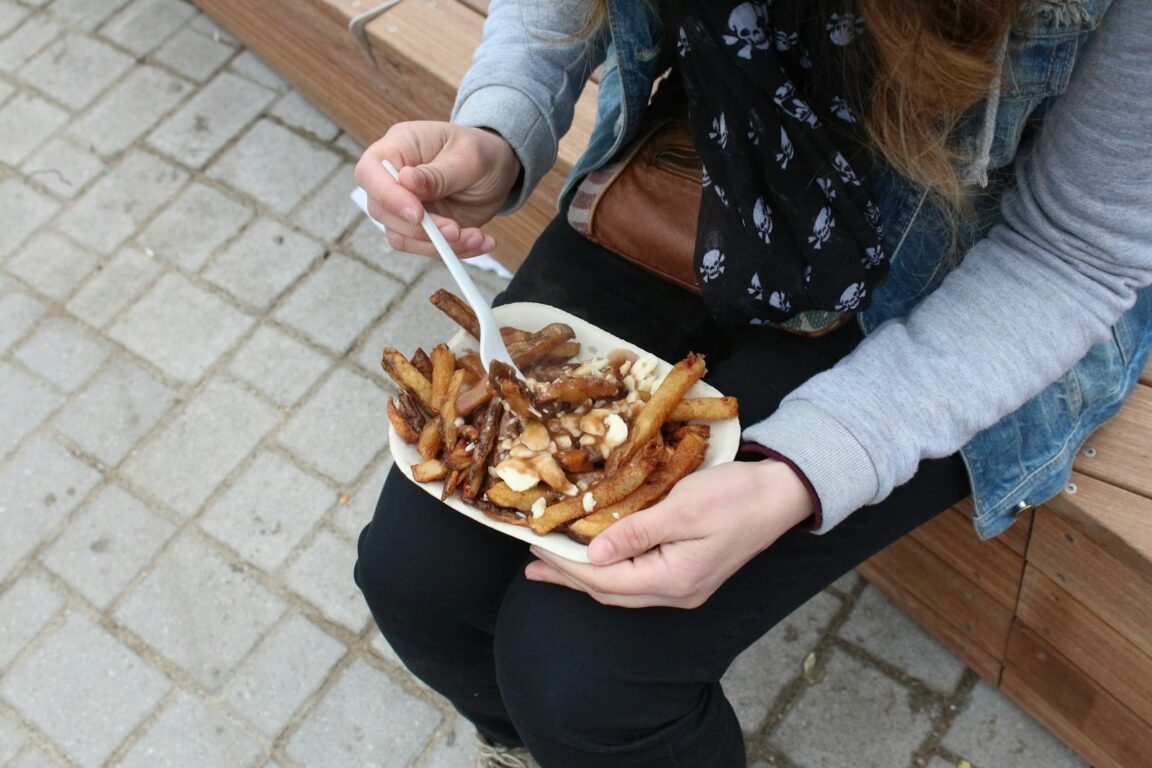
Poutine is three things and only three things at its base: French fries, fresh cheese curds and a hot brown gravy that melts the curds just enough to squeak. It appeared in central Quebec in the late 1950s, in the region where the cheese factories making the curds stood, and spread from snack bars and casse croutes across the province and then the country. The curds must be fresh enough to squeak against the teeth; grated cheese of any kind is a different dish wearing the same name.
For a first poutine, La Banquise at 994 Rue Rachel East in the Plateau is the standard answer for good reasons: it has specialised in poutine since long before the dish was fashionable, it serves more than 30 variations from the classic to loaded versions with smoked meat, guacamole or merguez, and it is open 24 hours, which makes it as much a 2 a.m. institution as a lunch stop. Order the classic first, in the regular size, before any variation. The variations are the second visit talking.
What about the rich end of poutine?
Montreal also took poutine upmarket. Au Pied de Cochon, the Plateau restaurant devoted to pork and foie gras, made its name partly on a foie gras poutine that swaps the standard gravy for something far richer. Treat that as the splurge chapter of the story, booked ahead, rather than the introduction. Between the counter and the dining room sits a whole middle tier of snack bars across the Plateau and Mile End serving their own classics, and a traveller with three poutines in a trip will develop opinions fast. That is the intended outcome.
How should Jean-Talon Market be worked?
Jean-Talon Market fills its block at 7070 Henri-Julien Avenue in Little Italy, where it was inaugurated in May 1933 on the former Shamrock lacrosse grounds. It is run by Marches Publics de Montreal, the body that manages the city public markets, and it trades year round: in summer the open air aisles run at full stretch with Quebec farm stalls, and in winter the market pulls inwards and keeps going through the snow. Plan it as a circuit with tastings, not a supermarket run.
What is the circuit?
Start with produce in the central aisles, where the season writes the menu: strawberries and corn in summer, apples, squash and cranberries in autumn, maple products as spring approaches. Then work the permanent shops around the edges: the fromageries for Quebec raw milk cheeses, the butchers and charcuterie counters, the spice merchant Epices de Cru on Henri-Julien, the tea shop Camellia Sinensis, and the Italian grocers that serve the Little Italy streets around the market, including the celebrated green grocer Chez Nino on Place du Marche du Nord. Eat as you go: oysters opened at the seafood counter, a crepe, a coffee, whatever the stalls are sampling.
The market rewards a second loop with a bag. Buy the cheese, the maple syrup and the charcuterie on the second pass, once you know the layout, and sit down at one of the small restaurants on the market edge to eat something cooked from the same produce. Travellers building a Quebec trip around food should pair this circuit with our Quebec City in winter itinerary, where the old port market tradition continues in a smaller, colder key.
What else belongs on a first Montreal food circuit?
Smoked meat. The deli tradition on Saint-Laurent Boulevard, the Main, gave Montreal its other great sandwich: beef brisket cured, smoked and steamed, sliced thick and stacked on rye with mustard. Schwartz, the famous deli on the Main, is the name every visitor hears first, and the order is a medium smoked meat sandwich, a pickle and a cherry cola. Expect a queue and shared tables, both part of the format.
Beyond the canon, follow the Michelin Guide Montreal selection as a discovery signal for the dining room end of the trip, and follow the neighbourhoods for everything else: Portuguese grilled chicken on Rachel in the Plateau, Italian coffee in Little Italy, and the bakeries of Mile End for the morning after the bagels. For a coastal Canadian contrast built on markets and seafood, our Prince Edward Island travel guide covers the Atlantic end of the same food first approach.
Frequently Asked Questions
Are Montreal bagels really better than New York bagels?
They are different rather than better: smaller, denser, sweeter from the honey water boil and baked in wood fired ovens. Montrealers defend theirs fiercely and New Yorkers return the compliment. The only fair test is a warm sesame bagel eaten outside the Mile End shop that baked it.
What time should I visit Jean-Talon Market?
Morning, ideally before 11 a.m., when the produce is freshest and the aisles are passable. The operator lists opening at 8 a.m. Monday to Saturday and 8 a.m. to 5 p.m. on Sunday, but individual stalls keep their own hours, so arrive hungry and flexible.
Is La Banquise worth the queue?
For a first poutine, yes. It is open 24 hours, so the simplest way to skip the queue is to go at an off hour, late afternoon or genuinely late at night, when the room runs at its natural snack bar pace. Order the classic before any of the 30 plus variations.
What should I bring home from Jean-Talon Market?
Maple syrup in a tin, Quebec cheese bought on your last day and eaten within the trip if your home rules restrict dairy imports, spice blends from the market spice merchant and charcuterie for the train or the picnic. Check your own country import rules for meat and dairy before flying with any of it.
How many days does a Montreal food trip need?
Two full days cover the circuit in this guide without rushing: Mile End and the Plateau on day one, Jean-Talon and Little Italy on day two, with a smoked meat lunch fitted between. A third day is for the dining rooms, the bakeries and the second bagel comparison.