 Priya Nair
Six Senses Thimphu is the lodge to choose if a Bhutan trip starts, as most do, in the capital: a hilltop property above Thimphu with reflecting ponds at its entrance, valley views from nearly every room, the largest spa of the five Six Senses Bhutan lodges circuit and a kitchen built around its own organic garden. Six Senses calls it the Palace in the Sky, and for once the nickname is descriptive rather than decorative. It suits travellers who want Bhutan wellness and altitude calm wrapped around their sightseeing days, and it works best as the first or last lodge of a multi valley journey rather than as a standalone resort holiday.
Quick Facts
- Best for: Travellers opening or closing a Bhutan journey in the capital who want serious spa time, big valley views and a full service lodge above the city
- The setting: A hillside perch at Chunimeding, Babesa, south of Thimphu town, at around 2,650 metres, among apple orchards and young pine forest
- The size: 25 suites and villas in total, from Lodge Suites to one, two and three bedroom villas, the largest lodge of the five in the Six Senses Bhutan circuit
- The circuit: Six Senses Bhutan links five lodges, in Thimphu, Paro, Punakha, Gangtey and Bumthang, travelled as one journey with a private guide and driver
- The spa: Hot stone baths, five treatment rooms including two for couples, steam and sauna, an indoor yoga studio, a prayer and meditation pavilion and a fitness centre, per the lodge own wellness listing
- The table: Namkha, the lodge restaurant, serves Bhutanese and international dishes built heavily on the lodge organic garden produce
- The fee to budget: Bhutan Sustainable Development Fee is USD 100 per adult per night, with a one off USD 40 visa fee, per Bhutan official tourism channels, paid on top of any lodge rate
What is the Palace in the Sky idea?
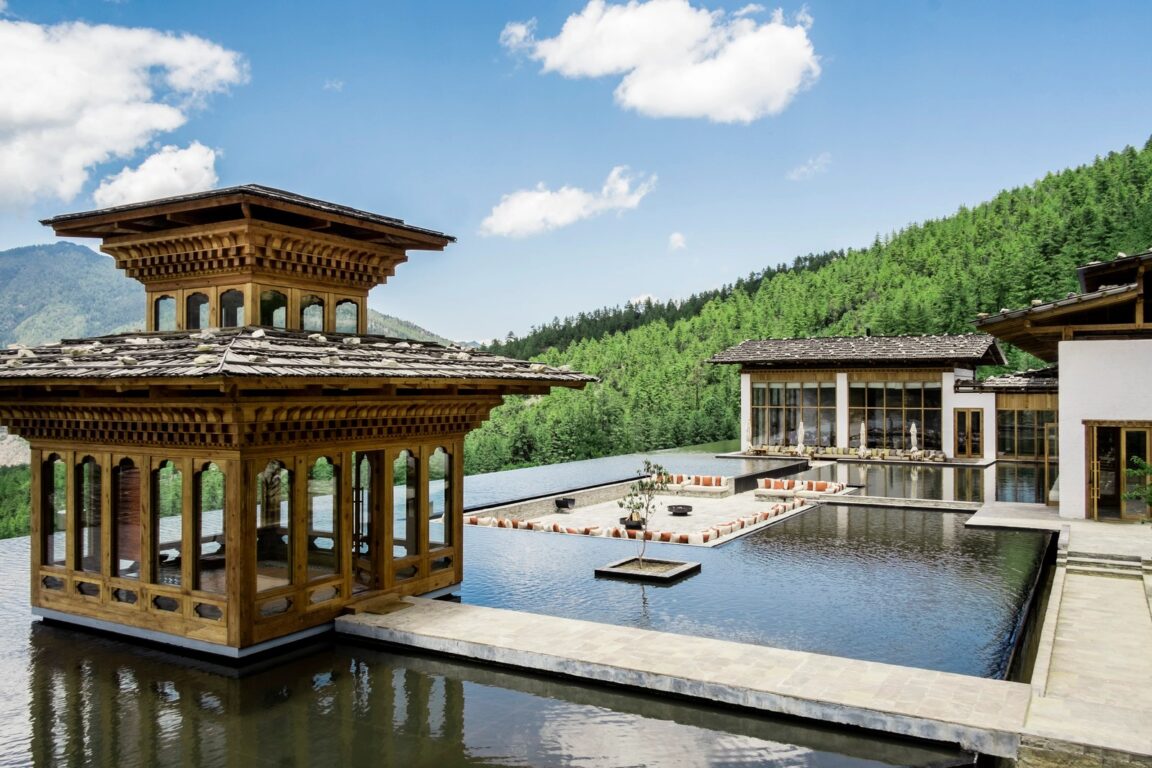
The lodge takes its design cues from a dzong, the fortress monasteries that anchor every Bhutanese valley, translated into low, stone and timber buildings arranged around courtyards and water. The arrival sequence sets the tone: reflecting ponds mirror the sky and the prayer flags at the entrance, and the main pavilion frames the Thimphu Valley through full height glass. Inside, the language is Bhutanese craft without theme park excess: hand woven textiles, carved wood, and a bukhari, the traditional wood burning stove, warming suites on cold high altitude evenings.
Thimphu is the natural gateway lodge. Most Bhutan journeys land at Paro airport and drive about an hour to the capital, and the city holds the kingdom biggest concentration of sights: the giant Buddha Dordenma statue above the valley, the Tashichho Dzong, the folk heritage and textile museums, and the weekend market. Basing those days at a lodge above the town, rather than in it, gives the sightseeing a retreat to return to, which at 2,650 metres is not a luxury detail. Altitude makes most visitors slower and sleepier on the first days, and a quiet hilltop is the right place to be both.
What are the suites and villas like?
The 25 keys divide into Lodge Suites, Upper Lodge Suites and villas of one to three bedrooms. Lodge Suites pair an indoor living space with an outdoor deck, floor to ceiling windows over the valley, deep bathtubs positioned for the view and the bukhari stove that becomes the room evening ritual. The villas scale the same idea up for families and groups, adding separate living and dining space and, in the larger categories, private spa treatment space, so a multi generational Bhutan trip can keep everyone under one roof without crowding.
Choose on party shape rather than price ladder. A couple on a five lodge circuit will spend their Thimphu nights out sightseeing and in the spa, and a Lodge Suite answers everything. A family, or a group travelling the valleys together, will use a villa living room every single day, for guide briefings, for tea, for the evenings when altitude and early starts make the lodge the destination. That is the honest split, and the lodge staff plan journeys around it.
What does the spa actually offer?
This is a Six Senses, so wellness is the operating system rather than an amenity list. The lodge own listing for its spa and wellness centre sets out hot stone baths, five treatment rooms including two couple rooms, steam and sauna, an indoor yoga studio, a prayer and meditation pavilion, a fitness centre and a manicure and pedicure room, alongside indoor pool facilities. The hot stone bath deserves its sentence: the Bhutanese dotsho heats river stones until they crack and release their heat and minerals into a wooden bath, often with artemisia leaves, and it is the traditional answer to a day of mountain roads and temple stairs.
Programmes run from single treatments to multi day wellness screening and sleep support of the kind the brand builds its name on. Travellers combining Bhutan with a wider Himalayan wellness trip should compare the approach with our Ayurveda in Kerala retreat guide, where the same question, how to choose on verified treatment substance rather than brochure language, is worked through for India great wellness tradition.
What will you eat at Namkha?
Namkha is the lodge all day restaurant, set in the central pavilion with the valley spread out below its windows. The kitchen works the Six Senses pattern: a Bhutanese core, momos with fiery ezay chilli sauce, red rice, local trout and seasonal vegetables, surrounded by international dishes, with a strong pull from the lodge own organic gardens for salads, herbs and vegetables. Breakfasts are the quiet highlight, taken slowly over the valley as the light comes up, before the guide arrives for the day sightseeing.
Private dining in the villas and drinks at the lodge bar round out the offer. Bhutanese food runs hot, chilli is a vegetable here rather than a seasoning, and the kitchen will calibrate heat honestly if asked, which first time visitors should do without embarrassment.
Who does Six Senses Thimphu suit best, and who should look elsewhere?
It suits wellness led travellers, couples marking a major occasion, and families or groups travelling the five valley circuit who want their capital base to double as a retreat. It suits travellers who value a spa with real depth, a garden driven kitchen and staff who can pace a journey around altitude. It is also the practical choice for anyone whose Thimphu sightseeing list is long, because the lodge sits minutes from the city it overlooks.
Look elsewhere, or at least look at the sister lodges, if the trip is short and scenery led: Punakha lodge sits in a warmer, lower rice valley, and Gangtey overlooks the glacial Phobjikha Valley and its black necked cranes, both more dramatic first impressions than the capital. Look elsewhere in Thimphu itself if the budget is doing real work, because Bhutan luxury lodges are priced at the top of the Himalayan market before the nightly Sustainable Development Fee is added, and the city has simpler hotels that put the money into more nights in the kingdom instead. On any Bhutan route, the Kathmandu pairing is common, and our first time Kathmandu itinerary covers the usual pre or post Bhutan stop.
Frequently Asked Questions
How do you reach Six Senses Thimphu?
Fly into Paro, Bhutan only international airport, then drive roughly an hour to Thimphu. The lodge sits above the town at Chunimeding, Babesa. Six Senses Bhutan journeys include a private guide and driver, who handle the transfer and all sightseeing logistics.
What is the Sustainable Development Fee and is it included in the room rate?
It is Bhutan government levy on visitors, currently USD 100 per adult per night with children at reduced rates, plus a one off USD 40 visa fee, according to Bhutan official tourism information. It is a government charge paid as part of the visa process, separate from lodge rates, and it funds free healthcare, education and conservation in the kingdom.
How many nights should a Thimphu stay be?
Two nights is the working minimum: one full day for the capital sights and one spa paced day that also absorbs arrival and altitude. Three nights suits travellers using Thimphu as their only Bhutan base, though the kingdom rewards moving on to Paro or Punakha instead.
When is the best season for Thimphu?
Spring, March to May, brings rhododendron bloom and warming days; autumn, late September to November, brings the clearest mountain views and the Thimphu Tshechu festival season. Winter is cold but crisp and quiet at altitude, and the summer monsoon clouds the views while greening the valley.
Can you stay at Six Senses Thimphu without doing the full circuit?
Yes. The five lodges are designed to link into one journey, but each can be booked as a single stay, and Thimphu is the most practical single lodge choice because of its position above the capital and its full size spa.