 Kwame Mensah
Visit the Vatican Museums on a timed ticket bought only from the official site, enter at 8 a.m. or late in the afternoon to dodge the worst lines, and walk the one way route in its fixed order, through the classical sculpture galleries, the Gallery of Maps and the Raphael Rooms, to the Sistine Chapel, which comes last. The full ticket costs 20 euros at the ticket office or 25 euros booked online, the museums open Monday to Saturday from 8 a.m. to 8 p.m. with final entry at 6 p.m., and every price and hour in this guide was checked on the Vatican Museums’ own site on the day of writing.
What are the quick facts for visiting the Vatican Museums?
- Opening hours: Monday to Saturday, 8 a.m. to 8 p.m., final entry 6 p.m. Visitors must leave the halls 30 minutes before closing.
- Full ticket: 20 euros at the ticket office, or 25 euros with the official skip the line online booking, which adds a 5 euro fee.
- Reduced ticket: 10 euros, or 15 euros booked online, for eligible children, students up to 25 with valid documentation and other concession categories listed by the museums.
- Free entry: Children under 7 always, and everyone on the last Sunday of the month, when the museums open 9 a.m. to 2 p.m. with final entry at 12.30 p.m.
- Closed: Every Sunday except the last of the month, plus 1 and 6 January, 11 February, 19 March, Easter Monday, 1 May, 29 June, 14 and 15 August, 1 November and 8, 25 and 26 December.
- Only official seller: tickets.museivaticani.va. The ticket covers the museums and the Sistine Chapel, is valid only on the day it is issued for, and cannot be refunded.
- Route order: Sculpture galleries first, then the Gallery of Candelabra, Tapestries and Maps, the Raphael Rooms, and the Sistine Chapel last of all.
- Entrance: The visitor entrance is on Viale Vaticano, on the north wall of Vatican City, a walk of about ten minutes from Ottaviano metro station.
Where should you buy Vatican Museums tickets, and what do they cost?
Buy from one place only. The museums state that tickets.museivaticani.va is their official online booking site, and they warn visitors about lookalike sellers charging far more. On the official prices page, a full entry ticket costs 20 euros without online booking and 25 euros with the skip the line booking, made up of the 20 euro ticket plus a 5 euro booking fee. The reduced ticket is 10 euros, or 15 euros booked online, and school groups pay 5 euros plus a 2 euro booking fee. Students pay the reduced rate up to and including the age of 25, with valid documentation.
Three terms matter more than the price. The ticket entitles you to visit the museums and the Sistine Chapel solely on the day for which it is issued. Tickets cannot be refunded. And the booking is for a named entry time, so the day and slot you choose are the day and slot you get. Free entry applies to children below the age of 7, to visitors with a certified disability of at least 67 percent together with a companion where needed, and to everyone on the last Sunday of the month. Book as soon as your Rome dates are fixed, because the popular morning slots on the official calendar sell out weeks ahead in spring, summer and around Easter and Christmas. If the official calendar is sold out for your day, a guided tour from a reputable operator is the legitimate fallback, since tour allocations are separate; a resold standard ticket at a large markup is not.
What are the Vatican Museums opening hours and closing days?
The museums’ own days and hours page sets the pattern. From Monday to Saturday the museums open from 8 a.m. to 8 p.m., with final entry at 6 p.m., and visitors are required to leave the halls 30 minutes before closing time. On the last Sunday of the month they open from 9 a.m. to 2 p.m., with final entry at 12.30 p.m. and free entry, provided that Sunday does not coincide with Easter Sunday, 29 June, or 25, 26 or 31 December.
On all other Sundays the museums are closed, and the closure list for the year also includes 1 and 6 January, 11 February, 19 March, Easter Monday, 1 May, 29 June, 14 and 15 August, 1 November, and 8, 25 and 26 December. Watch the same page for temporary closures, which the museums publish by sector: the Sistine Chapel, for example, is scheduled to close early, at 6 p.m. with last entry at 5.30 p.m., on 4 and 18 December in the current calendar. A closure line on that page beats any guidebook, including this one, so check it again on the morning of the visit.
In what order do you see the rooms, and where is the Sistine Chapel?
The visit is a one way river, and the Sistine Chapel is its sea. From the entrance hall on Viale Vaticano, the route climbs to the Courtyard of the Pinecone, then runs through the classical sculpture collections, the Chiaramonti Gallery’s long line of Roman portrait busts, the Braccio Nuovo and the Pio Clementino Museum, where the Laocoon group and the Apollo Belvedere stand. Only after the sculpture does the route turn to the upper galleries: the Gallery of the Candelabra, the Gallery of the Tapestries and then the Gallery of the Maps, a 120 metre corridor of painted Italian geography that is the last long view before the Renaissance rooms.
Next come the Raphael Rooms, the apartment painted for Pope Julius II, where the School of Athens faces the Disputation across the Room of the Segnatura. From there the route passes through later apartments and the collection of modern religious art before it reaches the Sistine Chapel. There is no legitimate way to see the chapel first and the rest afterwards on a standard ticket: the order is fixed by the building. Visitors who rush the galleries to reach Michelangelo miss the Raphael Rooms at their emptiest, because the crowd thins as it hurries. Visitors short on time can use the signposted shortcut that bypasses some later rooms after the Gallery of Maps, at the cost of the Raphael Rooms, which is a poor trade for anyone who may only come once. Allow three hours as a working minimum and four for a visit that stops properly; the museums reward the same patience as the walk in the Grand Egyptian Museum guide, where the headline room also comes at the end of a long sequence.
What should you look for inside the Sistine Chapel?
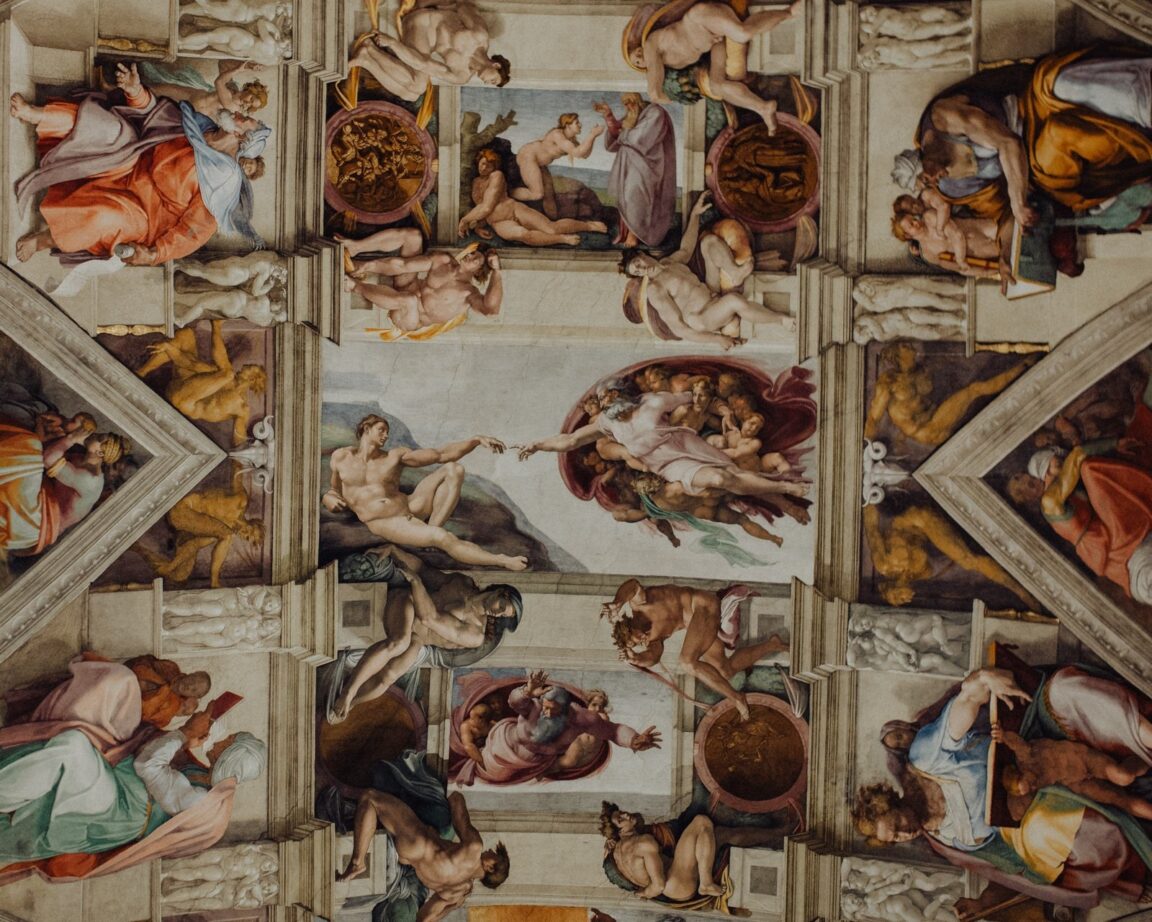
The chapel is a working papal chapel, the room where conclaves elect a new pope, and it asks for covered shoulders and knees, quiet, and no photography at all, a rule staff enforce constantly. Look in the order Michelangelo’s work was painted. The ceiling came first, between 1508 and 1512, nine scenes from Genesis running from the Separation of Light from Darkness above the altar to the Drunkenness of Noah near the door, with the Creation of Adam in the fourth panel from the altar end and the prophets and sibyls ranged along the sides. The Last Judgment, on the altar wall, came a generation later, painted between 1536 and 1541, and its scale only registers once you turn at the door and take the whole wall in.
Do not skip the walls between the two famous surfaces. The side frescoes of the 1480s, by Botticelli, Perugino, Ghirlandaio and their contemporaries, tell the lives of Moses and Christ in parallel, and they are the reason the room was already important before Michelangelo arrived. Stand in the middle, work from ceiling to altar wall to side walls, and give the room a full twenty minutes. Benches along the walls free up in rotation, and a seat changes the angle on the ceiling enough to be worth waiting for.
How do you dodge the worst lines at the Vatican Museums?
Four decisions do most of the work. First, book the official timed ticket online; the 5 euro fee replaces the ticket office queue, which on a spring morning can run for hundreds of metres along the Vatican walls, and leaves only the security check, which every visitor passes. Second, pick your hour like a local. The first entry at 8 a.m. and the entries after 3 p.m. are the calmest bands of the day; the worst crush arrives between 9.30 a.m. and noon, when the tour groups land together. A late ticket has a second advantage, because the galleries empty as closing approaches and the Gallery of Maps photographs best in late light.
Third, choose your day. Midweek days outside Italian public holidays are quieter than Mondays, when the museums absorb the weekend’s overflow, and quieter by far than the free last Sunday of the month, which is the one day this guide advises against for a first visit: entry costs nothing and the rooms cost you the pictures. Fourth, arrive at the right door, on Viale Vaticano, with the booking on your phone and identification that matches the name on the ticket, and travel light, because large bags and backpacks go to the cloakroom and add a second queue at the end. Rome rewards an early start generally, and a base within walking distance of the Vatican, such as the garden quarter covered in the Hotel de Russie guide, turns the 8 a.m. slot from an expedition into a stroll.
How does St. Peter’s Basilica fit into the same day?
St. Peter’s is a separate visit with separate rules. The basilica is not part of the museums ticket, entry is free, and its door is on St. Peter’s Square, on the opposite side of Vatican City from the museums entrance, with its own security line. A door inside the Sistine Chapel leads toward the basilica, but it is generally reserved for guided groups, so independent visitors should expect to exit the museums, walk around the Vatican walls, about fifteen minutes, and queue at the square. Sequence the day as museums first on the timed ticket, basilica second, because the basilica’s line is shortest in the late afternoon and its interior holds the day’s last light well. Michelangelo bookends the visit: the Sistine ceiling in the morning or afternoon, and his Pieta, just inside the basilica’s right aisle, to close.
Frequently asked questions about visiting the Vatican Museums
How much does a Vatican Museums ticket cost?
20 euros for a full ticket at the ticket office, or 25 euros booked on the official site, made up of the 20 euro ticket plus a 5 euro skip the line booking fee. The reduced ticket is 10 euros, or 15 euros booked online. Children under 7 enter free.
What time do the Vatican Museums open and close?
Monday to Saturday, 8 a.m. to 8 p.m., with final entry at 6 p.m. and the halls clearing 30 minutes before closing. On the last Sunday of the month they open 9 a.m. to 2 p.m., final entry 12.30 p.m., with free entry. They close on all other Sundays and on the listed feast days.
Can you go straight to the Sistine Chapel?
No. The Sistine Chapel is the last major room on the one way museum route, after the sculpture galleries, the Gallery of Maps and the Raphael Rooms. A signposted shortcut after the Maps gallery shortens the walk but skips rooms most visitors should not miss.
Is the Vatican Museums free on the last Sunday of the month?
Yes, when that Sunday does not coincide with Easter Sunday, 29 June, or 25, 26 or 31 December. Hours are 9 a.m. to 2 p.m. with final entry at 12.30 p.m. It is also the most crowded morning of the month, so first time visitors do better on a paid weekday ticket.
Can you take photos in the Sistine Chapel?
No. Photography and filming are prohibited inside the Sistine Chapel, and staff enforce the ban. Photos without flash are permitted in most of the museum galleries, so save the camera for the Gallery of Maps, the Pinecone Courtyard and the spiral staircase at the exit.
Does the Vatican Museums ticket include St. Peter’s Basilica?
No. The ticket covers the museums and the Sistine Chapel only, on the day of issue, and it cannot be refunded. St. Peter’s Basilica is entered separately from St. Peter’s Square and is free, with its own security queue.