 Kwame Mensah
Eat in Savannah by working through three lists: the Lowcountry plates built on rice, shrimp, crab and okra; the soul food institutions where fried chicken, collard greens and cornbread dressing anchor a shared table; and a walking circuit of the historic squares that strings the meals together, from a weekday lunch at Mrs. Wilkes to dinner at The Grey and a cone at Leopold’s to finish. Savannah rewards eaters who plan around two fixed points, lunch at Mrs. Wilkes Dining Room, which serves only on weekdays, and one booked dinner, and then let the 22 squares set the pace for everything in between.
What are the quick facts for eating in Savannah?
- Defining cuisine: Lowcountry cooking, the rice based food of the Georgia and South Carolina coast, shaped by West African, English, French and Caribbean influences and by Gullah Geechee foodways.
- Order first: Shrimp and grits, she crab soup, Savannah red rice and a Lowcountry boil of shrimp, sausage, corn and potatoes.
- Soul food anchor: Mrs. Wilkes Dining Room, 107 West Jones Street, family style lunch at shared tables for ten, Monday to Friday, 11 a.m. to 2 p.m. only.
- Book ahead dinner: The Grey, chef Mashama Bailey’s Port City Southern restaurant inside a restored 1938 Greyhound bus terminal at 109 Martin Luther King Jr. Boulevard.
- Sweet finish: Leopold’s Ice Cream on Broughton Street, founded in 1919 by three brothers from Greece.
- The circuit: 22 of Savannah’s original 24 squares survive, and the Bull Street line of Johnson, Wright, Chippewa, Madison and Monterey Squares runs from the river to Forsyth Park.
- Michelin status: Savannah has no Michelin starred restaurants, because the Michelin Guide does not cover the city yet. Judge kitchens here by local and national food press, not stars.
What makes a plate Lowcountry in Savannah?
Lowcountry food starts with the marsh. The tidal coast around Savannah grows rice well, and rice sits under almost everything: red rice tinted with tomato, perloo and purloo style pots where rice cooks with seafood or chicken, and the rice that arrives beside fried fish and stewed okra. Shrimp come from the local fleet, blue crab goes into soups and cakes, and oysters roast in clusters in the cooler months. Okra, field peas, collards and sweet potatoes fill out the table, a pantry that reflects the region’s African roots as much as its European ones.
Three dishes explain the grammar. Shrimp and grits pairs the day’s shrimp with stone ground grits, often with bacon, peppers or a brown gravy, and it works at breakfast, lunch or dinner. She crab soup is a rich bisque of blue crab meat and roe, traditionally lifted with a little sherry. A Lowcountry boil, sometimes called a Frogmore stew, is a one pot feed of shrimp, smoked sausage, corn and red potatoes tipped out onto a table. If a short trip only allows three orders, make it those, and compare them with the same plates across the river in Charleston’s Lowcountry guide, where the two cities argue happily over who does each one best.
Where should you eat the classic Lowcountry plates?
Start at The Olde Pink House, the 1771 mansion on Reynolds Square at 23 Abercorn Street that is Savannah’s most formal old school dining room. Its menu is the Lowcountry canon in one place: Low Country she crab soup to start, fried green tomatoes, shrimp and grits, and the crispy scored flounder that regulars order on repeat. Book it for the dinner that marks the trip’s big night, and ask for the downstairs Planters Tavern if the main rooms are full, since the tavern serves the same kitchen in a lower key room.
For a modern reading of the same ingredients, Common Thread at 122 East 37th Street describes itself as an ingredient and seasonally inspired restaurant from the team behind FARM Bluffton, and Bon Appetit named it one of its 50 Best New Restaurants in 2022. The menu changes with the farms rather than with a fixed canon, so expect Georgia produce, local fish and a lighter hand with the cream and butter. It sits in Thomas Square, south of the main tourist grid, and it is the dinner to choose when one classic and one contemporary meal have to stand for the whole scene.
Why is The Grey the dinner everyone books first?
The Grey occupies a restored 1938 Greyhound bus terminal, an Art Deco room that was segregated in its working life and is now the city’s best known dining room. Chef Mashama Bailey, a James Beard Award winner for Best Chef in the Southeast in 2019, calls her cooking Port City Southern. Her own description of it, on the restaurant’s site, is food that is deep, layered and soulful, built on regional produce, seafood and meats, and reflecting the cultural mix of a port city. In practice that means dishes such as foie gras and grits, Country Captain, grilled local fish and oysters, in a dining room and a yard bar that split the formality between them.
Reserve as far ahead as the trip allows, because The Grey is the first table most food focused visitors request. If dinner is gone, the same kitchen’s Sunday brunch is the fallback worth setting an alarm for. Either way, treat it as the fixed point of the itinerary and build the squares circuit around it, not the other way round.
What happens at a soul food table at Mrs. Wilkes?
Mrs. Wilkes is the opposite of a tasting menu. The restaurant’s own site sets the scene: at 11 o’clock the doors of 107 West Jones Street open, and the lunch crowd takes seats at large tables for ten, shared with strangers. The tabletops arrive crowded with platters of fried chicken and cornbread dressing, sweet potato souffle, black eyed peas, okra gumbo, corn muffins and biscuits, and the menu changes daily so regulars can eat there through the week without repeating a plate. The fuller rotating list runs to cabbage, snap peas, macaroni and cheese, butter beans, collard greens, rice and gravy, candied yams and red rice with sausage.
The rules are part of the institution. Lunch runs Monday to Friday only, 11 a.m. to 2 p.m., with no weekend service, and the house closes for a winter break from January 1 into mid February, usually reopening around February 15. There are no reservations to hide behind, so the queue on Jones Street is the booking system: arrive before the doors open, expect to share a table, and plan nothing for the hour after lunch. Visitors who know only one Savannah meal by reputation usually know this one, and it earns it.
Where else does Savannah eat like a local?
Head south to the Starland District for Brochu’s Family Tradition at 2400 Bull Street, where chef Andrew Brochu, who cooked at Michelin starred level in Chicago before moving to Savannah, built the menu around his fried chicken and elevated Southern comfort food in a family owned room. It is the clearest bridge between the old institutions and the new kitchens: familiar plates, sharpened technique, no white tablecloth theatre.
Then give River Street its due, but order carefully. The cobbled waterfront, lined with former cotton warehouses, is where the Lowcountry boil is sold by the tray and where praline shops hand out hot samples to the passing crowd. A boil shared between two, eaten overlooking the Savannah River as the big ships come in, is a legitimate Savannah pleasure rather than a tourist trap, provided the shrimp are local and the pot is seasoned properly. Finish on Broughton Street at Leopold’s Ice Cream, founded in 1919 by George, Peter and Basil Leopold, three brothers from Greece, and still run by the family. Tutti Frutti is the historic house flavour; the line moves faster than it looks.
How do the squares turn meals into a circuit?
Savannah was laid out in 1733 on James Oglethorpe’s plan of wards, each centred on a public square. The city repeated the unit until it had 24 squares; 22 survive, and they make eating here a walking sport. The most useful line runs south down Bull Street. Johnson Square, the first and largest, sits by the river end of the grid. Wright Square and Chippewa Square follow, Chippewa holding Daniel Chester French’s 1910 bronze of Oglethorpe and the north side bench spot made famous by a film that used a prop bench, which is no longer there. Madison Square and Monterey Square complete the run, Monterey giving onto the Mercer Williams House and the short walk south to Forsyth Park.
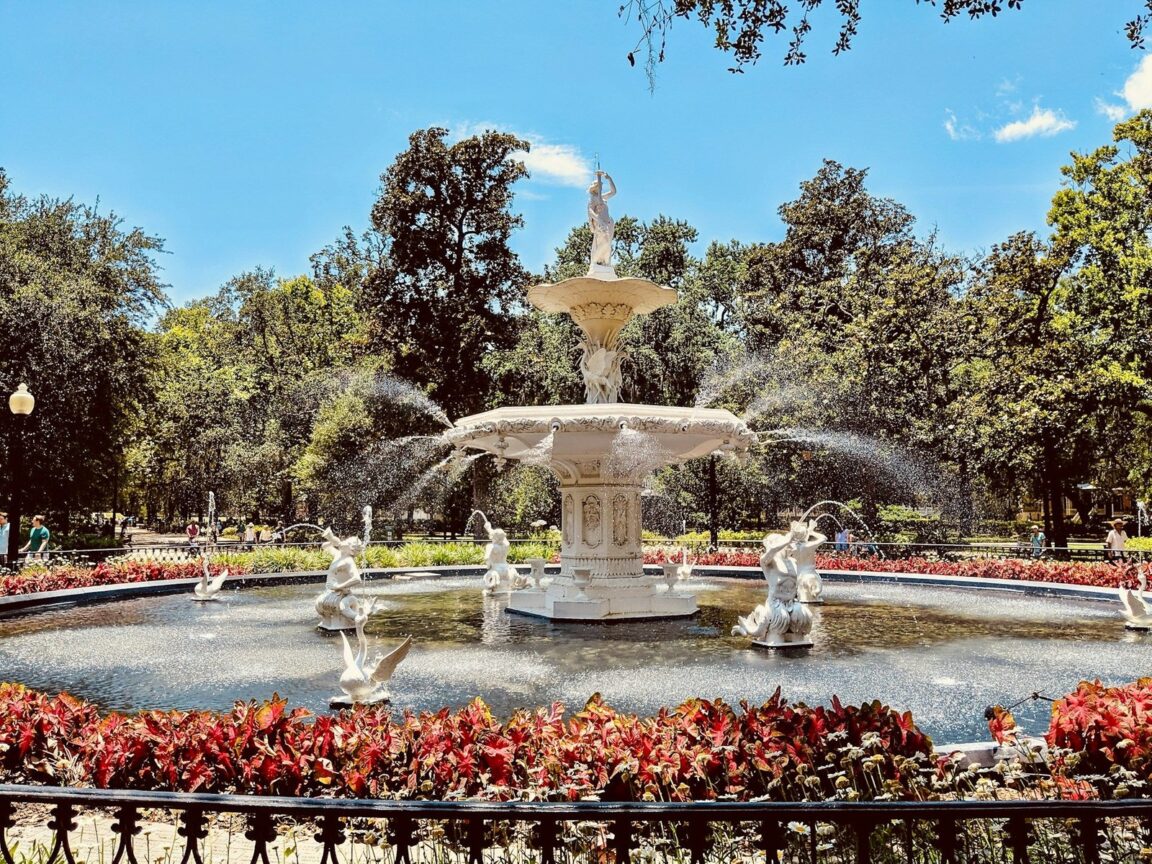
Pace the day on that line. Coffee near Johnson Square, a late morning drift through the squares to Reynolds Square for the Pink House at lunch or dinner, Leopold’s on Broughton Street a block off the line, and Forsyth Park at the end: 30 acres of lawns anchored by the white cast iron fountain installed in 1858. Mrs. Wilkes sits just west of the line on Jones Street, often called the prettiest street in the city, so a weekday can run queue, lunch, squares, nap, dinner without a car ever entering the plan. For the sister city’s take on the same pantry, the Lowcountry dishes in New Orleans’ classic dishes guide make a useful contrast, since the two ports season from opposite ends of the Gulf and Atlantic shelves.
Does Savannah have Michelin starred restaurants?
No, and the reason is coverage, not quality. When Michelin launched its American South guide in 2025, its Georgia coverage stopped at metro Atlanta; inspectors did not consider the rest of the state, including Savannah. Local chefs quoted at the launch called the omission odd while noting that the guide often expands state coverage in phases, as it did in Florida. Until that changes, Savannah’s honours come from elsewhere: James Beard Awards and nominations, Bon Appetit’s best new restaurant lists, and the simple test of which rooms locals book for their own celebrations. Do not let a star map route you away from this city; on the evidence of The Grey, Common Thread and Brochu’s, the cooking is already there.
How should you plan two days of eating in Savannah?
Day one belongs to the institutions. Queue at Mrs. Wilkes before 11 a.m. if it is a weekday, walk the Bull Street squares in the afternoon, and take the booked dinner at The Grey. Day two goes contemporary and coastal: a slow morning in Forsyth Park, Brochu’s or Common Thread for the main meal, a River Street boil if the group is hungry again, and Leopold’s to close. Build in the honest constraints. Mrs. Wilkes is closed at weekends and through its winter break, The Grey and the Pink House need reservations, and summer heat argues for the big meal at lunch and a lighter dinner. Prices, menus and hours change with the season, so confirm each restaurant on its own site on the day, which is also where dietary questions get a straight answer.
Frequently asked questions about what to eat in Savannah
What is the one dish to order first in Savannah?
Shrimp and grits, because it shows the whole Lowcountry system on one plate: local shrimp, stone ground corn and a savoury gravy. Follow it with she crab soup and, for a group, a shared Lowcountry boil.
Is Mrs. Wilkes open at weekends?
No. Mrs. Wilkes serves lunch Monday to Friday, 11 a.m. to 2 p.m., at 107 West Jones Street, and closes for a winter break from January 1 into mid February. Weekend visitors should book The Grey’s Sunday brunch or the Pink House instead.
Does Savannah have any Michelin stars?
None, because the Michelin Guide’s American South coverage in Georgia currently reaches only metro Atlanta. Savannah restaurants win James Beard and national list honours instead, and the guide may extend its Georgia scope in future editions.
What is Savannah red rice?
A tomato tinted rice cooked with peppers, onion and usually sausage or bacon, descended from the rice traditions of West Africa that shaped Lowcountry cooking. It appears as a side across the city, including on the rotating table at Mrs. Wilkes.
Where is the best area to stay for eating?
The Historic District, within walking distance of the Bull Street squares. It puts Mrs. Wilkes, The Grey, the Pink House and Leopold’s inside a car free circuit, with Starland and Thomas Square a short ride south for Brochu’s and Common Thread.
What should you eat on River Street?
A Lowcountry boil of shrimp, sausage, corn and potatoes, eaten as a shared tray, and a warm praline for dessert. River Street trades on volume and views, so choose a kitchen that names local shrimp and cook to order.