 Camille Baptiste
Start with the two dishes that define Charleston on a plate: a bowl of she-crab soup, rich with cream and blue crab and finished with sherry, and a plate of shrimp and grits, the Lowcountry’s famous pairing of sauteed shrimp and boiled cornmeal porridge. Everything else on the Lowcountry table follows from those two: Hoppin’ John and red rice, okra and collards, a Lowcountry boil shared at a table, and biscuits with sweet tea. Eat those dishes in the old city around the Market and King Street, walk them off along East Bay Street past Rainbow Row, and you will have tasted the city properly.
Quick Facts
- Where: Charleston, South Carolina, in the Lowcountry where the Ashley and Cooper rivers meet the harbor
- The two dishes: She-crab soup, a cream soup of Atlantic blue crab finished with dry sherry, and shrimp and grits, sauteed shrimp over boiled cornmeal porridge
- The roots: Lowcountry cooking is Gullah Geechee cooking at its heart, built on rice, okra, peas and seafood
- The rice: Carolina Gold, the long-grain rice associated with the Lowcountry table
- Shrimp season: The local shrimp season runs into the fall, peaking around November, when the catch is at its best
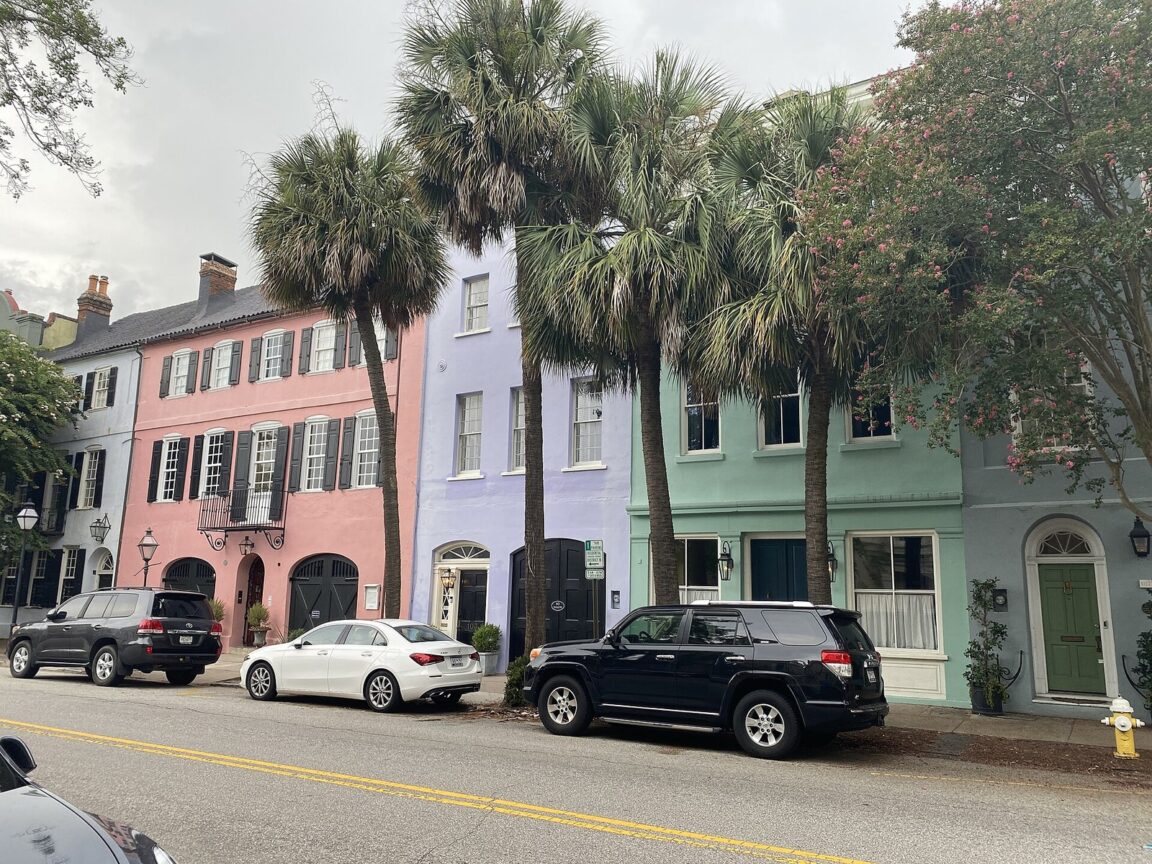
- The walk: Rainbow Row, thirteen pastel houses at 79 to 107 East Bay Street, restored in the 1930s and 1940s
- How to eat: Order soup as a starter and shrimp and grits as a main, and share the rest of the table
- Money: Prices vary widely between market stalls and white-tablecloth dining rooms, so check menus before you sit down
She-crab soup: the bowl to start with
She-crab soup is a rich soup, similar to a bisque, made with milk or heavy cream and crab or fish stock, Atlantic blue crab meat and, traditionally, crab roe. It is seasoned with a touch of mace and with shallots or onions, thickened by reduction or with a puree of boiled rice, and finished with dry sherry, added as the soup is plated. It is a South Carolina Lowcountry specialty, common on menus in Charleston and Savannah, and its name is literal: a she-crab is a female crab carrying roe, and the roe is what the traditional recipe is built around.
Order it as a starter, in a cup rather than a bowl, and pay attention to two things. First, ask whether the roe is in: traditional versions include it, and many modern bowls skip it. Second, taste it before you reach for anything else: the soup is rich enough that salt, pepper and hot sauce should be additions, not defaults. The sherry is not decoration. It cuts the cream and sharpens the crab, and a bowl without it tastes flat by comparison. If the menu offers a cup and a bowl, take the cup: you want to save room for what comes next, and the soup is at its best as an opening, not as a meal on its own.
Shrimp and grits: from breakfast to signature dish
Shrimp and grits is a Lowcountry dish of sauteed shrimp served with grits, a boiled cornmeal porridge. It was historically a breakfast dish, eaten during shrimp season with small creek shrimp, and the credit for the dish belongs to the Gullah Geechee people of the Lowcountry. Early names for it tell the story: breakfast shrimps, shrimp gravy and smuttered shrimp. A 1931 cookbook, 200 Years of Charleston Cooking, already lists shrimp and hominy among its recipes, and since the 1990s Charleston chefs have served modified versions, often with cream and French shallots.
What you will actually be served today is a generous main course: creamy grits, shrimp cooked in a savory gravy, and a spoonful of the cooking liquid over the top. The test of a good plate is the grits, which should be smooth and slow-cooked, never gluey or underdone, and the shrimp, which should be just cooked and still sweet. Order it for brunch or for dinner, because the dish long ago stopped being a breakfast-only affair, and pair it with something green, collards or a simple salad, to balance the richness. If you only eat one dish in Charleston, make it this one: it is the plate that tells you the most about the city in a single sitting.
The rest of the Lowcountry table
Once you have the two headline dishes, the rest of the table fills in quickly. Hoppin’ John is black-eyed peas cooked with rice, the everyday Lowcountry plate that sits beside almost everything. Charleston red rice is rice cooked with tomato and sausage, a close cousin of the Spanish and West African rice dishes that travelled to the Lowcountry. A Lowcountry boil, also called Frogmore stew, is shrimp, sausage, corn and potatoes cooked together in one pot and eaten communally, usually poured out on a table covered in newspaper and shared with your hands.
Okra came to the Lowcountry through the Gullah Geechee kitchen, and it shows up fried, stewed with tomatoes and in soups. Collard greens, slow-cooked with a little pork, are the standard side. Benne wafers, crisp sesame seed biscuits, are the city’s classic sweet, and pimento cheese, the sharp cheddar and pepper spread, turns up on sandwiches and crackers everywhere. Biscuits are a breakfast staple, and sweet tea is the default drink: ask for unsweetened if you want it that way, because sweet is the house style. None of these dishes needs a special occasion. They are the food Charlestonians eat every day, which is exactly why they are worth a traveler’s time.
How to eat your way through Charleston in a day
Start the morning with biscuits and grits, and take a walk through the Market area while the city is still cool. The old city rewards walking: the streets are flat, the distances are short, and the best food is rarely far from the next good walk. At midday, order she-crab soup as a starter and Hoppin’ John or red rice as the main, and eat slowly: the midday heat is real, and a long lunch in the shade is the Charleston way. The approach is the same one that works in any food city, as our guide to eating in Osaka shows: eat early, eat well, and let the food set the shape of the day.
In the afternoon, walk East Bay Street to Rainbow Row, the thirteen pastel houses at 79 to 107 East Bay Street, north of Tradd Street and south of Elliott Street. The houses were painted in pastel colors as they were restored in the 1930s and 1940s, and the row is now one of the most photographed streets in the United States. It is a good place to walk off lunch, and the stretch of East Bay Street around it is also where you will find sweet tea and a bench in the shade. In the evening, sit down to shrimp and grits as the main event, or a Lowcountry boil if you are eating with a group. And if the evening stretches on, finish it with music: our guide to Havana after dark plans a night the same way, food first, then the rooms where the music plays. The next morning, take a slow walk before breakfast, the way our Sedona guide plans slow mornings after full days, and start again with biscuits.
What to know before you order
A few practical points. Menus change with the season and the catch, so the shrimp on your plate should be local when the season allows, and it is always worth asking what is fresh that day. Prices vary widely: a cup of soup at a market stall and a full dinner in a dining room are different budgets, so check the menu before you sit down. Portions are generous, so a starter and a main shared between two people often goes further than two full orders. And on weekends, the popular dining rooms fill up: book ahead for dinner if you have a specific place in mind, and walk in early for lunch, when the wait is usually shorter.
Frequently Asked Questions
What is the one dish I must try in Charleston?
If you eat one dish, make it shrimp and grits: it is the plate that carries the most Lowcountry history, from its Gullah Geechee roots to its modern restaurant versions. If you eat two, add a cup of she-crab soup as a starter.
Is she-crab soup made with roe?
Traditionally, yes: the soup is named for the she-crab, a female crab carrying roe, and the roe is part of the classic recipe. Many modern versions skip it, so ask if it matters to you.
What is Hoppin’ John?
Black-eyed peas cooked with rice, the everyday Lowcountry plate that sits beside almost everything else on the table.
Is shrimp and grits breakfast or dinner?
Both. It was historically a breakfast dish, eaten during shrimp season, and it is now served all day, from brunch menus to dinner tables.
Where is Rainbow Row?
On East Bay Street, at numbers 79 to 107, north of Tradd Street and south of Elliott Street. The thirteen pastel houses were restored in the 1930s and 1940s and are one of the most photographed sights in Charleston.
Dish history and Rainbow Row details checked 12 November 2026 against Wikipedia, including she-crab soup, shrimp and grits and Rainbow Row. Menus and prices change, so confirm them on the day.