 Aiko Tanaka
The eating order that works in Osaka is simple: start the day grazing at Kuromon Market, snack on takoyaki in Dotonbori in the afternoon, sit down properly for okonomiyaki, then finish in Shinsekai with kushikatsu and a beer, saving a second, neon-lit Dotonbori pass for late grazing. Osaka is Japan’s kitchen, a merchant city that built its identity on kuidaore, the local philosophy usually translated as eat until you drop, and its famous dishes are cheap, fast and designed to be eaten standing up, at a counter, or walking a canal. This guide explains what each signature dish is, where its home turf is, the one etiquette rule that actually matters, and how to sequence a full food day without queueing for the same thing twice.
Quick Facts: Eating in Osaka at a Glance
- Where: Osaka, Japan. The food action concentrates in Minami, the southern centre: Dotonbori and Namba, Kuromon Market in Nipponbashi, and Shinsekai under the Tsutenkaku tower further south.
- The big three: Takoyaki, batter balls with octopus, born in Osaka in the 1930s street stall scene. Okonomiyaki, the savoury cabbage pancake cooked on a griddle. Kushikatsu, breaded and deep-fried skewers, the signature of Shinsekai.
- The eating order: Market breakfast at Kuromon, takoyaki as an afternoon snack, okonomiyaki as the sit-down meal, kushikatsu in Shinsekai for the evening, Dotonbori after dark for a final graze.
- The one rule: Never double-dip a kushikatsu skewer in the shared sauce. Dip once, before the first bite, and use the free cabbage to scoop extra sauce.
- Getting around: Namba station, served by Osaka Metro and the Nankai and Kintetsu lines, is the gateway for Dotonbori and Kuromon. Shinsekai is a short hop south by Metro or a longer walk.
- Money note: Small stalls and market counters may be cash-led and prices are posted on menu boards that change often, so this guide deliberately quotes no prices: check the board, order small, and keep grazing.
- Last checked: November 11, 2026, against Japan National Tourism Organization and Osaka tourism sources.
Why is Osaka called Japan’s kitchen?
Osaka grew rich as Japan’s merchant and distribution city, the place where rice, seafood and produce from across the country were traded, and its food culture kept the merchant character: fast, filling, good value and completely uninterested in ceremony. The Japan Tourism Agency’s own Dotonbori profile describes the district as the standard-bearer of kuidaore culture and lists the same core dishes every Osaka food day is built on: kushikatsu, takoyaki and okonomiyaki off the griddle, plus Osaka-style udon in a mild dashi broth. Where Kyoto food performs refinement and Tokyo food performs precision, Osaka food performs generosity. Portions are honest, stalls compete on the same street, and the correct response to a good first stop is to keep walking and eat again somewhere else.
What is takoyaki, and where should it sit in the day?
Takoyaki are balls of wheat batter poured into a cast-iron pan with hemispherical moulds, each ball built around a piece of octopus, with tempura scraps, pickled ginger and green onion in the mix. The cook turns them constantly with a pick until the outside is crisp and golden and the centre stays soft, almost molten, then dresses them with takoyaki sauce, mayonnaise, dried bonito flakes that wave in the heat, and aonori seaweed powder. Two warnings from every local source agree: the centre is scalding for longer than the outside suggests, so let the first ball rest, and the classic sauce version should be your first order, before the ponzu, salt or cheese experiments, because it is the benchmark every stall is judged on. Dotonbori’s canal strip is wall to wall with takoyaki counters, including famous names such as Kukuru and Wanaka, whose Sennichimae main shop sits a short walk from the canal. Takoyaki works best as an afternoon or pre-dinner snack, eaten standing at the counter, because it is rich enough to spoil a sit-down meal if you order a full tray an hour before it. In the eating order, it is step two: fuel, not the main event.
Okonomiyaki: the sit-down centre of the day
Okonomiyaki is Osaka’s griddle pancake: a batter of flour, egg and dashi loaded with shredded cabbage, plus your chosen additions, pork belly, squid, shrimp, cheese or noodles in the Hiroshima-influenced modern-yaki style, cooked on a hot plate, flipped once, and finished with okonomiyaki sauce, mayonnaise, bonito and aonori. The name means roughly as you like it, grilled, and the format rewards sitting down: a proper okonomiyaki takes time on the griddle, arrives too hot and too big to rush, and anchors the middle of a food day the way takoyaki cannot. Dotonbori and the streets behind it are dense with okonomiyaki houses, from high-volume counters on the main strip to older names a block or two away from the canal, and the practical advice from local guides is consistent: the further from the Glico sign postcard shot, the calmer the room. Order one pancake between two people if the grazing continues afterwards, add yakisoba noodles only if it is the last big stop, and expect the staff to finish the pancake on the griddle in front of you rather than handing over a spatula and wishing you luck, unless the house style invites you to cook it yourself.
Kushikatsu and Shinsekai: how does the evening stop work?
Kushikatsu are skewers of meat, seafood and vegetables, beef, pork, prawn, quail egg, lotus root, cheese and more, each coated in a fine panko crumb, deep-fried, and served with a thin, tangy Worcestershire-style dipping sauce and a plate of raw cabbage. The dish belongs to Shinsekai, the retro entertainment district built around the Tsutenkaku tower south of Namba, where kushikatsu houses have served working crowds since the early twentieth century and where Daruma, the best known name, traces its sauce recipe to 1929. The etiquette is famous and absolute: the sauce pot is shared, so a skewer is dipped once, before biting, and never returned after it has touched your mouth. Signs in English repeat the rule in most Shinsekai and Dotonbori shops, cabbage is the sanctioned way to carry extra sauce, and some modern shops now bring individual sauce portions, which changes nothing about the principle. Order in rounds of a few skewers, because kushikatsu is best in the first minute out of the fryer, and let the evening run long: Shinsekai after dark, tower lit, skewers arriving in waves, is the Osaka food experience that most rewards slowing down. The same grazing logic structures great food cities everywhere, as our guide to what to eat in Istanbul shows with its breakfast to kokorec arc across one day.
Kuromon Market: why the food day starts here
Kuromon Ichiba, a covered market of roughly 170 shops a short walk east of Dotonbori in Nipponbashi, has been called Osaka’s kitchen for generations, because it is where the city’s restaurants and home cooks have long bought fish, meat, produce and pickles. For visitors it is the ideal first stop of the day, from mid-morning: stalls grill seafood to order, slice sashimi, sear wagyu skewers, squeeze juice and sell strawberries the size of plums, and the correct method is the market method, a bite here, a skewer there, nothing that fills you up before noon. Kuromon also teaches the geography of Osaka eating in one walk, since it sits between Namba’s department stores, the electronics blocks of Den Den Town and the canal. Go on a weekday morning for the working market rather than the weekend crowd scene, carry cash for the smallest counters, and treat Kuromon as the appetiser for the day rather than lunch itself. Travelers continuing north after Osaka will find the capital’s very different food registers mapped in our first time in Tokyo itinerary, which sequences the two cities well in a single Japan trip.
What else belongs on an Osaka eating list?
Beyond the big three, four supporting dishes complete the picture. Ikayaki is a pressed grilled squid pancake, a Dotonbori area fast food with a chewy, savoury bite. Doteyaki is beef sinew simmered until tender in miso and mirin, the classic Shinsekai side order alongside kushikatsu. Butaman, the steamed pork buns sold by long-established chains, are the portable snack locals actually queue for at stations. Kitsune udon, wheat noodles in dashi topped with sweet fried tofu, is Osaka’s gentle bowl, named for the fox spirits said to love the topping, and it is the right final order on a day when the fried food has added up. Ramen, gyoza and yakiniku are everywhere in Dotonbori and all can be excellent, but they are national dishes playing an away game here, so give the local five the first day and the imports the second.
How does Dotonbori itself fit together after dark?
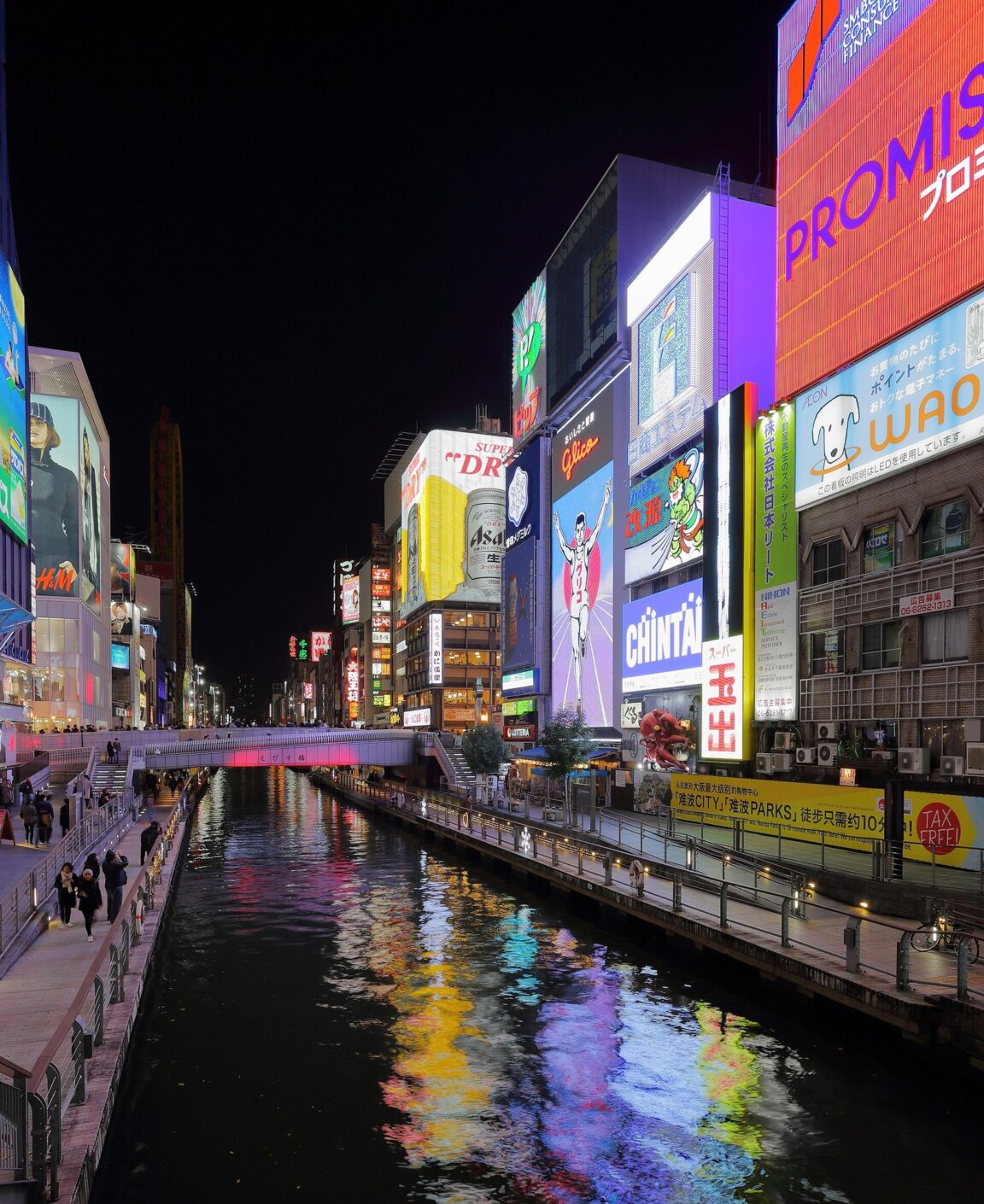
Dotonbori is a canal, a shopping street and a theatre district turned food strip, running through Chuo Ward in Namba, a few minutes on foot from Namba station. Its landmarks are advertisements: the Glico running man sign above Ebisubashi bridge, first erected in 1935 and now in its sixth, LED generation, the giant mechanical crab of Kani Doraku, and the Kuidaore Taro drumming clown outside the Nakaza Kuidaore Building. The strip began as a seventeenth-century canal project and was designated an entertainment district in the 1620s, which explains its density: theatres drew crowds, crowds drew food stalls, and the food stalls outlived the theatres. Visit twice, once in daylight to read the street and choose targets, and once after sunset when the signs reflect in the canal and the takoyaki queues move fastest. Because signage and shop line-ups on the strip change, and the Glico sign itself is periodically renewed, check current Osaka tourism listings on the day rather than navigating by any guide’s shop map, this one included.
Frequently Asked Questions
What is the one dish to try first in Osaka?
Takoyaki in its classic form, sauce, mayonnaise, bonito flakes and aonori, from a busy Dotonbori or Sennichimae counter. It is Osaka’s signature, it is ready in minutes, and it sets the benchmark for everything else in the day. Let it cool briefly before the first bite: the centre stays molten.
What does kuidaore mean?
Kuidaore is Osaka’s food philosophy, usually translated as eat until you drop, or more literally, ruin yourself with food. In practice it means grazing across many stalls and small dishes rather than committing to one long formal meal, which is why the eating order in this guide sequences small stops through the day.
What is the kushikatsu double-dipping rule?
Never dip a skewer into the shared sauce a second time, and never dip after biting. Dip once at the start, eat the skewer, and use the free raw cabbage provided to scoop extra sauce if you want more. Shops post the rule prominently, and some now offer individual sauce portions instead.
Is Dotonbori the only place to eat well in Osaka?
No. Dotonbori is the famous strip, but Kuromon Market is better for morning grazing, Shinsekai is the home of kushikatsu, and the bar and restaurant streets of Ura Namba behind the station and the retro blocks of Shinsekai reward anyone who walks ten minutes beyond the canal. Dotonbori is the start of an Osaka food day, not its limit.
When should each dish be eaten during the day?
Kuromon Market from mid-morning, takoyaki as an afternoon snack, okonomiyaki as the sit-down meal in the early evening, and kushikatsu in Shinsekai as the long evening stop, with a late Dotonbori graze to close. The order spreads fried food across the day and puts each dish in its home district at its best hour.
Image: Dotonbori, Osaka, at night, the canal strip where the food day in this guide begins and ends. Facts checked against the Japan Tourism Agency, the Japan National Tourism Organization and Osaka tourism sources on November 11, 2026. Prices are deliberately not quoted, because stall and menu board prices in Osaka change frequently: the boards at each counter are the authority on the day. No meal is claimed as eaten by the author.