 Rafael Santos
Arequipa rewards travellers who give it days rather than hours: Peru’s great southern city sits at about 2,335 metres beneath the perfect cone of El Misti volcano, its historic centre built from luminous white sillar stone and protected by UNESCO since 2000, and it deserves to be treated as a destination in itself, with the monastery city of Santa Catalina, a serious food scene and gentle acclimatisation, before any trip out to the Colca Canyon. Visit in the dry season from April to November for the clearest volcano views.
What are the quick facts for a first visit?
- Where: Southern Peru, Peru’s second city, below the western edge of the Altiplano
- Altitude: About 2,335 metres above sea level
- Nickname: The White City, for its white sillar volcanic stone buildings
- Status: Historic centre inscribed by UNESCO in 2000
- Volcanoes: El Misti at about 5,822 metres, Chachani at about 6,075 metres, Pichu Pichu at about 5,664 metres
- Signature sight: Santa Catalina Monastery, founded in 1579, a walled city within the city
- Best season: April to November, the dry season, with May to November especially clear
- Colca Canyon: A separate trip of about 3 to 4 hours by road each way, best as an overnight excursion
Why is Arequipa white, and what exactly is sillar?
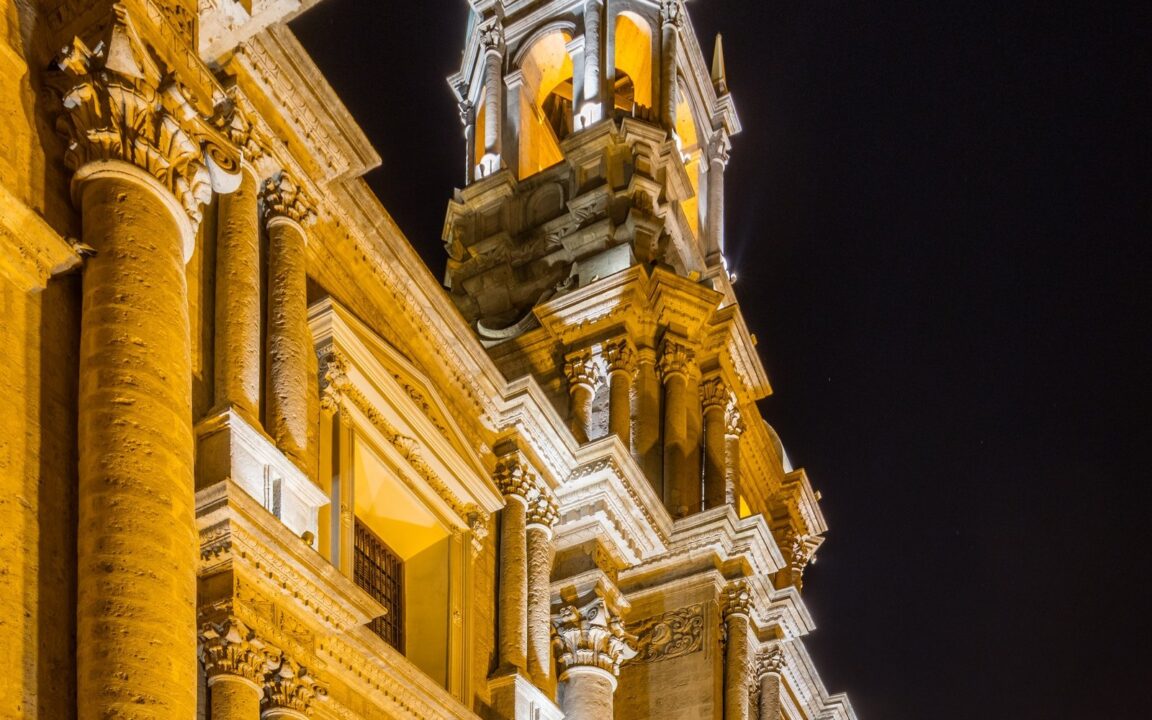
Sillar is a pale volcanic stone, formed from the ash and pumice of ancient eruptions and quarried from the foothills around the city, notably at the Añashuayco quarries where stonecutters still work the white cliffs today. Arequipa’s builders used it for churches, mansions, cloisters and ordinary houses alike, and the effect at street level is unlike anywhere else in Peru: facades that glow gold in the early morning, soften to cream at midday and turn faintly rose at dusk, all of them carved with an Andean baroque language of suns, vines, pumas and saints that merges European forms with local hands and local symbols.
The historic centre that resulted was inscribed by UNESCO in 2000. At its heart stands the Plaza de Armas, one of the most handsome main squares in South America, arcaded on three sides and dominated on the fourth by the twin-towered Cathedral, rebuilt in sillar after earthquakes and fire repeatedly tested the city. A short walk away, the Church of La Compañía de Jesús holds some of the finest carved stonework and mural painting in the city, including a polychrome dome that repays a slow look upward. Arequipa has endured serious earthquakes across its history, and its low, thick-walled sillar construction is itself part of the story, an architecture adapted to a volatile landscape.
What should you see inside Santa Catalina Monastery?
The Monasterio de Santa Catalina, two blocks north of the Plaza de Armas, is the single essential interior in Arequipa. Founded in 1579 and opened to the public only in 1970 after nearly four centuries of cloistered life, it covers about 20,000 square metres and functions as a complete small city behind its high walls: named streets, plazas, fountains, communal kitchens, a laundry channelled with running water, and rows of individual cells where nuns, historically drawn from wealthy families, lived with servants in private domestic worlds. A small community of nuns still lives in one section today.
Allow at least two hours, and three if photography or quiet corners appeal to you. The colour is the surprise after the white city outside: walls washed in deep terracotta, indigo blue and ochre, geraniums in courtyards, and light that changes by the hour. Independent guides at the entrance offer one-hour tours that explain the cloister’s economics and daily rituals far better than wandering alone, and late openings on certain evenings let you see the lanes lit and nearly empty. Dress modestly, keep voices low in the areas near the active community, and do not rush the cloisters, the art gallery of colonial religious painting is stronger than most visitors expect.
Who was Juanita, and where can you learn her story?
A few streets away, the Museo Santuarios Andinos, the Museum of Andean Sanctuaries, presents one of the most moving exhibitions in Peru: the story of the Inca capacocha ceremonies, in which children were sacrificed on the high summits of sacred volcanoes. Its most famous subject is Juanita, the Ice Maiden, a girl who died on Mount Ampato in the 15th century and whose frozen body was discovered in the 1990s, preserved with her offerings, textiles and pottery. Visits run as guided tours only, beginning with a documentary film, and the presentation is sombre and respectful rather than sensational.
One practical warning matters: Juanita herself is not on display all year, and in some periods a different preserved child from the same ceremonies takes her place while she is protected from light and deterioration. If seeing Juanita specifically is central to your visit, check with the museum shortly before you go and accept the answer with good grace. The exhibition’s power lies in the whole narrative, the archaeology, the mountain shrines and the extraordinary textiles, not in a single figure.
How does the altitude work, and how should you pace your first days?
At about 2,335 metres, Arequipa sits far lower than Cusco at about 3,400 metres or Puno at about 3,830 metres, which makes it the gentlest introduction to Andean altitude on the standard southern circuit. Most visitors arriving from Lima at sea level feel little more than a dry throat, a faster heartbeat on stairs and a need for sun protection, because the high-altitude sun is fierce even when the air feels cool. One or two easy days here, walking the flat historic grid, eating lightly, drinking water steadily and moderating alcohol, measurably improves comfort later at higher elevations.
Use those days well rather than treating them as a waiting room. Add the viewpoints of Yanahuara, across the river, where sillar arches frame El Misti in the city’s most famous postcard composition, and the traditional district of San Lázaro, a small labyrinth of sillar lanes near the centre. Visit the vast San Camilo Market, designed in the era of iron architecture, for fruit halls, herbal stalls and a true sense of the city’s appetite, and eat in a traditional picantería, where Arequipeñan cooking, rocoto relleno, adobo stew, chupe de camarones when river prawns are in season, is served at communal tables at lunchtime. Food is not a side note in Arequipa: locals defend their cuisine as Peru’s finest with genuine conviction, a debate best explored alongside our Lima food guide to ceviche, Nikkei cooking and Barranco.
Is Colca Canyon a day trip, and how should you actually do it?
The Colca Canyon is not in Arequipa, and treating it as a casual city excursion is the most common planning error here. The canyon lies about 150 to 160 kilometres away, a drive of roughly three to four hours each way to Chivay, the main town at the head of the valley, and onward to the Cruz del Cóndor viewpoint where Andean condors ride the morning thermals. The road crosses the Salinas and Aguada Blanca National Reserve, where wild vicuñas graze on the high puna, and climbs over the Patapampa pass at around 4,900 metres, an altitude jump that demands the acclimatisation your Arequipa days provide.
One-day tours exist and leave in the small hours of the morning, but they compress the drive, the viewpoint and the return into a punishing schedule at altitude. An overnight trip is the far better pattern: travel to Chivay, visit the hot springs, sleep in the valley, reach the condor viewpoint in the morning when the birds fly, and return to Arequipa the following afternoon, or continue onward to Puno as many itineraries do. Travellers with more time can trek down into the canyon itself from Cabanaconde, descending more than a kilometre to oasis lodges by the river over two or three demanding days. However you do it, budget Colca as its own chapter, pay the separate valley tourist ticket in cash, and build your city days around it rather than instead of it. Machu Picchu travellers passing through the south can compare approaches in our earlier guide to the Belmond Sanctuary Lodge at Machu Picchu.
When should you go, and should you climb El Misti?
The dry season runs from April to November, bringing sunny days, afternoon temperatures in the low twenties Celsius, cold nights and near-constant views of the three volcanoes. The wetter months from December to March or April bring afternoon showers, greener hills and fresh snow on the summits, but cloud that can hide Misti for days. April, May and November are particularly attractive shoulder points, clear and slightly quieter.
El Misti itself, at about 5,822 metres, is climbed over two days by fit, acclimatised trekkers with experienced local guides, sleeping at a base camp around 4,500 metres and summiting at dawn. It is a strenuous ash-slope ascent, not a sightseeing walk, and it should only be attempted after several days at altitude, with proper equipment and current advice on volcanic conditions. Its higher neighbour Chachani, at about 6,075 metres, is a still more serious undertaking. For most visitors, the better relationship with Misti is the one the city itself maintains: a constant, beautiful presence at the end of every white street, photographed from Yanahuara at sunset with a glass of something cold in hand.
Give Arequipa two full days for the city alone, three with a picantería crawl and the quarries, and add two more for Colca done properly. Travellers who do so consistently rank it among their favourite places in Peru, not as a stop on the way to somewhere else, but as the somewhere else.
Frequently asked questions
How many days do you need in Arequipa?
Two full days cover the historic centre, Santa Catalina Monastery, the Juanita museum, Yanahuara and the markets at a comfortable pace. Add at least one overnight, and ideally two days, for the Colca Canyon, which is a separate trip outside the city.
Will you get altitude sickness in Arequipa?
Most visitors feel only mild effects at about 2,335 metres, far less than in Cusco or Puno. Take the first day gently, hydrate, protect yourself from the strong sun, and use Arequipa as acclimatisation before travelling higher, including to Colca, where the road crosses a pass near 4,900 metres.
What is the best time of year to visit Arequipa?
The dry season from April to November, when skies are clear, days are sunny and the volcanoes are reliably visible. Nights are cold, especially in June and July, so pack warm layers alongside sun protection.
Can you visit Colca Canyon in one day from Arequipa?
You can, on a very early one-day tour, but the round trip involves roughly seven to eight hours of driving and a high pass near 4,900 metres. An overnight stay in the Colca Valley is strongly recommended for the condor viewpoint, the hot springs and a safer pace at altitude.
Why is Arequipa called the White City?
Because its historic buildings are constructed from sillar, a white volcanic stone quarried around the city. The stone gives the centre its luminous appearance and its nickname, La Ciudad Blanca, and the historic centre was inscribed by UNESCO in 2000.