 Maya Chen
Luang Prabang is the gentlest first stop in Laos: a small former royal capital on a narrow peninsula where the Mekong and Nam Khan rivers meet, listed by UNESCO since 1995 for its blend of Lao temples and French colonial houses, and best experienced slowly over three or four days in the cool, dry months from November to February. Come for the dawn alms ceremony, the gilded roof of Wat Xieng Thong and the turquoise pools of Kuang Si Falls, and stay for the early nights, the night market and a pace that resists rushing.
What are the quick facts for a first visit?
- Where: Northern Laos, on a peninsula at the confluence of the Mekong and Nam Khan rivers
- Status: UNESCO World Heritage Site since 1995, former royal capital of Laos
- Best season: November to February, cool and dry
- Airport: Luang Prabang International Airport (LPQ), about 4 kilometres from the old town
- Signature sights: Wat Xieng Thong, Mount Phousi, Royal Palace Museum, Pak Ou Caves
- Day trip: Kuang Si Falls, about 29 to 30 kilometres south, 45 to 60 minutes by road
- Ideal stay: Three to four days without rushing
Why does the old town feel different from other Southeast Asian cities?
Geography protected Luang Prabang. The historic centre sits on a slim peninsula between two rivers, which limited its growth and kept its scale walkable: you can stroll from one end of the old town to the other in under half an hour. Within that space sit more than thirty temples, shophouses and colonial-era villas with shutters and balconies, low rooflines and palm-shaded lanes. UNESCO inscribed the town in 1995, recognising the unusually complete fusion of traditional Lao architecture and European colonial building from the 19th and 20th centuries, and conservation rules since then have kept large buses out of the core and new construction in check.
The result is a living town rather than an open-air museum. Monks still collect alms at dawn, markets still serve residents first, and the peninsula empties early in the evening under a longstanding late-night curfew that protects its quiet character. Travellers used to the late hours of Bangkok or Hanoi should recalibrate: Luang Prabang rewards early starts and forgives early bedtimes, and its pleasures, river light, temple gold, strong coffee and slow breakfasts, are daylight pleasures.
If you are combining capitals on one trip, the contrast is instructive. Our first-time Bangkok three-day itinerary covers a city that runs at full volume, while the food-led days in our Hanoi food guide sit somewhere in between. Luang Prabang is the quiet end of that arc, which is precisely why it works so well as a final stop.
How should you watch the Tak Bat alms ceremony respectfully?
Every morning at dawn, roughly between 5:30 and 6:30, hundreds of monks and novices in saffron robes walk barefoot in single file through the old town streets, collecting sticky rice and other offerings from kneeling residents. The ceremony is called Tak Bat. It is a daily religious practice sustained by the local community, not a performance staged for visitors, and the way you watch it determines whether your presence supports or undermines it.
The respectful approach is simple and strict. Watch from the opposite side of the street, stay several metres back, remain silent, dress with shoulders and knees covered, and never use flash photography or step into the line to take a close photograph. Do not touch a monk, and be aware that women in particular must never make physical contact with monks. Choose a quieter side street away from the busiest stretch of Sisavangvong Road if you can, arrive before the procession, and leave without fuss when it passes.
Participating is possible but should not be casual. If you wish to offer food, prepare or buy it properly in advance, ideally from the morning market rather than from street sellers who target tourists with stale rice, kneel or sit so that your head is lower than the monks, and follow the lead of local residents. If any of that feels uncertain, watching quietly is the better contribution. Tourism pressure around Tak Bat is a genuine local concern, and the town has repeatedly asked visitors to protect the ceremony by keeping their distance.
Which temples and sights deserve your time first?
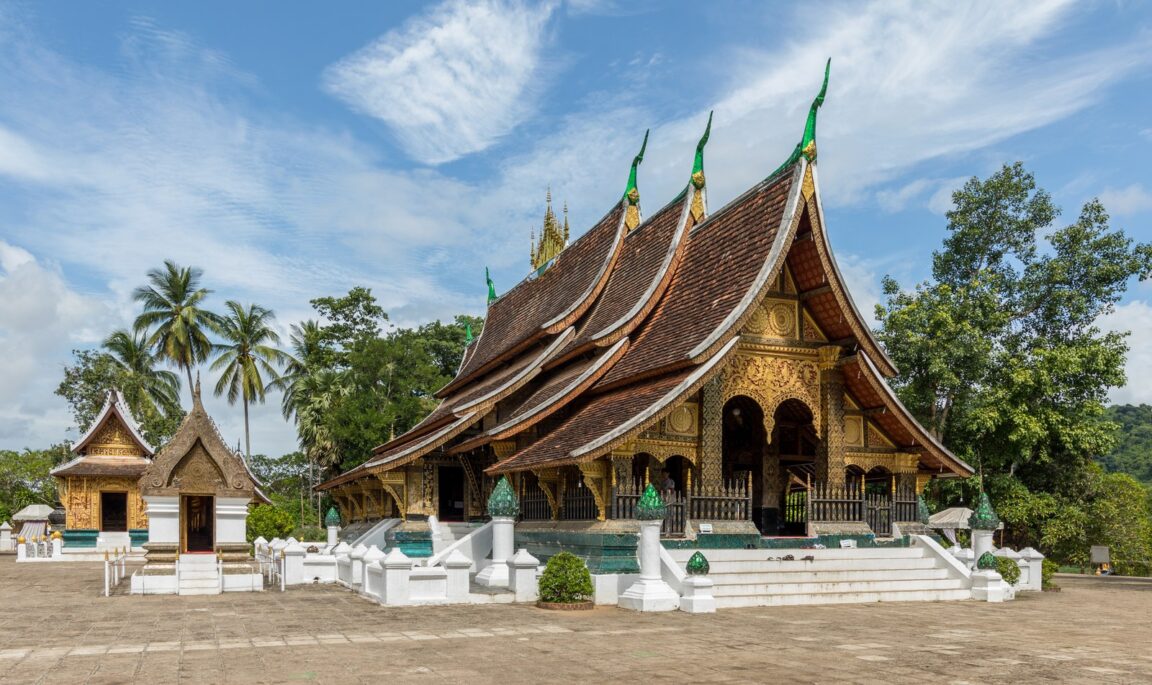
Start with Wat Xieng Thong, near the tip of the peninsula, built in 1560 and widely regarded as the most important temple in Luang Prabang. Its low, sweeping, layered roofs are the classic expression of local temple style, and its walls carry gilded stencilling and a striking mosaic of the tree of life. Give it an unhurried hour in the morning, when the light is soft and tour groups are fewer, and cover shoulders and knees as you would at any active temple in Laos.
From there, the peninsula unfolds in an easy sequence. The Royal Palace Museum, the former residence of the Lao royal family, explains the town’s 20th century history and houses the Phra Bang, the sacred Buddha image that gives the city its name. Wat Mai, next door, is known for its gilded relief facade. The Traditional Arts and Ethnology Centre, a small and excellent museum, provides the context that temple-hopping alone cannot: an introduction to the ethnic diversity of Laos, its textiles and its craft traditions, presented with unusual care. Late in the day, climb the roughly 330 steps of Mount Phousi, the hill at the centre of town, for sunset views across both rivers, and expect company, because everyone else has the same idea.
How do you visit Kuang Si Falls, and what else lies beyond town?
Kuang Si Falls, about 29 to 30 kilometres south of town and 45 to 60 minutes by tuk-tuk, shared minivan or private car, is the essential day trip. A main cascade drops through jungle into a chain of milky turquoise limestone pools, several of which are designated for swimming, linked by paths and small bridges. Go early, ideally arriving soon after the gates open in the morning, to swim and walk the upper tiers before the midday groups arrive. Near the entrance, a rescue centre cares for Asiatic black bears confiscated from the illegal wildlife and bile trades, and a short stop there adds necessary context to the beauty beyond it.
Bring swimwear, a towel, modest cover for the journey, and cash in kip for entry and transport. Respect the signs that close certain pools, both for safety and for religious reasons, and take every piece of litter back out with you. In the rainy season the falls run fuller and more dramatic but the paths grow slippery, while in the cool season the pools are at their clearest and most inviting.
The other classic excursion runs in the opposite direction: by boat up the Mekong to the Pak Ou Caves, about 25 kilometres upstream, where two grottoes in a limestone cliff hold thousands of Buddha figures left by pilgrims over centuries. The river journey is half the experience, passing fishing villages and steep green banks, and it pairs well with a stop at a riverside weaving or whisky-making village on the return, provided you buy thoughtfully and bargain gently.
What happens in the evening, and where do you eat?
Each evening the main street, Sisavangvong Road, closes to traffic and fills with the night market: rows of low stalls under warm light selling handwoven Lao textiles, scarves, paper lanterns, silverwork and wood carving. Prices are gentle and so is the bargaining, which here is a brief, friendly negotiation rather than a contest. Just off the main strip, a food alley serves the market’s best value dinner, with buffet-style stalls where a plate piled with Lao dishes, grilled river fish, sausages, sticky rice and salads costs only a few dollars.
Wider eating in town mixes Lao kitchens, bakeries left by the French era, and riverside restaurants along the Mekong and Nam Khan. Seek out laap, the national dish of finely chopped meat or fish with herbs and lime, or lam, a peppery stew associated with Luang Prabang itself, and khao soi in the local style, which here means a tomato and fermented soybean noodle soup quite different from the Thai version of the same name. Finish an evening early, as the town intends, and let the dawn start feel easy rather than punishing.
When should you go, and how do you get there and around?
The best season is November to February, the cool, dry period, when days are comfortable for temple walking and river trips, mornings can be surprisingly chilly, and the countryside is still green after the rains. March and April bring rising heat and, in many years, haze from agricultural burning in the surrounding hills. From May to October the rains return, peaking in mid-summer: waterfalls surge, visitor numbers fall, and travel takes more patience.
Most visitors arrive at Luang Prabang International Airport, code LPQ, about 4 kilometres from the old town, with regional flights from cities including Bangkok, Hanoi and Chiang Mai and domestic flights from Vientiane, though routes change frequently and should be checked at booking. The Laos-China Railway has transformed overland travel, linking Luang Prabang with Vientiane in around two hours, with the station outside town requiring a short transfer. The slow boat down the Mekong from the Thai border at Huay Xai takes two days and remains a beloved arrival for travellers with time. Inside town, walking covers the peninsula, bicycles suit the flat lanes, and tuk-tuks handle everything further, with prices agreed before you set off.
Allow three to four days. Two days can cover the temples, Phousi and Kuang Si at a push, but the third day, given to the river, a museum or simply a long breakfast and a second, slower look at a favourite temple, is when Luang Prabang tends to win people over.
Frequently asked questions
How many days do you need in Luang Prabang?
Three to four days is the sweet spot. That allows one day for the peninsula temples and Mount Phousi, one for Kuang Si Falls, one for a Mekong trip to the Pak Ou Caves, and breathing room for the night market and the museums.
What is the best month to visit Luang Prabang?
November to February offers the coolest, driest weather and the clearest conditions for temples, waterfalls and river cruises. December and January are the busiest months, so book accommodation early if you travel then.
Can you swim at Kuang Si Falls?
Yes, in the designated lower pools, which are clearly signed. Some pools are closed to swimming for safety or religious reasons, so follow the signs, and take care on wet limestone paths, especially in the rainy season.
Is it appropriate to photograph the alms ceremony?
Only from a respectful distance, without flash, and without blocking the procession or stepping close for a portrait. Many visitors choose to put the camera away entirely, which local guidance encourages. Silence and distance matter more than any photograph.
How far is the airport from the old town?
Luang Prabang International Airport is about 4 kilometres from the peninsula, roughly 10 to 20 minutes by tuk-tuk, shared shuttle or taxi depending on traffic. Agree the fare or confirm the shuttle price before you travel.