 Camille Baptiste
Trinidad Carnival is not a parade you watch from the pavement. It is a season you join, and the fastest way to miss the point is to fly in for Carnival Tuesday alone, watch the pretty costumes cross the stage, and fly out thinking you have seen it. Plan for the full arc instead: arrive in Port of Spain by the Friday before, hear Panorama on Saturday, watch Dimanche Gras on Sunday night, get up in the dark for J’Ouvert on Monday morning, and then play mas or follow the bands on Monday and Tuesday. For the next edition, Carnival Monday and Tuesday fall on 8 and 9 February 2027, the two days before Ash Wednesday on 10 February. The 2026 edition ran on 16 and 17 February 2026. Dates move every year because they are set by Easter, so always confirm against the National Carnival Commission calendar before you book.
Quick Facts
- Next dates: Carnival Monday 8 February and Carnival Tuesday 9 February 2027, Port of Spain, Trinidad
- Season start: Fetes, band launches and panyard rehearsals build from just after Christmas
- Key events: Panorama finals on Carnival Saturday, Dimanche Gras on Sunday night, J’Ouvert from around 4 a.m. on Carnival Monday
- Main stage: Queen’s Park Savannah, where bands cross and are judged
- To play mas: Register with a costume band months ahead; your package normally covers costume, security, music trucks and drinks on the road
- Official sources: National Carnival Commission (ncctt.org) and Visit Trinidad (visittrinidad.tt)
What is Trinidad Carnival, really?
Carnival in Trinidad grew out of two histories meeting in the street. French planters who arrived in the late 18th century held masquerade balls before Lent. Enslaved Africans, excluded from those balls, built their own celebrations around Canboulay, the processions linked to cane harvests and emancipation, with drumming, stick fighting and satirical masquerade characters that mocked the planter class. After emancipation, those street traditions became the heart of Carnival, and they still are. Calypso, soca and the steelpan, the national instrument of Trinidad and Tobago, were all forged in this festival. That history is the point a first timer needs to hold onto: the feathers are beautiful, but Carnival is also memory, competition, craft and commentary, made by communities over a whole year.
Understanding that changes how you plan. You stop asking only where the party is, and start asking who made the costume, which panyard the band rehearses in, and what the calypso lyrics are actually saying about the year just passed.
When should you arrive, and how long should you stay?
Arrive no later than the Friday before Carnival Monday, and stay until at least Ash Wednesday. That gives you the full final weekend, which is where the season concentrates its meaning. Panorama finals, the national steelpan competition, are traditionally held on Carnival Saturday at the Queen’s Park Savannah, when large steel orchestras with dozens of players perform arrangements they have rehearsed for weeks. Dimanche Gras follows on Sunday night, the grand show built around the King and Queen of Carnival costume competition and the Calypso Monarch. Sleep early that night if you can, because J’Ouvert starts in the dark.
If you have more time, come a week earlier. The fete season, the parties that fund and fuel the bands, runs for weeks, and panyards welcome visitors during rehearsals earlier in the season, when you can hear a Panorama tune being built section by section. That slower week is often what turns a good trip into an understanding one.
What happens at J’Ouvert?
J’Ouvert, from the French jour ouvert, meaning daybreak, officially opens Carnival in the early hours of Carnival Monday, traditionally around 4 a.m. Revelers take to the streets covered in mud, paint, oil, powder or chocolate, dancing behind steelbands and music trucks as the sky lightens. It is deliberately the opposite of Tuesday’s polished costumes: messy, funny, satirical and rooted in the oldest street traditions, including characters such as the jab molassie, the blue devil figure smeared in paint.
First timers have two choices. Join a J’Ouvert band, which provides a simple package, usually a T-shirt, paint or mud, drinks and security, and keeps you inside an organized group. Or watch from the edge of a main street in the early hours and join the flow as it passes. Either way, wear clothes and shoes you are prepared to throw away, seal your phone in a waterproof pouch, carry almost nothing, and agree a meeting point with your group in case you separate in the crowd.
How do costume bands and playing mas work?
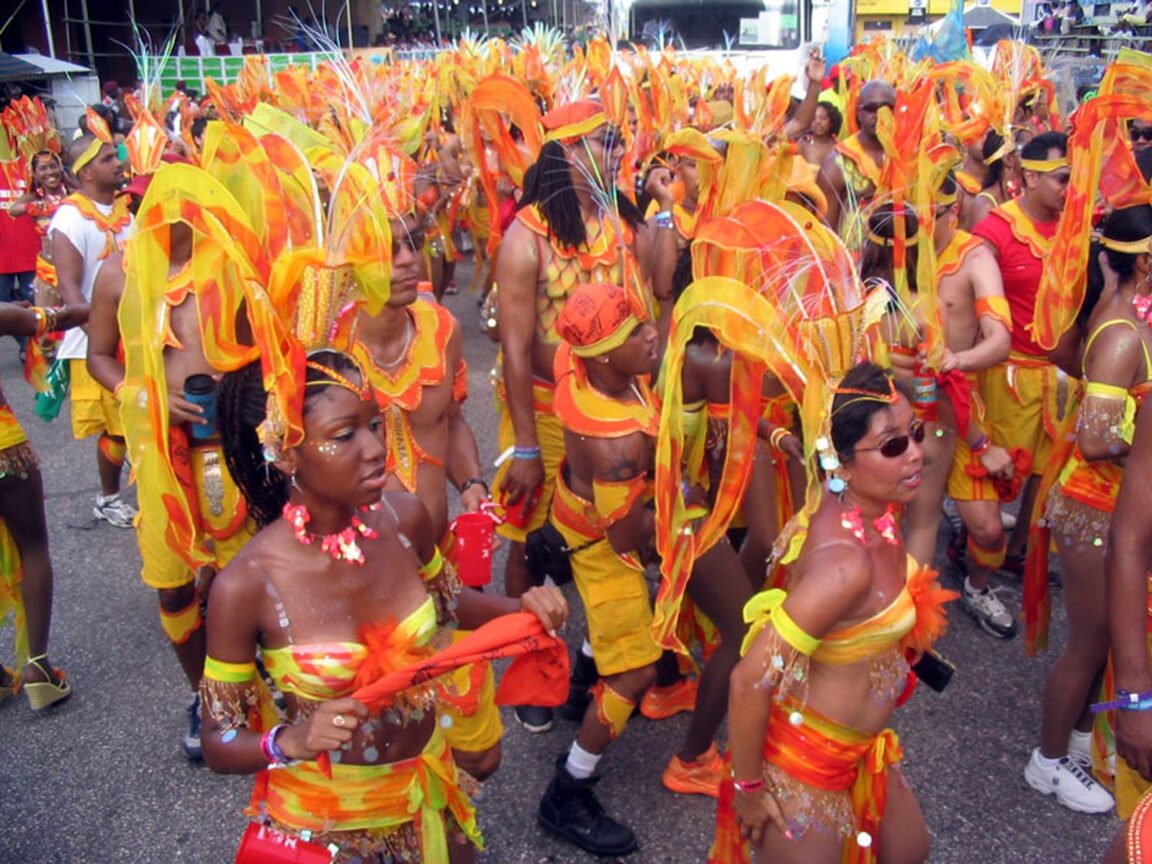
To play mas is to join a band. Bands are the costume organizations, some with thousands of members, that design a themed presentation each year, build the costumes in their mas camps, and parade across the Savannah stage and through the streets on Monday and Tuesday. Well known large bands in recent years have included Tribe, Bliss, Harts and The Lost Tribe, each with a different balance of glamour, artistry and traditional mas craft.
Registration opens months in advance, often in late summer or autumn, and popular sections sell out. Your fee buys the costume and the road experience: the music trucks, drinks, food stops, security and portable facilities that move with the band. Monday mas is usually more relaxed, with many masqueraders wearing a simplified version of the costume or band T-shirt. Tuesday is the full costume day, when the big King and Queen pieces and frontline costumes appear in full feather and beadwork. Budget honestly: between band registration, J’Ouvert, two or three fetes, flights and a hotel booked early, Carnival is a significant spend, and last minute decisions are the most expensive ones.
What are fetes, and how many should you book?
Fetes are the parties of the season, ranging from cooler fetes where you bring your own drinks, to all inclusive events with food and premium bars, breakfast fetes that end as the sun comes up, and boat rides off the coast. They are joyful, and they are also a trap for first timers: book too many and you will arrive at J’Ouvert already exhausted, having spent the weekend in parties that could happen anywhere, and miss the events that could only happen in Trinidad.
A balanced first year is two or three fetes across the whole stay, chosen for music and setting rather than hype, with Panorama and Dimanche Gras treated as non negotiable. Leave one evening completely empty. Carnival rewards people with energy left on Tuesday.
What should you not miss beyond the road?
Visit a panyard. The rehearsal yards of the great steel orchestras are open, working spaces where you can stand close to the pans, hear the engine room of a Panorama arrangement, and understand why the steelband is a community institution, not just an instrument. Go earlier in the evening, buy a drink, and listen more than you talk.
Seek out traditional mas as well as pretty mas. Characters such as the moko jumbie stilt walker, the midnight robber with his long theatrical speech, fancy sailors, bats and dame Lorraine figures carry stories that go back generations. The National Carnival Commission programmes traditional mas events during the season, and they are the clearest window into what Carnival meant before the feather backpack era. If festival culture approached respectfully is your kind of travel, our guide to Day of the Dead in Oaxaca makes a good companion read, as does our first timer guide to Edinburgh in August, another city that reorganizes itself around a festival season.
Where should you stay in Port of Spain?
Stay as close to the action as your budget allows: around the Queen’s Park Savannah, in Woodbrook, St Clair or central Port of Spain puts the stage, the mas camps and many fete venues within a short ride. Hotels fill months ahead for Carnival weekend and prices rise sharply, so book as soon as your dates are fixed, and confirm how road closures on Monday and Tuesday affect access to your hotel. Wherever you stay, plan your movements around the parade route rather than fighting it, and use drivers or shuttles your hotel recommends on the two big days.
Frequently Asked Questions
When is Trinidad Carnival 2027?
Carnival Monday is 8 February 2027 and Carnival Tuesday is 9 February 2027, with J’Ouvert in the early hours of Monday and Ash Wednesday on 10 February. Confirm final event timings on the National Carnival Commission calendar, as schedules are published closer to the season.
Do I have to join a band to enjoy Carnival?
No. Spectators can watch the bands cross the Savannah stage and line the streets for free, and J’Ouvert, Panorama and the fetes are open to ticket buyers. Joining a band is the fullest experience, but a well planned spectator weekend still delivers the music, the craft and the street energy.
How far ahead should I book?
Months ahead. Band registration for popular sections, Carnival weekend hotel rooms and the best known fetes all sell early. Flights into Port of Spain also fill. Treat booking as a late summer or autumn task for a February Carnival.
What is the difference between Monday mas and Tuesday mas?
Monday is the relaxed day: many masqueraders wear part of their costume or a band shirt, and the pace is looser. Tuesday is full costume day, when bands present their complete designs for judging, and the road is at its most spectacular.
Is J’Ouvert safe for a first timer?
Joining a registered J’Ouvert band is the most structured way to take part, with security and a defined group. As at any huge night street event, keep valuables minimal, stay with your group, and follow local guidance on routes and transport.
Dates and event details checked against National Carnival Commission and Visit Trinidad information on 10 November 2026. Carnival schedules are confirmed season by season, so recheck timings before you travel.