 LeVar Thomas
Cesky Krumlov is a fairytale town that rewards an overnight stay. Its UNESCO listed old town fills a tight horseshoe bend of the Vltava River in South Bohemia, beneath a vast castle with a painted round tower, and the way to see it without the day trip crowds is simple: arrive in the late afternoon as the tour buses leave, stay the night, and walk the old town early the next morning before the next wave arrives from Prague. That single decision, overnight instead of day trip, changes Cesky Krumlov from a crowded photo stop into one of the most atmospheric small towns in Central Europe.
Quick Facts
- Where: Cesky Krumlov, South Bohemia, Czechia, about 170 to 180 kilometres south of Prague, on both banks of the Vltava River
- UNESCO status: Historic Centre of Cesky Krumlov inscribed on the World Heritage List in 1992
- Castle: Founded in the 13th century, grown into a complex of around 40 buildings around five courtyards, described as the second largest castle complex in Czechia after Prague Castle
- Signature sight: The castle tower and old town seen from the castle grounds and bridges over the Vltava bends
- Getting there: Direct bus from Prague takes roughly 2 hours 45 minutes to 3 hours; trains usually require a change at Ceske Budejovice and take longer
- Best strategy: Stay at least one night, explore early morning and after late afternoon, and tour the castle interiors in the middle of the day
- Official planning sources: Cesky Krumlov official tourism information and the UNESCO listing
- Prices checked: November 2026. Castle tour routes, hours and admission change by season, so confirm on the official castle site before travel
Why Does Cesky Krumlov Look Like a Fairytale?
Geography explains the look. The Vltava loops around the old town in a deep meander, then loops again around the castle rock and the Latran quarter on the opposite bank, so water, bridges and steep lanes define every view. UNESCO describes the historic centre as an outstanding example of a small Central European medieval town whose architectural heritage has remained intact thanks to peaceful evolution over several centuries. Gothic, Renaissance and Baroque houses stand side by side on lanes that still follow the medieval plan, many with painted facades and sgraffito decoration, and almost no modern building interrupts the rooflines inside the old town.
Above it all stands the castle. Founded in the 13th century and expanded under successive noble families, most famously the Rozmberks and later the Schwarzenbergs, it stretches along the rock in a long sequence of courtyards. Its round tower, decorated with Renaissance painting, is the image most visitors carry home, but the scale only becomes clear on foot: this is not a single palace but a small fortified town in itself, with its own theatre, gardens, bear moat and bridge. Understanding that scale is the first reason to allow more than a few hours here.
How Do You See It Without the Day Trip Crowds?
The crowd pattern is predictable, and that makes it beatable. Most visitors arrive from Prague between late morning and early afternoon, concentrate on Namesti Svornosti, the main square, the castle bridge and the best known viewpoints, and leave by late afternoon. In peak summer the centre can feel shoulder to shoulder in those middle hours. Overnight visitors experience a different town twice a day: in the early evening, when restaurants fill with people who are staying rather than rushing, and in the early morning, when deliveries and local life have the lanes almost to themselves and the light on the river bends is at its best.
Use the busy middle hours deliberately. That is the time for ticketed, capacity controlled experiences that crowds affect less: a guided castle interior route, the Castle Museum, a museum in the old town such as the Egon Schiele Art Centrum, or a longer lunch away from the main square. Save the old town wandering, the tower climb and the classic viewpoints for before about 10 in the morning or after about 4 in the afternoon. Visiting outside July and August helps as well. May, June, September and October keep most services running with noticeably lighter pressure, while winter is quiet and atmospheric, though some castle routes and businesses reduce hours or close, so check listings carefully for those months.
If you are building a wider first trip in Europe, compare this approach with our first time Paris itinerary, where the same early and late strategy unlocks famous places, and our 3 days in Vienna itinerary, another Central European capital that pairs naturally with Prague and South Bohemia in a single journey.
What Should You See Inside the Castle?
Castle interiors are visited on guided routes at set times, and routes, languages and hours vary by season, so book through the official castle channels and arrive knowing which route you want. The main routes cover state rooms that trace the castle’s growth from Gothic fortress to Renaissance and Baroque residence. Even if interiors do not usually hold your attention, one route is worthwhile here because it explains who built the town below and why it looks as unified as it does.
Two castle experiences deserve special mention. The Baroque theatre, completed in 1766, is one of the best preserved Baroque theatres in Europe, with original stage machinery, sets and costumes surviving to an unusual degree. Access is by specific guided visits and can be limited by conservation and performance work, so treat it as a bonus to check for rather than a guarantee. The castle gardens, laid out beyond the theatre, offer the opposite pleasure: open space, formal planting, a revolving auditorium in summer and a quieter view back over the complex. The Castle Museum and tower, which can usually be visited independently of the guided interior routes, give the clearest overview of the town plan, so they work well early in a stay.
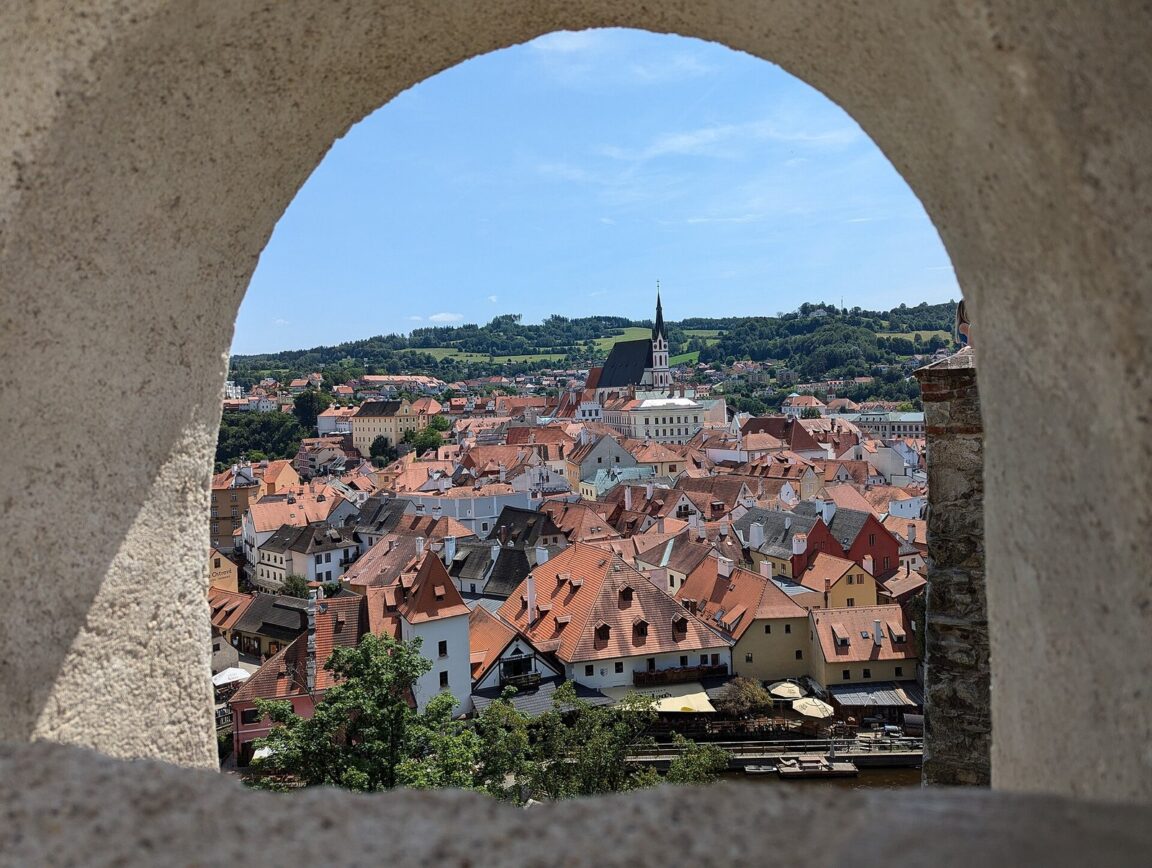
Do not miss the walk itself. Crossing the Cloak Bridge, the multi level covered bridge that links parts of the castle over a deep cut in the rock, and looking down through its arches to the river, is one of the great small moments in Czech travel. From the castle terraces the old town’s red roofs fill the river bend below in a view that explains, at a glance, why the town was listed as a whole rather than for any single building.
What Is There to Do in the Old Town and Latran?
The old town inside the river bend is made for slow wandering. Namesti Svornosti, the sloping main square, has arcaded houses, a Marian plague column and the town hall, and it is a useful orientation point rather than a place to linger at midday. From there, lanes radiate toward the river in every direction, each a slightly different mix of galleries, small museums, cafes and workshops. The Church of St. Vitus, the Gothic parish church whose spire balances the castle tower in skyline views, anchors the southern part of the old town.
Cross the river to Latran, the quarter that grew up below the castle, for a second, distinct atmosphere. Latran street leads up toward the castle gates past painted houses, the former church of St. Jost and the Budejovice Gate, the only surviving town gate of its kind here. This is also a good area for dinner, with restaurants a street or two away from the busiest old town lanes. In summer, rafting and canoe trips on the Vltava pass right through the town and offer a completely different perspective, looking up at the castle and old town from the water. Operators, water conditions and seasons vary, so book locally through the official visitor information channels and treat any trip as weather dependent.
Should You Visit as a Day Trip From Prague or Stay Overnight?
Stay overnight if you possibly can. The arithmetic alone argues for it: the journey from Prague takes roughly three hours each way by road, and usually longer by train with a change at Ceske Budejovice, so a day trip spends about as long in transit as in the town, and the hours in town coincide exactly with peak crowds. An overnight stay costs little extra time overall, removes the rush, and gives you the two best windows of the day, early morning and evening, that day visitors never see.
If a day trip is truly all you have, make it work harder. Take the earliest practical direct bus from Prague, go straight to the castle for a morning route and the tower, walk the old town in the early afternoon while accepting the crowds on the main lanes, and explore side streets, where pressure drops within a minute of the square. Eat a late lunch rather than an early one to avoid the noon peak, and take a later bus back than the first wave of departures. Direct buses run by operators such as RegioJet and FlixBus are generally the simplest day trip option; trains are more scenic in places but the change at Ceske Budejovice and the walk from Cesky Krumlov station, which sits outside the centre, add time and effort. Check current timetables and fares with the operator for your exact date rather than relying on any guide’s snapshot.
Where Should You Stay and Eat?
Stay inside the old town or Latran if your budget allows, because location is the whole strategy of this trip: being able to walk out before breakfast into empty lanes is the benefit you came for. Small hotels and guesthouses in converted historic houses dominate the supply, with rooms that vary widely in size and stair access, so read property details carefully, especially for step free access, parking and luggage help, none of which should be assumed in a medieval building. Staying just outside the centre, near the bus station, lowers prices and eases parking while keeping the walk in manageable.
Eating follows the same crowd logic. Restaurants on and near the main square cater heavily to the midday day trip trade. A street or two away, and in Latran, you will find quieter places serving Czech staples such as roast meats, dumplings, soups and river fish, alongside Italian and international options. In the evening, when overnight visitors are the main audience, the whole town eats at a more relaxed pace, and booking a table for dinner in peak season is a sensible precaution.
Frequently Asked Questions
How long do you need in Cesky Krumlov?
One night and parts of two days is the ideal minimum. That allows a castle interior route, the museum and tower, the gardens, unhurried old town walks in the quiet hours and an evening in town. A day trip of five to six hours covers the highlights but only at the busiest time of day.
What is the best way to get from Prague to Cesky Krumlov?
For most visitors, a direct bus is simplest, at roughly 2 hours 45 minutes to 3 hours. Trains usually require a change at Ceske Budejovice and take around 3 hours 15 minutes or more, plus a walk or local transfer from the station. Driving takes roughly 2 hours 30 minutes in good conditions. Always confirm the timetable for your date.
When is Cesky Krumlov most crowded?
Late morning to mid afternoon in June, July and August is the peak, when day trip arrivals concentrate on the main square, castle bridge and viewpoints. Early mornings and late afternoons are far quieter in every season, and May, June, September and October offer a good balance of open services and lighter crowds.
Do you need to book castle tours in advance?
In peak season, yes, booking a specific castle route and time in advance through official channels is strongly recommended, as popular times and languages sell out. The Baroque theatre has especially limited access. Outside peak season, same day tickets are more often available, but hours and routes are reduced.
Is Cesky Krumlov suitable for children?
Yes, with realistic expectations. The castle grounds, tower views, river setting and gardens hold children’s attention well, while long guided interior routes may suit older children better. Cobbles, steps and steep lanes make sturdy footwear and care with strollers important.
Sources: UNESCO World Heritage Centre, Historic Centre of Cesky Krumlov, Cesky Krumlov official tourism information and the official Cesky Krumlov Castle site. Tour routes, hours and transport timetables were checked in November 2026 and should be reconfirmed before travel.