 Rafael Santos
Puebla is a colonial city founded in 1531 in a high valley southeast of Mexico City, famous for three things that define a visit: facades covered in Talavera tiles, a historic center recognized by UNESCO in 1987 that is anchored by its Zocalo and cathedral, and the Battle of Puebla on 5 May 1862, when Mexican forces under General Ignacio Zaragoza defeated a French army, the victory that Cinco de Mayo commemorates. Add one of Mexico’s great regional cuisines, the birthplace legends of mole poblano and chiles en nogada, views toward the Popocatepetl and Iztaccihuatl volcanoes on clear mornings, and the giant pyramid at nearby Cholula, and Puebla becomes far more than a day trip: it is one of the most complete historic city visits in the country.
Quick Facts
- Founded: 1531, as a Spanish colonial city on the route between Mexico City and the port of Veracruz
- Historic center: Inscribed on the UNESCO World Heritage List in 1987, with thousands of listed historic buildings around a grid of colonial streets
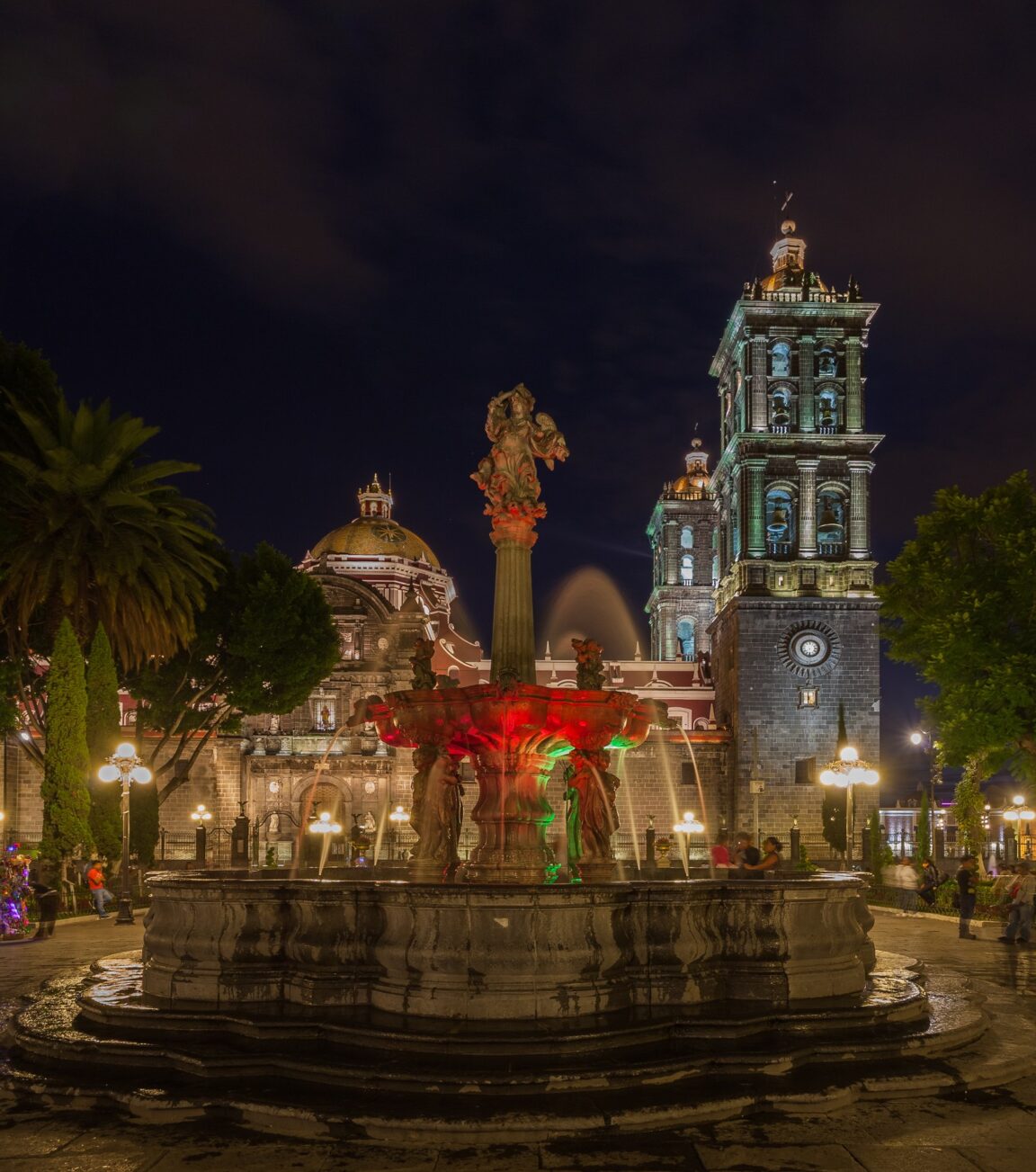
- Centerpiece: The Zocalo, the main square, facing Puebla Cathedral, consecrated in 1649, with the San Miguel fountain at its center
- Signature craft: Talavera pottery and tiles, produced in Puebla workshops for centuries and protected by a denomination of origin for authentic Puebla Talavera
- Historic date: 5 May 1862, the Battle of Puebla, when General Ignacio Zaragoza’s Mexican forces defeated French troops at the forts of Loreto and Guadalupe
- Famous library: Biblioteca Palafoxiana, founded in 1646 and regarded as the first public library in the Americas
- Signature dishes: Mole poblano and chiles en nogada, both wrapped in Puebla origin legends, plus cemitas and tacos arabes for everyday eating
- Setting: A high altitude valley with views, in clear conditions, to the Popocatepetl and Iztaccihuatl volcanoes, and the town of Cholula and its Great Pyramid a short drive away
Why does Puebla look the way it does?
Most great colonial cities in Mexico grew on top of older settlements. Puebla was planned. Founded in 1531 on open ground between indigenous towns, it was laid out as a model Spanish city of straight streets, a central plaza and lots assigned in an orderly grid, and it prospered as the staging point on the royal road between the capital and Veracruz, the port where goods and people moved between New Spain and Europe. Wealth from trade, textiles and agriculture paid for churches, convents and merchant houses on a scale that still startles: the historic center holds thousands of catalogued buildings from the sixteenth to the nineteenth centuries, which is the substance behind the UNESCO inscription of 1987.
The detail that makes Puebla instantly recognizable is on the walls. Local clay, Spanish and indigenous ceramic traditions and tile making that drew on influences carried across the Spanish world produced Talavera: glazed tiles and pottery in blue and white and later in rich polychrome, set into facades, domes, kitchens and courtyards across the city. Church domes glitter with tile. House fronts around the center carry whole panels of it. The effect, street after street, is a city that wears its craft on its skin, and it is why a simple walk in Puebla delivers more visual information than a formal tour in many other places. Travelers coming from the capital should pair this guide with a Mexico City food guide for the wider regional picture, because the two cities explain each other: the capital as the vast metropolis, Puebla as the carefully built second city that fed, supplied and sometimes rivalled it.
How should a first visit work around the Zocalo?
Start where the city starts: the Zocalo. Puebla’s main square, shaded and arcaded, is both the geographic center and the social one, with the cathedral occupying its southern side and the municipal palace and cafe arcades, Los Portales, framing the rest. Puebla Cathedral deserves unhurried time. Consecrated in 1649 and completed over the following decades, it is one of the great churches of colonial Mexico, with twin towers among the tallest in the country, a severe Herrerian influenced facade, and an interior that holds major works of New Spanish art, including its celebrated choir stalls, organs and the Altar of the Kings. As an active cathedral it is a place of worship first, so visits should be timed and dressed accordingly, and photography rules inside should be followed as posted.
From the Zocalo, the essential sights sit within a few blocks in every direction. Two blocks away stands the Biblioteca Palafoxiana, founded in 1646 by Bishop Juan de Palafox y Mendoza, who donated his collection on the condition it be open to anyone who could read: the act that makes it regarded as the first public library in the Americas. Its three tiers of wooden shelves, holding tens of thousands of volumes in a single beautiful room inside the Casa de la Cultura, offer one of the most memorable interiors in Mexico. Nearby, the Rosario Chapel inside the Santo Domingo church is the city’s baroque showpiece, a chapel so dense with gilded stucco work that it was once promoted as a wonder of the New World. The Amparo Museum, in colonial buildings a short walk south, is the city’s best general museum, with strong pre-Hispanic and colonial collections presented to a modern standard. None of this requires transport, a guide, or a schedule tighter than a morning.
What is Talavera, and how can travelers tell the real thing?
Talavera in Puebla is both a technique and a protected name. Authentic Talavera de Puebla is made from local clays, formed, glazed with a tin based glaze and hand painted with mineral pigments, then fired, following processes rooted in the colonial period. Because imitations are everywhere, Mexico protects genuine Puebla Talavera with a denomination of origin, and certified workshops mark their pieces accordingly. The practical guidance for buyers follows from that. Buy from established workshops and their own shops, where pieces carry the workshop’s mark and the maker can explain the process: names with long histories in the city include Uriarte Talavera, in production since the nineteenth century, among others. Expect real pieces to cost real money for the labor in them, and expect small variations: hand painted work is not identical, piece to piece, and that is evidence of the process, not a flaw.
For travelers who do not intend to buy, Talavera is still a highlight, because the city itself is the gallery: tiled facades, the Talavera covered kitchen of the Santa Rosa convent where tradition places the creation of mole poblano, and workshop visits that show the painting stage up close. A tile panel shipped home needs proper packing and a conversation about luggage; workshops that sell to visitors are used to both, and shipping arrangements should be agreed in writing before payment.
What really happened on Cinco de Mayo?
Cinco de Mayo is widely misunderstood outside Mexico, so Puebla, where it happened, is the right place to learn it properly. It is not Mexican Independence Day: independence is celebrated on 16 September, marking the start of the independence movement in 1810. Cinco de Mayo commemorates a battle. In 1862, a French expeditionary force, sent in an intervention that would soon try to install an empire in Mexico, marched inland from Veracruz. On 5 May 1862, Mexican forces under the young General Ignacio Zaragoza, outnumbered and defending the hilltop forts of Loreto and Guadalupe above Puebla, repelled the French attacks. France later returned with greater force and took the city, so the victory was not the end of the war. It was, however, a profound symbolic defeat of a European power by a Mexican army, and it is commemorated most seriously in Puebla itself, where the forts are now museums in a park overlooking the city and where the date is a major local civic occasion.
Visiting the Zona Historica de los Fuertes, the forts district, completes a Puebla trip in a way the center cannot. The museums in and around the Loreto and Guadalupe forts explain the battle and the French intervention, the views show exactly why the high ground mattered, and the surrounding parkland is where poblanos themselves go to walk and exercise. Travelers in Mexico in early May should expect parades and commemorations in Puebla and plan accommodation accordingly; travelers at other times of year get the museums and the viewpoint largely to themselves.
What should visitors eat in Puebla?
Puebla’s kitchen is one of Mexico’s foundational regional cuisines, shaped by convents, markets and the meeting of indigenous ingredients with Spanish techniques. Two dishes carry the city’s name around the world. Mole poblano is the famous one: a deep, complex sauce of dried chiles, spices, nuts, seeds and a little chocolate, served most classically over turkey or chicken with sesame seeds. Tradition credits the nuns of the Santa Rosa convent with its creation, and like all great food legends it should be enjoyed as tradition rather than audited as fact. Chiles en nogada is the beautiful one: a poblano chile stuffed with a sweet savory picadillo of meat, fruit and nuts, covered in a walnut cream sauce and scattered with pomegranate seeds and parsley, in the green, white and red of the Mexican flag. It is seasonal, tied to the walnut and pomegranate harvest in late summer and early autumn, and Puebla during that season is one of the great food pilgrimages in Mexico.
Everyday eating is just as rewarding. The cemita is Puebla’s signature sandwich, a sesame topped roll filled with milanesa or other meats, quesillo cheese, avocado and papalo herb, sold at market stalls and cemita specialists across the city. Tacos arabes, spit roasted pork served in a pita style bread, tell the later story of Lebanese immigration to Puebla, and their rolled descendants, tacos al pastor, conquered the whole country. The markets, above all the traditional food stalls in and around the center, and the sweet shops of the Calle de los Dulces near Santa Clara, selling camotes and other convent sweets, make grazing a legitimate sightseeing strategy. Wine travelers extending a Mexico trip west can connect this food first approach with the Valle de Guadalupe wine guide for a very different, coastal expression of modern Mexican eating and drinking.
What about the volcanoes and Cholula?
Puebla sits in a valley watched over by volcanoes, and on clear mornings, most often in the drier months and early in the day, the snow capped cone of Popocatepetl and the long silhouette of Iztaccihuatl dominate the western horizon. Popocatepetl is an active volcano, monitored by Mexican authorities, with access restrictions that must be respected absolutely: views are the experience for visitors, not approaches to the crater, and any visit toward the national park area should follow current official guidance. The volcanoes are best treated as Puebla’s backdrop and compass, photographed from the forts district or a rooftop at breakfast, not as a hiking objective.
Cholula, by contrast, is a trip to make. A short drive or local transport ride west of the center, the town of Cholula is home to the Great Pyramid, the largest pyramid by volume in the world, built over centuries by pre-Hispanic peoples and now appearing as a grass covered hill crowned by the church of Nuestra Senora de los Remedios, built in the colonial period. Visitors can enter tunnels excavated through the pyramid’s interior and walk the surrounding archaeological zone, then explore Cholula’s own churches, market and university town energy. Half a day is the minimum; the pyramid, the views back to the volcanoes from the church atrium, and lunch in Cholula make an easy full day.
Frequently Asked Questions
How many days does Puebla need?
Two full days cover the historic center, a Talavera workshop, the forts district and the main dishes. Add a third day for Cholula at a relaxed pace, or for the chiles en nogada season, when meals deserve scheduling of their own.
Is Puebla a day trip from Mexico City?
It can be, and buses between the two cities are frequent, but a day trip compresses a city that rewards slow walking and long lunches. One or two nights in the historic center is the better structure whenever the itinerary allows.
Is Cinco de Mayo a big celebration across Mexico?
No. It commemorates the 1862 Battle of Puebla and is observed most seriously in Puebla itself. Mexican Independence Day, on 16 September, is the nationwide patriotic celebration.
When is chiles en nogada season in Puebla?
Late summer into early autumn, when fresh walnuts and pomegranates are harvested. Exact weeks vary by year and harvest, so travelers planning around the dish should check with restaurants close to the trip.
Can travelers see Popocatepetl up close?
Popocatepetl is an active volcano with official access restrictions. Visitors should enjoy it as a viewpoint subject from the city and follow current guidance from Mexican civil protection and park authorities for any excursion toward the area.
Practical closing notes for Puebla
Stay inside the historic center, within a few blocks of the Zocalo, so that the cathedral, the Palafoxiana Library, the Rosario Chapel and the best eating are all a walk away. Start sightseeing early, when the light is good for the tiled facades and the volcanoes may still be visible, and give the long midday meal the respect Puebla’s cooks expect. Buy Talavera from certified workshops, not from the cheapest stall, and climb to the forts before leaving the city. Puebla does not need embellishment or hurry. It built its reputation over five centuries of cooking, crafting and, on one May morning in 1862, defending itself, and it rewards travelers who meet it at its own pace.