 Priya Nair
Soneva Fushi is the original barefoot luxury resort in the Maldives, set on Kunfunadhoo Island in the Baa Atoll, a UNESCO Biosphere Reserve, and built around a simple, radical philosophy the resort calls No News, No Shoes: shoes come off on arrival, the island’s jungle is left dense and wild, and very large villas hide among the trees a few steps from the beach, alongside a small collection of overwater reserves with slides into the lagoon. It suits travelers who want space, privacy, and a real island with a house reef, rather than a polished sandbank with a hotel on it, and this guide explains the villa choice, the seaplane arrival, and who should book a different Maldives resort instead.
Quick Facts
- Location: Kunfunadhoo Island, Baa Atoll, Maldives, a UNESCO World Biosphere Reserve, per Soneva’s official site
- Island: About 1,400 by 400 metres, described by Soneva as one of the largest island resorts in the Maldives, with dense natural foliage between villas
- Philosophy: No News, No Shoes, the resort’s founding barefoot luxury ethos, with a Barefoot Butler assigned to each villa, per the official site
- Accommodation: Beach villas and suites set among the trees, Crusoe villas and suites, family suites, large multi bedroom beach estates, and Water Reserves over the lagoon, many with private pools and some with slides, per the official villa pages
- Access: About 30 minutes by seaplane from Velana International Airport in Male direct to the resort, or a domestic flight to Dharavandhoo Airport followed by a 12 minute speedboat ride, per the official journey guide
- Rates note: This guide quotes no nightly rates. Soneva pricing varies sharply by season, villa, and package, so check the live rate for your exact villa and dates on soneva.com
What makes Soneva Fushi different from other Maldives resorts?
Most Maldives resorts are built on small islands where the resort is the island, every path is manicured, and the villas line the beach at regular intervals. Kunfunadhoo is different in scale and in intent. The island is large by Maldivian standards, the interior is genuine jungle, and the villas are set back inside that greenery, so the walk from a front door to the sand passes through trees rather than past neighbours. Soneva, founded by Sonu and Eva Shivdasani, opened Fushi in the 1990s as the first of its resorts and the place where its whole language of barefoot luxury, sustainability, and slow, spacious island living was worked out. Other resorts have since adopted pieces of that language. Fushi remains the original, and it feels it: established, confident, and noticeably less interested in gloss than in shade, space, and sea.
The Baa Atoll setting is the other half of the difference. The atoll was designated a UNESCO Biosphere Reserve for the richness of its reefs and its seasonal marine life, and the resort’s house reef runs along the island, so snorkelling begins from the beach rather than from a boat. Travelers comparing Indian Ocean private islands will find a useful contrast in our guide to The Brando on Tetiaroa, a similarly conservation led private island resort built at a smaller, more formal scale in French Polynesia.
How does the arrival actually work?
The seaplane, and its hard daylight rule
Transfers are arranged by the resort’s reservations team. The recommended route, per Soneva’s official journey guide, is a seaplane from Velana International Airport in Male direct to Soneva Fushi, a flight of approximately 30 minutes over the atolls. Two facts govern every itinerary. Seaplanes fly only in daylight, because they take off and land on water, and the last seaplane leaves Male at 17:00, so the resort advises arriving in Male by 15:30 at the latest for a same day seaplane connection. The standard seaplane baggage allowance is 25 kilograms per person including hand luggage, per the same guide, which is a real constraint for a long, villa based stay and worth planning luggage around rather than discovering at the seaplane terminal.
The alternative, and the late arrival plan
The second route is a domestic flight from Male to Dharavandhoo Airport, the local airport for the atoll, followed by a 12 minute speedboat ride to the resort. Domestic flights run later, with the last departure listed by the resort at 23:15, which makes this route the answer for evening international arrivals who would otherwise lose a night in Male. On landing at Fushi, the No News, No Shoes ritual begins, shoes are surrendered, and each villa’s Barefoot Butler takes over the practical running of the stay, from bicycles to bookings, which is the resort’s personal butler service under its island name.
What are the villas like, and which type should you choose?
Beach villas, Crusoe villas, and family suites
The core of Fushi is its beach accommodation, set within the island’s natural greenery, in the official site’s phrasing, with pathways winding through the trees to spaces that open easily to the outdoors. The range runs from one bedroom beach hideaways and the castaway styled Crusoe villas and suites, through Soneva Fushi villas and villa suites with private pools, to family suites designed with separate sleeping areas for children. The consistent themes across the official descriptions are space, outdoor living, shaded gardens, and seclusion that feels natural rather than designed. Choose this side of the island for shade, for direct beach access in bare feet, and for the classic Fushi experience the resort was founded on.
Water Reserves, with slides
Reached by jetty and set above the lagoon, the Water Reserves are Fushi’s overwater category, in one to four bedroom forms, including sunset facing versions. The official descriptions emphasise sweeping lagoon views, wide decks, private pools, and, in the signature detail, a slide from the villa directly into the clear water below. They are expansive and playful, and they trade the jungle privacy of the beach villas for horizon, light, and immediate lagoon swimming. Families with older children tend to be their natural audience, along with anyone for whom overwater living is the point of a Maldives trip.
Estates and residences for groups
At the top of the range, the beach estates and residences run to three, four, six, and nine bedroom forms on the official villa list, with generous pools and flowing indoor outdoor living areas hidden among tropical gardens near the shoreline. These are private houses in all but name, aimed at multi generational families and groups who want one shared base with resort service behind it. The practical advice across all categories is the same: on an island this green, villa position matters, sunrise or sunset side, distance to the reef and the main facilities, and how much garden stands between you and the beach, so study the resort map and ask the reservations team direct questions before choosing.
What do you actually do all day?
Fushi days organise themselves around the reef, the table, and rest. Snorkelling on the house reef is the daily default, with diving and boat excursions into the wider Baa Atoll, a biosphere reserve known for rich reef life, arranged through the resort. On land, the island itself is the activity: bicycles along sand paths, long lunches, spa and wellness treatments under the resort’s Soneva Soul programme, which the official transfer pages reference for resort credit redemption, and evenings that end early and quietly, in keeping with the no news half of the philosophy. Dining is spread across the island in a collection of restaurants and bars rather than concentrated in one room, and the resort’s materials consistently present food, much of it grown or sourced with its sustainability programme in mind, as a central pleasure rather than a facility.
Families are a core audience, not an afterthought: the family suites, the large estates, the lagoon slides, and the island’s safe, car free sand paths all point the same way. Couples, meanwhile, get their version of the island through the Crusoe villas, the sunset Water Reserves, and the sheer amount of private space per villa. Both audiences should understand the trade the island makes: entertainment here is nature, sea, food, and quiet, and there is no nightlife scene to speak of, by design.
Who does Soneva Fushi suit best?
It suits travelers who measure luxury in space, shade, reef quality, and service rather than in marble and formality, and who will happily go barefoot for a week. It suits families who want a large, safe, natural island where children can roam, cycle, and slide into a lagoon, with suites and estates that genuinely fit a family. It suits snorkellers and divers who value a biosphere reserve address and a house reef at the end of the garden. And it suits repeat Maldives visitors who have done the polished sandbank resort and want the wilder, greener original instead. Travelers weighing it against a South Pacific splurge can compare the villa logic here with Kokomo Private Island in Fiji, another large villa, reef first resort with a very different cultural setting.
Who should book somewhere else?
Travelers who want a small, sleek, design led resort with a short transfer should look elsewhere: Fushi requires a seaplane, keeps daylight hours, and hides its buildings in jungle rather than displaying them. Travelers who dislike sand paths, insects, and real tropical greenery will find the island’s wildness a drawback rather than the point. Anyone whose international flight lands in Male in the evening must either accept the domestic flight and speedboat route or lose the first night, so itineraries that cannot flex should be planned around the 15:30 seaplane advice from the start. And value, in any conventional sense, is not the offer: this is among the Maldives’ most expensive resorts, rates are highly seasonal and package dependent, and the honest procedure is to price your exact villa and dates on the official site, including transfers, before comparing it with anything else.
What should you check before booking?
Four checks do most of the work. First, the transfer fit: your international arrival and departure times against the seaplane daylight rule and the domestic alternative, confirmed with the reservations team. Second, the villa position and category, beach or overwater, sunrise or sunset side, and the distance to the reef entry and main restaurants. Third, what your package includes, since dining, experiences, and Soneva Soul treatments are treated differently across rates, and resort credits carry exclusions the resort itself spells out. Fourth, the season, for both weather and marine life, since a biosphere reserve trip is partly a wildlife trip and the atoll’s famous seasonal gatherings follow their own calendar. Pack light within the 25 kilogram seaplane allowance, bring reef safe sun protection and very little footwear, and leave the rest to the island. On Kunfunadhoo, that is rather the point.
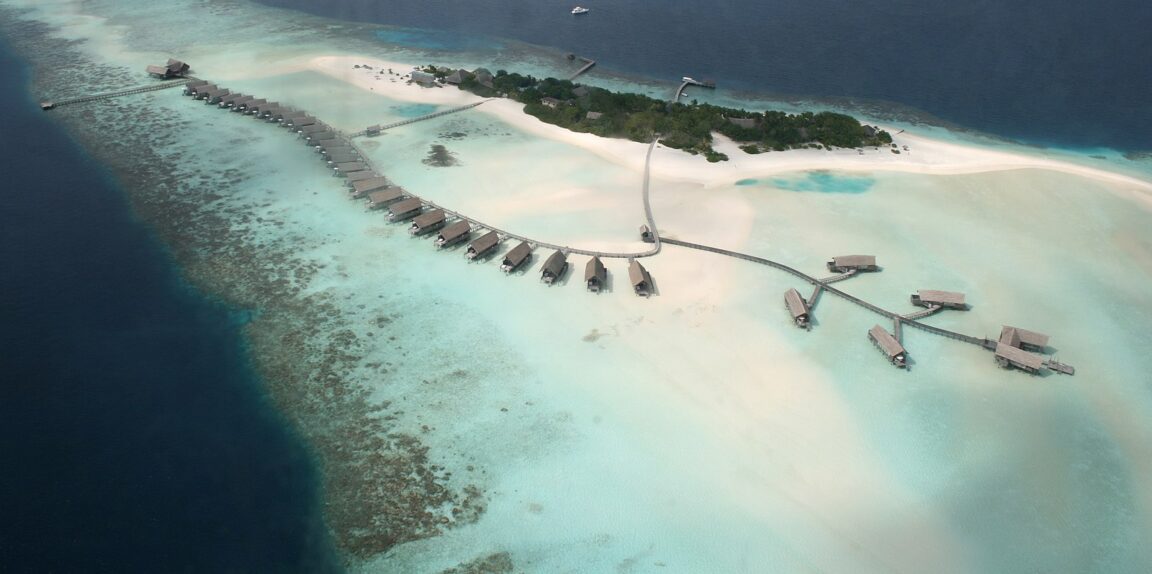
Image: An aerial view of a small island on a coral reef in the Maldives, the Baa Atoll setting of Soneva Fushi. No licensed photograph of the resort itself is available on Wikimedia Commons, so this package uses a captioned image of its Maldives reef island setting, not the property. Facts checked against soneva.com, the resort’s official site, in November 2026.