 LeVar Thomas
Two days in Salzburg are enough for the essential city if the order is right: spend day one in the old town on the left bank of the Salzach, with Mozart’s Birthplace on Getreidegasse in the morning, the cathedral quarter at midday, and Hohensalzburg Fortress above the rooftops in the late afternoon, then use day two for the Mozart Residence and Mirabell Gardens across the river, a clear eyed decision about The Sound of Music, and one excursion, to Hellbrunn Palace or up the Untersberg, rather than trying to do both. Salzburg is compact, heavily visited, and built for walking, so the plan below protects the mornings, keeps the two Mozart houses separate, and treats the film locations as an optional half day, not the reason the whole trip bends out of shape.
Quick Facts: Salzburg in 2 Days at a Glance
- Where: Salzburg, Austria, on the Salzach River near the German border, with an old town on both banks beneath the Monchsberg and Festungsberg hills.
- Historic centre: Inscribed by UNESCO as a World Heritage Site, recognised for its baroque old town and its long association with music.
- Mozart: Wolfgang Amadeus Mozart was born in Salzburg in 1756, at Getreidegasse 9, and lived in the city until he left for Vienna in 1781.
- The fortress: Hohensalzburg Fortress, begun in 1077, is one of the largest medieval castle complexes in Europe and the city’s defining landmark.
- Bases: The old town for a first visit and maximum walkability, or the New Town side around Mirabell for slightly calmer streets a short walk from the bridges.
- Itinerary shape: Day 1, old town, Mozart’s Birthplace, cathedral quarter, fortress. Day 2, Mozart Residence, Mirabell, the Sound of Music decision, and one excursion.
- Last checked: November 11, 2026.
How Is Salzburg Laid Out?
The Salzach River does the organising. On the left, southern bank sits the Altstadt, the old town of narrow lanes, church towers, and squares that most visitors picture: Getreidegasse, the cathedral, Residenzplatz, and the fortress rising directly behind. On the right, northern bank is the Neustadt, the newer town in relative terms, holding Mirabell Palace and Gardens, the Mozart Residence on Makartplatz, and the main station further north. Bridges link the two sides every few minutes of walking, so a two day plan can treat the city as one walkable core with a river through it, and no part of this itinerary needs a car.
The sights divide naturally by bank, which is why this plan gives each bank its own morning instead of zigzagging across the river. The vertical city matters too: the fortress looks down on everything, and its views are part of the visit, not an extra. Travelers who like a compact core sequenced by the clock will recognise the structure from our 3 days in Lisbon itinerary.
Day 1 Morning: Getreidegasse and Mozart’s Birthplace
Start on the shopping street that is also a museum row
Begin on Getreidegasse, the old town’s most famous lane, known for its wrought iron guild signs projecting over the street, its narrow passages through to courtyards, and its tall, tight houses. Come early, before the day groups fill it, and walk it slowly once end to end. At number 9, the bright yellow house is Mozart’s Birthplace, the Geburtshaus, where the composer was born on January 27, 1756, and where the Mozart family lived until 1773. The museum inside, run by the Salzburg Mozarteum Foundation, spreads across the family’s former rooms and presents instruments, portraits, letters, and the rooms of a prosperous Salzburg household of the period, including the small violin Mozart played as a child.
How long, and what order?
Allow around an hour inside the Birthplace, more for devoted listeners who read everything. The honest sequencing advice is to do this house first and the Residence tomorrow: the two museums tell one life in two halves, birth and childhood here, the family’s later, larger home across the river there, and splitting them by a day keeps each visit fresh. From Getreidegasse, continue into the adjoining lanes, Alter Markt with its old pharmacy and small square, and Judengasse toward the river, rather than retracing the same street.
Day 1 Midday: The Cathedral Quarter
The DomQuartier brings together the cathedral, the Residenz, and the abbey and museum collections around Domplatz and Residenzplatz in one combined visit, and it is the right midday anchor: largely indoors, central, and the best single explanation of the prince archbishops who ruled Salzburg and employed the Mozarts, father and son. Salzburg Cathedral itself, the Dom, is the early baroque church where Mozart was baptised and where he later served as court organist, rebuilt in the 17th century on a site of much older churches. Stand in Domplatz for the scale of the facade, then go inside for the cool, ordered interior before deciding how much of the wider DomQuartier circuit to add.
Lunch in the old town lanes, keeping it simple: the centre is full of bakeries, coffee houses, and traditional inns, and a two day trip gains more from a rested lunch than from another sight squeezed into the busiest hour. Coffee house time is not a detour in Austria, a point our 3 days in Vienna itinerary makes at greater length.
Day 1 Late Afternoon: Hohensalzburg Fortress
Why the fortress takes the late slot
Hohensalzburg Fortress has watched over Salzburg since 1077, when Archbishop Gebhard founded the first castle on the Festungsberg during the Investiture Controversy, and it grew over the following centuries into one of the largest fully preserved castle complexes in Europe. It was never taken by force, which is why its state rooms, walls, and museums survive in such completeness. Late afternoon suits it for the same reasons it suits fortresses everywhere in this programme: the stone has cooled, the light over the old town and out toward the mountains is at its best, and the day groups have thinned.
Getting up, and what to see
The FestungsBahn funicular, one of Austria’s oldest railways of its kind, climbs from Festungsgasse in the old town in about a minute, and walking up the steep path is the slower, free alternative for the fit. Inside, prioritise three things: the Prince’s Chambers, the richly decorated late Gothic state rooms of the archbishops, the Fortress Museum for the building’s military and everyday history, and the ramparts and Reckturm tower for the panorama, over the cathedral towers and the Salzach to the Untersberg and the Alps beyond. The fortress site notes that it can be visited with the Salzburg Card, and that the funicular and the Prince’s Chambers are included once with the card, a detail worth weighing in the practical section below.
Day 1 Evening: Music in the City That Sells It
Salzburg evenings run on concerts, from fortress concerts above the city to chamber performances at Mirabell. With only two nights, choose one concert, book it once dates are fixed, and let the other evening stay loose for dinner and a walk through the lit old town. Traditional Austrian cooking, dumplings, schnitzel, and the local Stiegl beer are the safe and satisfying default for day one.
Day 2 Morning: The Right Bank, Mirabell and the Mozart Residence
Cross the Salzach after breakfast to Makartplatz, where the Mozart Residence, the Wohnhaus, stands. The Mozart family moved here in 1773, into a larger and more comfortable house than the Getreidegasse apartment, and Wolfgang lived here on and off until his move to Vienna. The building was largely destroyed in the Second World War and later rebuilt, reopening as a museum in 1996, and its displays cover the family’s Salzburg years, Mozart’s instruments and composing, and the famous dance hall of the house. Seen the day after the Birthplace, it reads as a second chapter rather than a repeat.
From Makartplatz it is a short walk to Mirabell Palace and Gardens, laid out in the early 17th century for a prince archbishop and remodelled in baroque style in the 18th century. The gardens are free to enter, formal, and intensely photogenic: the great parterre, the Pegasus fountain, the dwarf garden of historic stone figures, and the view back across the flower beds to the fortress, which is the single most composed view in the city. Mirabell also opens the Sound of Music question, because its gardens are where the film’s Do Re Mi sequence reaches its steps, and that question deserves its own honest section.
The Sound of Music Decision, Made Properly
What the film connection actually is
The Sound of Music, released in 1965 and filmed largely in and around Salzburg, turned the city into a pilgrimage site for the film’s admirers, and the industry around it is substantial: bus tours, bike tours, and walking tours visiting locations including Mirabell Gardens, Leopoldskron Palace across the lake from which the von Trapp home was filmed, Hellbrunn Palace, where the gazebo now stands, Nonnberg Abbey, and Mondsee, the lakeside town whose church hosted the film’s wedding. The real von Trapp family history, their villa in Aigen, and the film’s story differ in many details, and Salzburg itself treats the phenomenon with a certain distance, since the film was never the local success it became in the English speaking world.
So should a two day visitor do a tour?
Decide by affection, not by obligation. If the film is a genuine love, take a dedicated half day tour on day two afternoon and give it proper time: the locations are scattered well beyond walking distance, which is precisely what the tours solve, and fans consistently rate the experience highly. If the film is a mild pleasure, skip the tour and collect the two locations already inside this itinerary, Mirabell Gardens and the Hellbrunn gazebo if the excursion below is chosen, at no extra cost in time. If the film means nothing, Salzburg loses nothing: the city underneath it, baroque, musical, and alpine, is the stronger attraction. What not to do is compress: a rushed film tour squeezed against the fortress and both Mozart houses makes all three worse.
Day 2 Afternoon: One Excursion, Chosen Well
Option A: Hellbrunn Palace and its trick fountains
Hellbrunn, a short bus ride south of the centre, is the summer palace built in the early 17th century for Prince Archbishop Markus Sittikus, famous above all for its trick fountains: water jokes engineered into seats, tables, grottoes, and figures, demonstrated on guided tours through the gardens, which run seasonally. It is playful where the fortress is solemn, pairs naturally with the Sound of Music gazebo in its grounds, and suits families and anyone whose day two needs lightness. Check the seasonal opening before building the afternoon around it, since the fountain tours do not run year round.
Option B: The Untersberg cable car
The Untersberg, the flat topped mountain on the city’s southern edge, is reached by bus to the valley station and then by cable car to the summit station, with walking trails and a panorama from the Dachstein to the Salzkammergut lakes in clear weather. It suits travelers who want the Alps inside a city break and who have the weather for it: in low cloud the summit is a grey room, so make this the fair weather choice and Hellbrunn the all weather one. Either excursion returns to the city in time for a final evening walk and dinner in the New Town or along the river.
Where to Stay for a 2-Day Visit
The old town suits first timers who want every sight in this itinerary on foot and the fortress overhead at breakfast, in hotels that range from historic inns on the lanes to larger properties along the river edge. The New Town side, around Mirabell and Linzergasse, suits travelers who want slightly calmer streets, easy station access, and the same walkability across the bridges, often at gentler prices. The station district itself is the practical, least atmospheric option, defensible only for a very early departure. In peak summer and during the Salzburg Festival, when the whole city becomes a stage and rooms are at their scarcest, book as early as the trip is certain: festival weeks transform both prices and availability.
Practical Notes: The Salzburg Card, Getting Around, and Timing
The Salzburg Card is the city’s official sightseeing card, sold for set periods, bundling one time admission to most major sights, the fortress funicular, and public transport. On this itinerary, where the fortress, both Mozart houses, and the DomQuartier all sit on the card’s list, it commonly pays for itself, but do the arithmetic against the current card price and the individual admissions on the official sites before buying, since both change. The centre itself needs no transport pass at all for most visitors: it is walked, end to end, in under half an hour. Salzburg Airport serves the city from a short bus ride away, and the main station connects by rail to Vienna, Munich, and Innsbruck in times that make Salzburg an easy two day module inside a longer Austria or Bavaria trip.
Frequently Asked Questions
Are two days enough for Salzburg?
Yes, for the city itself. Two sequenced days cover the old town, both Mozart houses, the cathedral quarter, the fortress, Mirabell, and one excursion. A third day is the point at which a full Sound of Music tour or a Salzkammergut lake trip fits without compression.
Which Mozart house should be visited if there is time for only one?
The Birthplace on Getreidegasse, for the birth room, the childhood instruments, and the original family apartment. The Residence is the better second visit, covering the family’s later years in a rebuilt house.
When should Hohensalzburg Fortress be visited?
Late afternoon, for cooler stone, fewer groups, and the best light over the old town, or first thing in the morning in peak summer. The funicular from Festungsgasse takes about a minute, and the walk up is the free alternative.
Is a Sound of Music tour worth it on a two day trip?
Only for genuine fans, as a dedicated half day. The film locations are scattered far beyond the walkable centre. Casual viewers can see Mirabell Gardens and, at Hellbrunn, the gazebo inside the normal itinerary instead.
Is the Salzburg Card worth buying for two days?
Often, yes, because this itinerary uses several of its included admissions, the fortress, both Mozart houses, and the DomQuartier among them, plus the funicular and transport. Compare its current price with the individual admissions on the official sites before deciding.
What is the best excursion if only one fits?
Hellbrunn Palace for its trick fountains in most weather and seasons when the tours run, and the Untersberg cable car on a clear day for the alpine panorama. Choose by the forecast on the morning of day two.
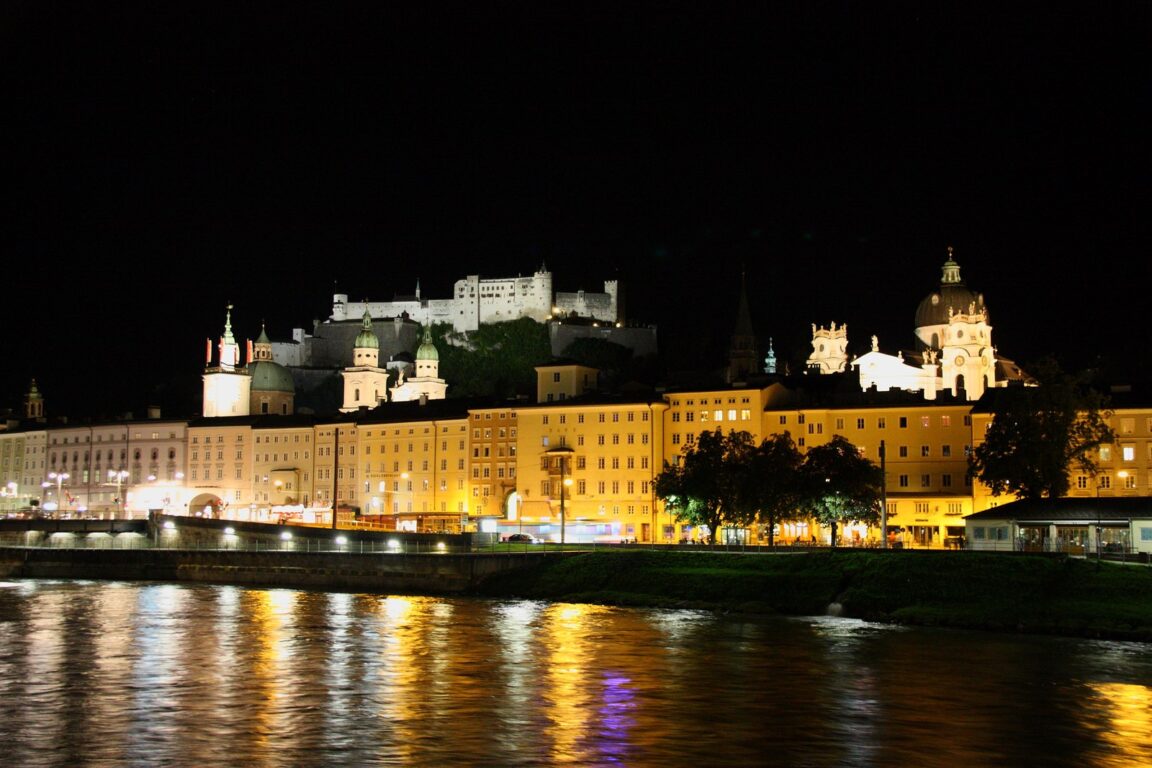
Image: Hohensalzburg Fortress above the Salzach at night, Salzburg. Facts checked against salzburg.info, the Mozarteum Foundation, and the fortress operator in November 2026.