 Thandiwe Nkosi
Yes, Stone Town deserves nights of its own, and not just a half day squeezed in before a flight home. Give it at least two nights, three if history is the point of the trip. The old town of Zanzibar City, on the west coast of Unguja island off mainland Tanzania, is a UNESCO World Heritage Site built from coral stone, carved timber and centuries of Indian Ocean trade, and it works on a different clock from the beach resorts: early mornings in the markets, slow afternoons in shaded lanes, and evenings on the seafront at Forodhani Gardens. Travelers who only pass through on a day trip see the doors and the waterfront. Travelers who stay get the slave market memorial at opening time, the spice stalls before the heat builds, and a town that is still a living Swahili city rather than a museum.
Quick Facts: Stone Town at a Glance
- Where: Stone Town, the historic quarter of Zanzibar City, on the western coast of Unguja, the main island of the Zanzibar Archipelago, Tanzania.
- Heritage status: Inscribed on the UNESCO World Heritage List in 2000, under criteria covering cultural fusion, centuries of seaborne trade between Africa and Asia, and the history of the slave trade and its suppression.
- Known for: Ornate carved wooden doors, coral stone merchant houses, the House of Wonders, the Old Fort, Darajani Market, and the former slave market site now marked by the Anglican Cathedral.
- How long: Two nights minimum to do the town justice, three for a spice farm excursion and an unhurried second day.
- Best rhythm: Sightsee early, retreat from the midday heat, and return to the seafront for the Forodhani Gardens food stalls in the evening.
- Pair it with: A beach stay elsewhere on Unguja, or another historic old town from our wider coverage, such as the walled port in our Kotor travel guide.
- Last checked: November 11, 2026.
Why Does Stone Town Deserve More Than a Beach Day Trip?
Most Zanzibar itineraries treat Stone Town as an arrival or departure chore: a night near the airport, a rushed walking tour, then the beach. That sequencing undersells the place badly. Stone Town is not an add-on to a Zanzibar holiday. It is the reason the island has a name known around the world at all, the port from which cloves, ivory and enslaved people were shipped across the Indian Ocean, and the capital from which Omani sultans ruled a maritime empire. The beaches, beautiful as they are, could belong to many tropical islands. This town belongs only here.
Staying overnight also fixes the two practical problems of the day trip. The first is timing: the former slave market deserves a quiet hour rather than a place in a midday procession, and the markets are at their most alive in the morning. The second is atmosphere. Stone Town after dark, when the Forodhani stalls are lit along the seafront, is a local evening out rather than a sightseeing shift.
What Makes Stone Town a UNESCO World Heritage Site?
UNESCO inscribed the Stone Town of Zanzibar on the World Heritage List in 2000. Its statement of value rests on three ideas. First, the town is an outstanding material expression of cultural fusion: African, Arab, Persian, Indian and European influences layered into one Swahili coastal trading town, visible in everything from mosque architecture to the brass studs on a merchant house door. Second, its buildings and street plan illustrate, in exceptional form, the centuries of intense seaborne trading activity between Asia and Africa. Third, Zanzibar carries great symbolic importance in the suppression of slavery, because it was one of the main slave trading ports in East Africa and also a base from which opponents of the trade, including David Livingstone, campaigned against it.
On the ground, that means a remarkably intact old town: a dense maze of narrow lanes between tall coral stone houses, many built in the eighteenth and nineteenth centuries. There is no single monument that explains Stone Town. The heritage is the whole fabric: the lanes, the baraza stone benches where neighbors sit and talk, the mosques, temples and churches within a few streets of each other, and the carved doors.
The Carved Doors: How to Read Stone Town’s Most Famous Detail
What do the carvings and brass studs mean?
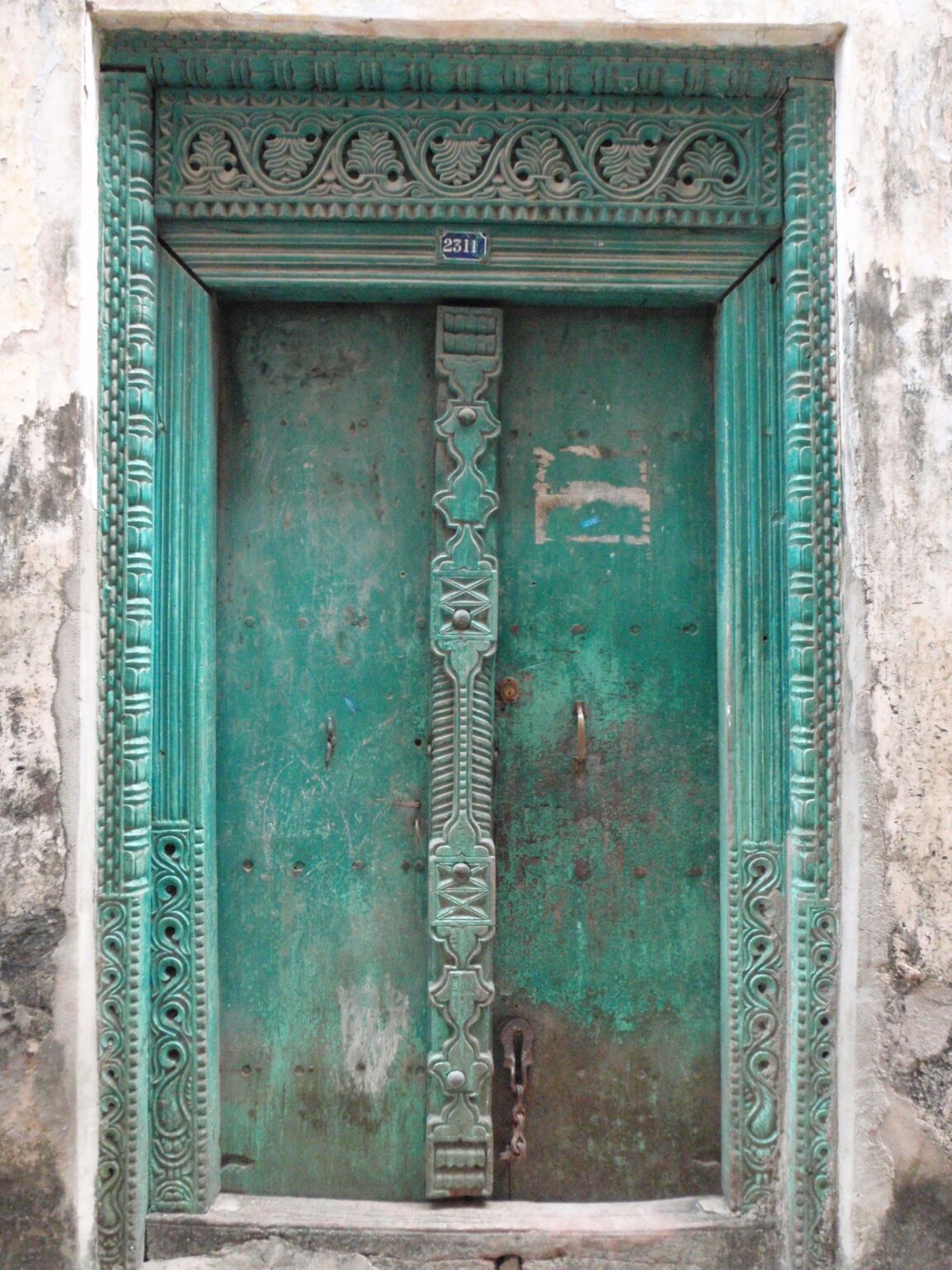
The carved wooden doors are the signature of Stone Town, and they reward close looking. They fronted the houses of wealthy merchants, and their size and ornament announced the standing of the household behind them. Two broad traditions meet in them. Doors in the Arab style tend to be rectangular, with geometric carving and, in some cases, inscriptions. Doors shaped by Indian craftsmanship more often carry elaborate floral work and rounded tops, and the heavy brass studs found on many Zanzibari doors descend from an Indian tradition in which such spikes were fitted to doors as a defense against elephants. In Zanzibar there were no war elephants to repel, so the studs became pure statement, a borrowed symbol of strength and status.
The motifs carved into the frames carry meaning too. Chains, fish, vines, flowers and geometric borders recur from door to door, read variously as signs of security, prosperity and faith. Not every door is old, and carving remains a living craft in the town, but the finest historic examples cluster in the older quarters, and a slow morning walk with no fixed destination is the best way to find them. Photograph from the street, and remember that most of these doors are still the entrances to private homes and businesses, not exhibits.
The Seafront: House of Wonders, the Old Fort and Forodhani Gardens
Why is it called the House of Wonders?
The House of Wonders, or Beit al-Ajaib, is the largest and tallest building in Stone Town, standing on Mizingani Road facing the Forodhani Gardens on the seafront. It was built in 1883 for Barghash bin Said, the second Sultan of Zanzibar, as a ceremonial palace and official reception hall, and it was a deliberate showpiece of modernity. It was the first building in Zanzibar to have electricity, and it had the first elevator in East Africa, marvels that explain its name. Its wide verandas carried on slender cast iron columns still give the waterfront its profile. The building has suffered serious structural problems in recent years, including a major partial collapse of the facade and clock tower in December 2020 during restoration work, so plan to admire it from the gardens and check its current status locally rather than counting on an interior visit.
What is the Old Fort, and what happens there now?
Next to the House of Wonders stands the Old Fort, known in Swahili as Ngome Kongwe. Built by Omani Arabs soon after they expelled the Portuguese in 1699, it is generally described as the oldest building in Stone Town, raised to defend the town against a Portuguese return. Across its long life it has served as a garrison, a prison and a railway depot. Today its high brown walls enclose a courtyard used for craft stalls, cultural offices and an open air amphitheatre that hosts major events, including the Zanzibar International Film Festival and the Sauti za Busara music festival. It is an easy, low effort visit that pairs naturally with the House of Wonders across the gardens.
Between the fort and the sea, Forodhani Gardens is where Stone Town spends its evenings. As the light fades, food stalls set up along the waterfront serving grilled seafood and Zanzibari street food to a crowd that mixes residents and visitors. Agree the price at the stall before your order goes on the grill.
The Former Slave Market and the Anglican Cathedral: Visiting the Hardest History
No honest guide to Stone Town can treat this site as one stop among many. Zanzibar was one of the principal slave trading ports of East Africa, and the Stone Town market was among the most notorious, a place through which enslaved people captured on the mainland were held and sold for shipment across the Indian Ocean and to the island’s own clove plantations. The market was closed in 1873. On its site, construction of the Anglican Cathedral of Christ Church began in the 1870s under Edward Steere, the third Bishop of Zanzibar, a deliberate act of replacement: a church where the whipping post and auction had stood, with the altar traditionally placed on the site of that post.
The visit today combines the cathedral with the preserved slave chambers nearby and an exhibition on the East African slave trade. The chambers, low stone cells below ground where enslaved people were held before sale, are the most confronting part of the site, and they should be. Go early in the day, take the guided interpretation offered on site rather than walking through quickly, and allow the visit its proper weight. UNESCO’s inclusion of the suppression of slavery among the reasons for inscription underlines the point: this history is not a footnote to Stone Town’s beauty. It is central to what the town was, and to what its wealth cost.
Spice Markets and the Trade That Named an Island
Where do you see the spice trade today?
Zanzibar’s other identity is the Spice Island, earned in the nineteenth century when the Omani Sultanate made Stone Town its capital and clove planting transformed the islands. Cloves had been introduced to Zanzibar in the 1820s, and Unguja and neighboring Pemba went on to produce a dominant share of the world’s supply, alongside cinnamon, nutmeg, cardamom, black pepper and vanilla. The wealth that built the carved doors and palaces came substantially from this trade, and, as the slave market makes clear, the plantation economy that produced the spices rested on enslaved labor. The two trades cannot be separated, and good interpretation in Stone Town does not try to.
The living end of the spice story is Darajani Market, the town’s main covered market, where sacks and stalls of cloves, cinnamon bark, cardamom and dried chilies sit alongside fish, fruit and everyday goods in a working market that serves residents first. It is busy, pungent and best in the morning. Small spice packets sold here and in the lanes around the market make the most portable souvenir in town, but the fuller experience is a half day spice farm excursion into the countryside beyond Stone Town, where the plants themselves, clove trees, cinnamon bark stripped from the branch, vanilla vines, nutmeg fruit, can be seen, smelled and tasted where they grow. Book through your hotel or a licensed local operator, confirm what the tour includes before paying, and treat it as the essential second day activity that justifies the third night.
How Many Nights, and How to Shape the Days
Two nights is the honest minimum: one full day for the historic core and one evening on the seafront, with the slave market, cathedral, Darajani Market, the Old Fort and the House of Wonders exterior all comfortably walkable in a single unhurried circuit. Three nights adds the spice farm half day and, just as valuable, slack: a second morning for door hunting in the lanes, time in the small museums and shops, and no need to choose between sites. Travelers whose main interest is the beach can reverse the usual order and end the trip here, since Stone Town sits close to the island’s ferry port and airport connections, making it a practical final stop before departure.
However many nights you give it, shape each day around the heat. Start early for the cathedral site and the market, spend the middle of the day somewhere shaded and slow, and come back out in the late afternoon for the waterfront and Forodhani. Dress with the town in mind: Zanzibar is predominantly Muslim and Stone Town is a conservative, residential city as well as a visitor destination, so covered shoulders and knees away from the beach are the respectful baseline, and swimwear belongs at the beach resorts, not in these lanes. Travelers used to planning old town days in other trading cities, from the souks covered in our 2 days in Marrakech itinerary to the ports of the Adriatic, will recognize the pattern: the maze is the attraction, getting mildly lost is part of the method, and a local guide for the first half day repays itself in orientation and in history you would otherwise walk straight past.
Frequently Asked Questions
Is Stone Town worth staying in, or just visiting from a beach resort?
Staying is worth it. A day trip compresses the town into its hottest, busiest hours and misses both the early morning markets and the evening at Forodhani Gardens. Two nights inside the old town changes Stone Town from a tour into a place you understand.
How many days do you need in Stone Town?
One full day covers the historic core: the former slave market and Anglican Cathedral, Darajani Market, the Old Fort, and the House of Wonders from the seafront. Add a second day for a spice farm excursion and unhurried exploration of the lanes, which makes three nights the comfortable stay.
Why is Stone Town a UNESCO World Heritage Site?
UNESCO inscribed Stone Town in 2000 for its outstanding expression of cultural fusion, for the way its architecture and street plan illustrate centuries of seaborne trade between Africa and Asia, and for Zanzibar’s symbolic importance in the history and suppression of the East African slave trade.
What is the House of Wonders, and can you go inside?
The House of Wonders, built in 1883 for Sultan Barghash bin Said, is Stone Town’s largest and tallest building, famed as the first in Zanzibar with electricity and the first in East Africa with an elevator. It suffered a major partial collapse in December 2020 during restoration, so treat it as an exterior landmark and check its current status when you arrive.
What should you buy in Stone Town?
Spices are the classic purchase: cloves, cinnamon, cardamom and vanilla from Darajani Market and the shops around it, sold in small packets that travel well. Carved wood and kangas and kikois cloth are the other traditional buys. Agree prices before paying, as bargaining is normal in the market lanes.
When is the best time of day to visit the former slave market?
Go in the morning, soon after opening, when the cathedral site and preserved slave chambers are quieter and the guided interpretation has more time for you. It is the most important visit in Stone Town, and it deserves an unhurried hour rather than the end of a hot afternoon.