 James Wolfe
Adelaide earns its nickname, the 20-minute city, honestly: the airport, the beach at Glenelg, the Adelaide Hills and almost everything in between sit within about twenty minutes of the central grid, and the city centre itself is a walkable square mile wrapped in park lands. Add the Central Market for breakfast, North Terrace for museums, a free tram ride to the sea, and three of Australia’s best known wine regions within day-trip range, and Adelaide becomes the Australian city that asks the least effort and gives back the most calm. This guide explains how the layout works, where to spend the hours, and how to use the tram and the wine country like a local would.
Quick Facts: Adelaide at a Glance
- Where: Capital of South Australia, on the Adelaide Plains between the Mount Lofty Ranges and Gulf St Vincent.
- Known for: A planned grid city ringed by park lands, the Adelaide Central Market, the Glenelg tram, and easy access to the Barossa Valley, McLaren Vale and Adelaide Hills wine regions.
- Getting around: The centre is flat and walkable. The tram runs from the Adelaide Entertainment Centre through the city to Glenelg, and travel on the city section is free.
- Best base: The central grid near Rundle Mall or North Terrace for first-timers; Glenelg for a beach-first stay.
- Day trips: Barossa Valley, McLaren Vale, Adelaide Hills and the Fleurieu Peninsula coast.
- Last checked: November 11, 2026.
Why Does Adelaide Call Itself the 20-Minute City?
The nickname comes from the city’s founding plan and its modest scale. Adelaide was laid out in the 1830s as a neat grid of wide streets and squares, North Adelaide across the River Torrens and the centre south of it, with a broad belt of park lands separating the city from its suburbs. That green ring still exists, and it keeps the centre compact: Victoria Square in the middle, four other squares in the grid, and no point in the centre more than a short walk from open park. Because the city never sprawled the way Sydney or Melbourne did, distances stay short. The airport is a brief drive west of the centre, the beach suburbs begin just beyond it, and the foothills rise immediately to the east. Twenty minutes is a slogan, but it is a slogan the map supports.
How the Centre Is Organised
First-timers should picture two anchors. King William Street runs north to south through Victoria Square and divides the grid. North Terrace, at the northern edge, is the cultural boulevard: the railway station, the Art Gallery of South Australia, the South Australian Museum, the State Library, the Botanic Garden and the university line up along it, most of them free to enter and easy to combine into one slow morning. Rundle Mall, a few streets south, is the shopping spine, a pedestrian mall opened in 1976 and still the busiest retail strip in the state, with the Adelaide Arcade cutting through it. Between those two anchors sit the cafes of Rundle Street’s east end, the laneway bars around Peel Street and Leigh Street, and Chinatown beside the Central Market in the southwest of the grid.
The Central Market: Start With Breakfast
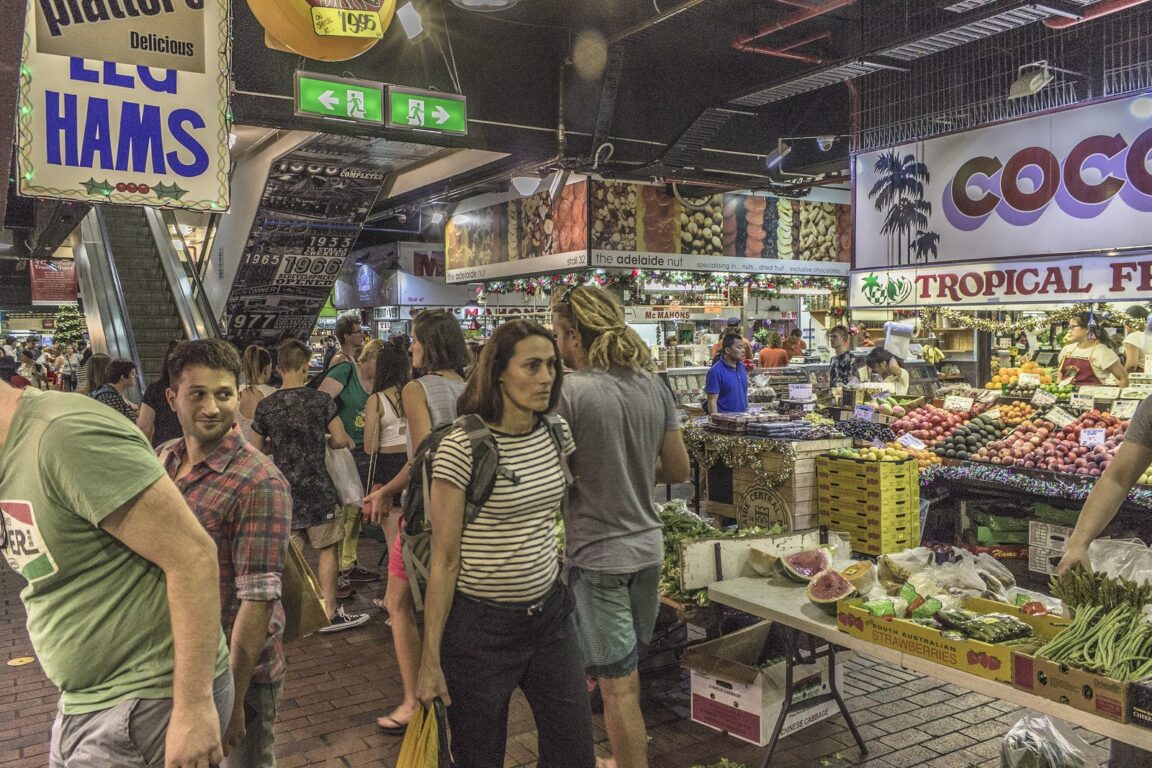
The Adelaide Central Market has traded on its Grote Street site since 1870, and it remains the city’s edible heart: more than 70 stalls under one roof selling South Australian produce, cheese, smallgoods, bread, coffee, flowers and ready-to-eat food from the state’s many migrant traditions. It sits beside Chinatown and the Market Plaza food court, so a market morning slides naturally into a dumpling lunch. Go early for the full theatre of deliveries and stallholders setting up, graze rather than committing to one big meal, and treat the market as the cheapest education in what South Australia grows and makes. Trading days and hours vary through the week and the market closes on some days, so check the current schedule before planning a dawn visit around it. Travelers who build trips around markets will find the same pleasure, at a very different scale, in the hawker centres described in our 2 days in Singapore itinerary.
The Tram to Glenelg: The City’s One Perfect Ride
Adelaide kept exactly one tram line when other Australian cities ripped theirs out or built whole networks, and that restraint is part of the charm. The Glenelg line runs from the Entertainment Centre in Hindmarsh, down North Terrace and King William Street, through Victoria Square, and then on its own corridor southwest to Glenelg, the city’s original beach suburb on Holdfast Bay. Travel within the city zone is free, which makes the tram a hop-on shuttle between North Terrace, the market precinct and Victoria Square as well as the beach train. At Glenelg, Moseley Square opens straight onto the jetty and the sand, with cafes along Jetty Road behind it. The ride reframes the 20-minute claim better than any statistic: one vehicle, no changes, from museum boulevard to sea.
North Terrace and the Park Lands
A first visit should give North Terrace half a day. The Art Gallery of South Australia holds a strong Australian collection including significant Aboriginal and Torres Strait Islander art, the neighbouring South Australian Museum is known for its Aboriginal cultures galleries and its natural history, and the State Library’s Mortlock Wing is worth entering for the room alone. The Adelaide Botanic Garden, at the eastern end, folds 50 hectares of themed planting into the park lands and pairs well with the National Wine Centre at its edge. The park lands themselves are not a backdrop but a facility: running loops, sports fields, the River Torrens linear trail and picnic lawns, all within minutes of the hotels. Adelaide Oval, just across the river in the park lands, runs stadium tours and a roof climb for travelers who want the city’s sporting cathedral with a view back over the grid.
Wine Regions: Three Directions, Three Personalities
The Barossa Valley
Northeast of the city, roughly an hour by road, the Barossa is Australia’s most famous wine valley, settled by Silesian Lutheran communities in the 19th century and home to some of the oldest continuously producing Shiraz vines in the world. Tanunda, Angaston and Nuriootpa anchor a day of cellar doors, bakeries and the Barossa Farmers Market on Saturday mornings. This is the headline day trip and the one to book if only one wine day fits.
McLaren Vale and the Fleurieu
South of the city, around 45 minutes, McLaren Vale trades the Barossa’s formality for a Mediterranean ease: Shiraz and Grenache, olive groves, the cube-shaped d’Arenberg winery building that nobody forgets, and the beaches of the Fleurieu Peninsula a few minutes beyond the vines. Pair a morning of tastings with lunch in the vale and a coastal stop at Port Willunga on the way home.
The Adelaide Hills
The Hills begin almost as soon as the freeway climbs east, with Stirling, Aldgate and the German-founded village of Hahndorf within about half an hour of the centre. Cool-climate Chardonnay and Pinot Noir, orchard country around Lenswood, and the Mount Lofty Summit lookout over the plains make the Hills the easiest half-day escape, and the natural pairing with a late start after a market breakfast. Travelers building a wider Australian route can contrast Adelaide’s compact calm with the laneway density in our 3 days in Melbourne itinerary.
Where to Stay and How Long to Give It
Stay in the central grid for a first visit: the Rundle Mall and North Terrace hotels put the market, museums and tram within a flat walk, and King William Street divides a quieter west from a livelier east. Glenelg suits travelers who want to swim before breakfast and tram into town for dinner. North Adelaide, across the river, offers village streets, pubs and the cathedral, a short walk or one tram stop from the centre. Two full days cover the centre, the market and Glenelg comfortably. Three to four days add one or two wine regions without rushing. Adelaide also works as a deliberate decompression stop between bigger Australian cities, a role its size and prices make natural.
When to Go and What to Expect
Adelaide has a Mediterranean climate: hot, dry summers, mild winters, and its rain spread through the cooler months. Late summer and early autumn bring the festival season, when the Adelaide Fringe and Adelaide Festival fill the park lands and streets with performances and the city runs at its most animated and most booked-out. Spring and autumn are the sweet spots for walking, wine country and the beach without peak heat. Summer days can be fierce, so plan the Hills or the coast for the hottest hours. Winter is gentle by global standards and suits museums, markets and red wine in the Barossa. Whatever the season, the city’s scale keeps plans flexible: when the weather turns, the next good option is rarely more than twenty minutes away.
Frequently Asked Questions
Is the Adelaide tram really free?
Travel on the tram within the city zone, between the South Terrace and Entertainment Centre ends of the city section, is free. Journeys beyond the city zone toward Glenelg’s outer stops require a paid fare or a metroCARD, so check the current zone boundary before riding the full line.
How many wine regions can be visited in one day?
One, properly. The Barossa, McLaren Vale and the Adelaide Hills lie in different directions from the city, and each rewards a full day. Combining two produces a windscreen tour rather than a tasting day.
Is Adelaide walkable for a first visit?
Yes. The centre is a flat, planned grid of about one square mile, ringed by park lands, with the main sights split between North Terrace and the streets south of it. Most first-timer itineraries need nothing more than walking and the tram.
What is the best day trip from Adelaide?
The Barossa Valley for wine, Glenelg for an easy beach afternoon without leaving the tram network, and the Adelaide Hills for the closest escape. Kangaroo Island is the standout overnight trip and deserves more than a day.
How long should a first trip to Adelaide be?
Two days cover the centre, market and Glenelg. Three to four days add the Barossa or McLaren Vale and give the city the unhurried pace it does best.