 Sofia Rossi
Lucca is the Tuscan town that kept its walls and then turned them into a park. A complete ring of Renaissance ramparts, roughly four kilometres around, encircles the old town, and the broad top of the walls is now a tree-lined promenade where the whole city walks, runs and cycles above the rooftops. Inside the ring, life runs at bicycle speed through Roman-grid streets, tower houses, silk-merchant churches and one famous oval piazza. This guide explains how to build a visit around the walls themselves, what to see once you drop down into the streets, and why Lucca rewards anyone who gives it a full day or a slow overnight instead of a hurried hour from Florence or Pisa.
Quick Facts: Lucca at a Glance
- Where: Northwestern Tuscany, on the Serchio River plain, between Pisa and Florence.
- Known for: Intact Renaissance city walls with a promenade on top, Piazza dell’Anfiteatro, the Guinigi Tower with trees on its roof, and churches in white, green and pink marble.
- The signature move: Hire a bicycle and ride the full wall circuit, then descend into the old town for the sights.
- Best base: Inside the walls for atmosphere; just outside a gate for easier parking and station access.
- Pairs with: Pisa, a short train ride away, and the wider Tuscan circuit.
- Last checked: November 11, 2026.
The Walls: A Fortress That Became a Promenade
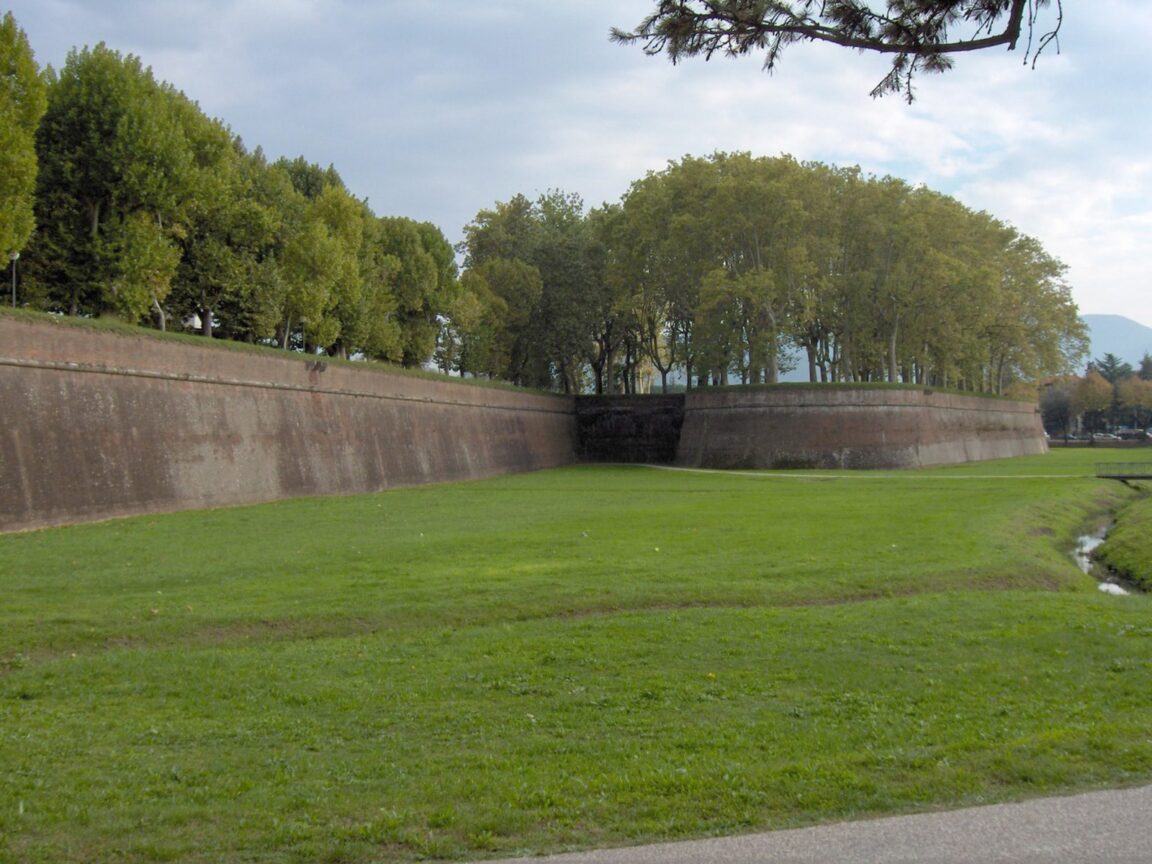
Lucca’s walls are not a fragment or a picturesque ruin. They are a complete early modern fortification system, built and rebuilt between the 16th and 17th centuries when the independent Republic of Lucca feared its larger neighbours, with eleven bastions, wide earth-filled ramparts and gates that still control entry to the old town. The walls were never seriously tested in battle, which is precisely why they survive intact while the defences of rival cities were demolished for ring roads and suburbs. In the 19th century the ramparts were planted with trees and converted into a public promenade, and that second life defines the city today.
The circuit on top runs for approximately four kilometres, shaded by avenues of plane trees, chestnuts and oaks, with lawns, benches, drinking fountains and small cafes at intervals. From the parapet the view alternates between the tiled roofs, towers and gardens of the old town inside and the modern suburbs, sports fields and the green Serchio plain outside, with the Apuan Alps on the northern horizon. Walkers share the route with runners, dog owners, grandparents teaching children to ride, and entire school groups, because the walls are not a monument Lucca visits. They are the park Lucca lives in.
Cycling the Walls, Inside and Out
The classic Lucca hour is a bicycle circuit of the walls, and hire shops cluster near the gates and inside the old town renting city bikes by the hour or day. One unhurried lap takes most riders well under an hour even with photo stops, and the correct approach is to ride it twice: once for the exercise and the orientation, and once slowly, stopping at the bastions and the small gardens that hang off the route. The former guardhouses on the bastions now host exhibitions and events, and the wall-top cafes make the circuit a social institution rather than a sightseeing chore.
The title of this guide means the second half of the ride as well. Inside the walls, the old town is effectively a cycling city: distances are tiny, cars are restricted, and locals of every age pedal the Roman streets with shopping in the basket. A bike that starts on the ramparts can drop through a gate and be at the cathedral, the shops of Via Fillungo or a bakery in minutes. Outside the walls, paths along the Serchio River extend the riding into open countryside for anyone staying longer. The practical cautions are simple ones: walk the bike through the busiest shopping streets at peak hours, lock it even for a coffee, and give way on the wall path where the promenade narrows near the cafes. Travelers who love a walled old town approached slowly will find a kindred spirit in our guide to Kotor, Montenegro, where the walls climb the mountain instead.
What to See Inside the Ring
Piazza dell’Anfiteatro
Lucca’s most distinctive square is an oval because it was built directly onto the footprint of the Roman amphitheatre that stood here in the 1st and 2nd centuries. Houses rose over the arena’s arches in the Middle Ages, and the piazza keeps the ellipse, entered through low vaulted passages that follow the ancient entrances. Today it is ringed with cafes and apartments, and the best way to read it is from a table at its edge, watching the shape do the explaining.
The Guinigi Tower
The Torre Guinigi is Lucca’s exclamation point: a 45-metre brick tower from the 14th century, built for the Guinigi family who ruled the city, with a hanging garden of holm oak trees growing from its summit. Climbing the tower earns the definitive view of Lucca, rooftops and churches inside the green wall ring, and the oaks overhead make the top feel like a small park in the sky. There is no lift, and the stairs are the price of the panorama.
Churches and the Cathedral
San Michele in Foro stands on the old Roman forum in patterned white marble, its facade stacked with arcades and topped by a winged St Michael. The Cathedral of San Martino, at the southern side of the old town, holds two of Lucca’s treasures: the Volto Santo, the revered wooden crucifix that made Lucca a pilgrimage stop on the Via Francigena, and the tomb of Ilaria del Carretto, Jacopo della Quercia’s serene early Renaissance masterpiece. San Frediano, in the north, counters with a golden mosaic facade and a vast baptismal font carved with biblical scenes. None of these requires a specialist’s patience: each is a short, rich stop on a walking loop between wall descents.
Via Fillungo and the Shopping Streets
Via Fillungo, the main street running north to south through the old town, threads past medieval tower houses, jewellers, clothing shops and the Antico Caffè’s old-world calm, with the clock tower, the Torre delle Ore, rising above it. Lucca was a silk city, and the shopping still skews toward quality textiles, leather and food shops rather than souvenir volume. Side streets off Fillungo deliver the quieter Lucca: small squares, wine bars pouring the local Colline Lucchesi wines, and bakeries selling buccellato, the city’s anise and raisin ring cake.
Puccini’s Lucca and the Evening Town
Giacomo Puccini was born in Lucca, in a house on Corte San Lorenzo that is now a small museum, and the city claims its composer with summer opera performances and concerts in churches through the year. Evenings inside the walls are Lucca at its best and the strongest argument for staying overnight: day visitors drain away to Florence and Pisa, the wall promenade turns golden, aperitivo fills the small squares, and restaurants serve the local canon of tortelli lucchesi, farro soup and chestnut desserts from the Garfagnana hills to the north. For a food-first Italian counterpoint, our guide to what to eat in Naples covers the other end of the country’s appetite.
Getting There, Getting Oriented, and How Long to Stay
Lucca sits on the rail line between Florence and Viareggio, with Pisa also a short train ride away, and the station stands just south of the walls, a few minutes on foot from Porta San Pietro. Drivers should park outside the walls: the old town is largely closed to non-resident traffic, and the gates are for looking at, not for improvising a route through. Orientation inside is genuinely easy, because the wall ring is always a few streets away in every direction, and a lost traveler only has to walk outward to find the promenade and reset. A day trip covers the walls, the amphitheatre piazza, one tower and one church at a civilised pace. An overnight adds the evening town, a second wall circuit at dawn, and time for the Puccini house and Palazzo Pfanner’s baroque garden, the combination that turns Lucca from a stop into a stay.
Frequently Asked Questions
How long does it take to cycle Lucca’s walls?
The circuit is approximately four kilometres. A gentle lap with stops takes most visitors 30 to 60 minutes, and hiring for half a day allows a second, slower circuit plus riding inside the old town.
Can visitors walk on top of the walls?
Yes. The top of the ramparts is a public tree-lined promenade, open to walkers, runners and cyclists, and it is the city’s main park. Access ramps and stairs rise from the old town at several points around the ring.
What is the one sight not to miss inside the walls?
Piazza dell’Anfiteatro for its Roman footprint, with the Guinigi Tower a close second for the view. Together they explain Lucca’s layers, Roman, medieval and Renaissance, in under an hour.
Is Lucca a day trip or a base?
Both work. It is an easy day trip from Florence or Pisa by train, but an overnight reveals the quieter evening and early morning town, and Lucca also serves as a relaxed base for Pisa and the Tuscan coast.
Can cars enter the old town?
The historic centre inside the walls is largely restricted to residents and authorised vehicles. Visitors should park outside the walls and walk in through a gate; the centre is small enough that nothing is far on foot.