 Thandiwe Nkosi
Arenal is best done as a rhythm, not a checklist: mornings in the national park or on the hanging bridges while the cone is most likely to be clear, afternoons when the rain often arrives, and evenings in the geothermal hot springs that the volcano heats for the town at its feet, La Fortuna. The volcano itself has been in a resting phase since its eruptive period ended in 2010, so there is no lava to chase and no summit to climb, and that is precisely what makes the modern Arenal trip work: lava fields you can walk across, rainforest you can cross at canopy height, a waterfall-fed river town, and hot water at the end of every day.
Quick Facts
- Base town: La Fortuna, in Alajuela province, the service town at the eastern foot of Arenal Volcano
- The volcano: Arenal, whose eruptive period that began in 1968 ended in 2010; it is now in a resting phase, with no lava viewing
- Summit rule: Climbing the cone is prohibited; all legal trails stay on the lower slopes and lava fields
- National park: Arenal Volcano National Park, managed by SINAC, open daily 8am to 4pm; non-resident adults US$15 and non-resident children US$5 on the official SINAC listing, before any taxes, checked 11 November 2026
- Park sectors: Two: the Volcano (Coladas) sector for lava fields, and the Peninsula sector on Lake Arenal for lake views and an accessible trail
- Hanging bridges: Mistico Arenal Hanging Bridges Park, a private reserve with 16 bridges, 6 of them suspension bridges, on a trail of about 3.2 km
- Hot springs: Geothermal springs clustered along the road west of La Fortuna toward the volcano, mostly run as hotels and day-visit resorts
- Best cone views: Early morning, before cloud builds on the summit; views are never guaranteed
What is Arenal actually like now that the lava has stopped?
For four decades, Arenal was sold on eruption: a perfectly conical volcano, quiet for centuries, that woke violently in 1968 and then produced lava flows, ash and spectacle until the activity ceased in October 2010. The Smithsonian and Costa Rican monitoring record, reflected in SINAC’s visitor information, is clear that the volcano is now in an indeterminate resting phase while remaining classified as active. What that means for a visitor is simple and worth stating plainly, because older guides still imply otherwise: there are no lava tours, no glowing flows at night and no crater hike, and any operator selling you one is selling a story, not a product.
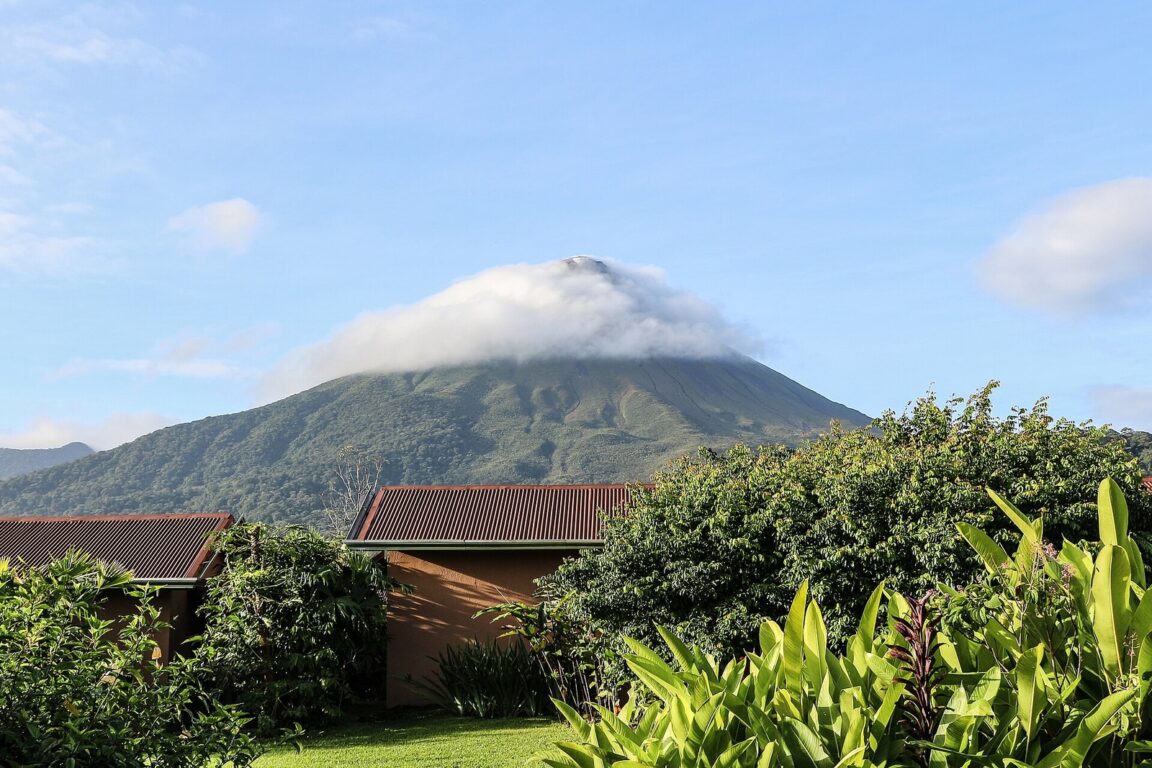
What remains is arguably better travel. The cone, when the cloud lifts, is one of the great volcano silhouettes in Central America, rising over Lake Arenal and a working agricultural landscape. The 1968 and later lava fields are walkable history under your boots. The rainforest on the lower slopes is rich, wet and loud with birds. And the geothermal system that powered the eruptions now heats the springs that define La Fortuna’s evenings. Travelers who arrive expecting a volcano park rather than a volcano show tend to leave happiest, in the same way that our guide to Kotor, Montenegro argues for staying in the old town rather than day-tripping through it: the place rewards the slower reading.
How do the national park’s two sectors differ?
Arenal Volcano National Park protects roughly 12,000 hectares and is run by SINAC, Costa Rica’s conservation authority. It has two visitor sectors with separate entrances, and they deliver different days. The Volcano sector, often called the Coladas sector, is the classic visit: a network of short trails through secondary forest and across the lava fields. SINAC’s visitor information lists the Coladas trail at about 1.7 km, reaching a viewpoint about 1.5 km from the entrance control point with the cone directly in view on a clear day, and the El Ceibo trail at about 2.3 km, a flatter forest loop named for a giant ceiba tree. Footing on the lava is uneven and the rock is sharp where it has not weathered, so closed, sturdy shoes are not optional here.
The Peninsula sector sits on a finger of land reaching into Lake Arenal and is the gentler half of the park. Its Los Miradores trail, about 1.2 km, is described in SINAC’s accessibility information as accessible to people with reduced mobility, with lake and volcano views and a viewing tower. Birdlife is the draw here as much as geology. The park is open daily from 8am to 4pm on SINAC’s listing; plan to be at the Volcano sector early, both for the clearest cone views and because a 4pm close makes Arenal a morning park by design. Entry for non-resident adults was listed by SINAC at US$15, with non-resident children at US$5, when checked on 11 November 2026; taxes and payment methods can change, so confirm at the gate or on the SINAC site before you set a budget in stone.
Are the hanging bridges worth it, and which park should you choose?
Yes, if you understand what they are: a canopy-level walk, not a thrill ride. The best-known operation, Mistico Arenal Hanging Bridges Park, is a private rainforest reserve west of La Fortuna on the road toward the Lake Arenal dam. Its trail, about 3.2 km in full, crosses 16 bridges in total, of which 6 are suspension bridges strung above the forest floor, the longest around 97 metres and the highest reaching roughly 45 metres above the ground. From the bridges you are at eye level with the mid-canopy: tanagers and toucans at working distance, coatis and monkeys moving through the branches, and, from the bridge named for the view, Arenal itself framed by forest. The park opens early, from around 6am, with last entry in the mid-afternoon; arrive at opening for the most active wildlife and the emptiest bridges, and book a naturalist guide at the gate if spotting is your priority, because on a self-guided walk you will walk past most of what a guide would stop for. Exact entry pricing varies by ticket type and season and is best checked on the park’s own site on the day you book.
Mistico is not the only canopy option near La Fortuna, and the choice is mostly about pace. A guided Mistico walk suits travelers who want ecology and views at walking speed. Parks that combine bridges with aerial trams and zip lines suit travelers who want the canopy as adventure rather than observation. Either way, go early, wear shoes that grip on wet decking, and keep expectations about the volcano view honest: the bridges face the cone, but cloud decides.
How do the hot springs work, and how do you choose one?
La Fortuna’s hot springs are geothermal water, heated underground by the same volcanic system, channelled into pools by the hotels and resorts that line the road running west from town toward the volcano and the lake. Almost all of the developed springs are private: you either stay at the property or buy a day pass, often bundled with dinner. That structure creates a clear spectrum. At one end are large resort complexes with many pools of graded temperatures, swim-up bars, slides and a lively, social atmosphere. At the other are small, quiet properties with a handful of pools in gardens, aimed squarely at couples and at travelers who want silence with their soak. In between sit mid-sized family-run places that are often the best value in town.
Choose on three questions. First, temperature range: a good springs property offers a ladder of pools from warm to properly hot, so you can soak for an evening rather than survive one very hot pool for ten minutes. Second, timing: springs are an evening activity in Arenal’s rhythm, after the park’s 4pm close and the afternoon rain, so a day pass that includes the evening hours matters more than one that ends at sunset. Third, honesty about the word natural: the water is genuinely geothermal everywhere in this strip, but the pools are built, landscaped and chlorinated to varying degrees, and marketing language will not tell you which end of that spectrum a property sits on; recent reviews and the property’s own photos will. For a very different geothermal culture, compare our guide to Banff in winter, where the hot springs ritual involves snow on the pool deck rather than rain on a rainforest canopy.
What else belongs in a La Fortuna day?
The town itself is compact, friendly and easy: a central park facing a church with the volcano as its backdrop, sodas serving casados at local prices, and tour desks that will sell you everything from white-water rafting on the Balsa and Sarapiqui rivers to night walks, coffee and chocolate tours on nearby farms, and the walk down to the La Fortuna Waterfall, where a steep stairway descends to a powerful plunge pool at the fall’s base. Build days loosely: one anchor activity booked for the morning, options in the afternoon, springs in the evening. Rain is a feature of the climate here, heaviest in the wetter months from around May to November and lighter in the drier window from December to April, and the sensible response is waterproof layers and mornings protected for the views, not disappointment.
How many days do you need, and where should you stay?
Three nights is the honest minimum: one day for the national park, one for the bridges and the waterfall, and a margin day for the morning the cone finally clears, because it will, usually early, and usually without warning. Stay in La Fortuna town if you want restaurants, tours and transport without a car, and stay on the springs road west of town if the soak is the point of the trip and you are happy to taxi or drive in for dinner. Drivers should note that the attractions string out along that same road, the national park and Mistico in the same general direction, which makes combining a bridges morning with a park visit, or a park morning with an evening at a nearby springs property, a natural piece of route planning rather than backtracking. Book the anchor experiences a day or two ahead in high season, keep one morning unbooked for weather, and let the volcano set the schedule.
Frequently Asked Questions
Can you see lava at Arenal Volcano now?
No. Arenal’s eruptive period ended in 2010 and the volcano is in a resting phase. There are no lava flows to view, day or night. What you visit today is a volcano landscape: lava fields from the 1968 and later eruptions, rainforest, lake views and geothermal springs.
Can you climb to the top of Arenal Volcano?
No. Access to the volcanic cone is prohibited, and SINAC directs visitors to designated areas and marked trails on the lower slopes. The park’s trails, including the Coladas trail across the lava field and the El Ceibo loop, are the legal and safe way to experience the volcano up close.
How much does Arenal Volcano National Park cost?
SINAC’s official listing, checked on 11 November 2026, shows US$15 for non-resident adults and US$5 for non-resident children, with lower colones rates for residents. Taxes or payment rules may add to the gate price, so confirm on the SINAC site or at the entrance before you go. The park is open daily from 8am to 4pm.
What is the difference between Mistico Park and the national park?
They are different products. The national park is the state-run SINAC site with short trails across lava fields and a lake sector. Mistico is a private reserve whose draw is its 16 bridges, including 6 suspension bridges, carrying a canopy-level trail through rainforest with volcano views. Most visitors who have the time do both, on different mornings.
When is the best time to see the Arenal cone clearly?
Early morning offers the best odds, before cloud builds on the summit, and the drier months from around December to April are statistically kinder than the wetter season. There is no guarantee in any month: build a spare morning into a three-night stay and check the sky at dawn.
Park hours, sectors, trails and SINAC entry rates checked on 11 November 2026. Mistico bridge counts and trail length are as published by the park and recent visitor sources; check current hours and ticket types on the park’s own site before booking.