 Rafael Santos
Cuenca is Ecuador’s most liveable colonial city, a UNESCO-listed highland centre at about 2,560 metres where a planned Spanish grid of churches, plazas and red-tiled roofs sits between four rivers, and where the world’s most famous hat, the Panama hat, is actually woven and finished. Go for the historic centre, inscribed by UNESCO in 1999, stay for the hat workshops, the Pumapungo ruins and the river walks, and give the altitude a day to settle before you rush. This guide covers why Cuenca rewards a slow visit, when to go, and how the old town and its crafts fit together.
Quick Facts About Cuenca
- What it is: The capital of Azuay Province in Ecuador’s southern Andes, and the country’s third-largest city.
- UNESCO status: The Historic Centre of Santa Ana de los Rios de Cuenca was inscribed on the World Heritage List in 1999.
- Founded: 1557, as a planned Spanish colonial town on the site of the Inca city of Tomebamba.
- Altitude: About 2,560 metres (roughly 8,400 feet). Expect cool nights and strong sun.
- The four rivers: The Tomebamba, Yanuncay, Tarqui and Machangara flow through and around the city.
- The hat: The Panama hat is Ecuadorian, woven from toquilla straw. UNESCO listed the traditional weaving on its Intangible Cultural Heritage list in 2012.
- Currency and language: The US dollar and Spanish. Ecuador uses the dollar officially.
- Getting there: Mariscal La Mar Airport (CUE) serves domestic flights, and long-distance buses connect Cuenca with Quito and Guayaquil.
Why go to Cuenca?
UNESCO’s inscription describes Cuenca as a remarkable example of a planned inland Spanish colonial town that has kept its original orthogonal plan for more than four centuries. That planning is exactly what a visitor feels. The historic centre is legible in an hour and rewarding for a week: a grid anchored by Parque Calderon, with the twin landmarks of the Old Cathedral and the blue-domed New Cathedral facing each other across the square, flower markets and church atriums filling the side streets, and the Tomebamba river dropping away to the south behind a row of colonial houses known as the Barranco. Travellers building an Andean route will find Cuenca the natural southern partner to the Peruvian highland cities in our Arequipa travel guide, and its market and food culture pairs well with the culinary depth of our Puebla travel guide for anyone travelling widely in Latin America’s colonial cities.
The second reason is that Cuenca is a working city, not a stage set. Its universities, workshops and markets serve residents first, the expatriate community that has settled here over the past two decades has added cafes and services without displacing the centre’s character, and prices across food, transport and lodging remain gentle by capital-city standards. The third reason sits just outside town: El Cajas National Park, a high paramo of lakes and trails to the west, and Ingapirca, Ecuador’s most important Inca archaeological site, to the north, both work as day trips.
When is the best time to visit Cuenca?
Cuenca’s climate is the famous Andean spring that never quite commits to a season. At 2,560 metres, daytime temperatures sit in the high teens to low twenties Celsius through the year, nights drop towards 10 degrees, and the daily pattern matters more than the monthly one: clear mornings, building cloud, and a real chance of afternoon rain. The relatively drier months run from about June to September, which is also when North American and European holiday traffic peaks. The wetter months, roughly October to May with the heaviest rain often in March and April, bring greener hillsides, fuller rivers and quieter streets, and the rain usually arrives as afternoon downpours rather than all-day washouts.
Two festival anchors are worth timing around. Cuenca celebrates its independence on 3 November with several days of craft fairs, concerts and food stalls that fill the centre, the city’s biggest annual party. The Pase del Nino Viajero procession on 24 December is one of Ecuador’s great Christmas Eve traditions, a long and joyful parade through the historic streets. Whenever you come, pack for the altitude rather than the calendar: layers, a real rain shell, sun protection for the fierce equatorial high-altitude sun, and a first day planned gently while your body adjusts.
How does the old town fit together?
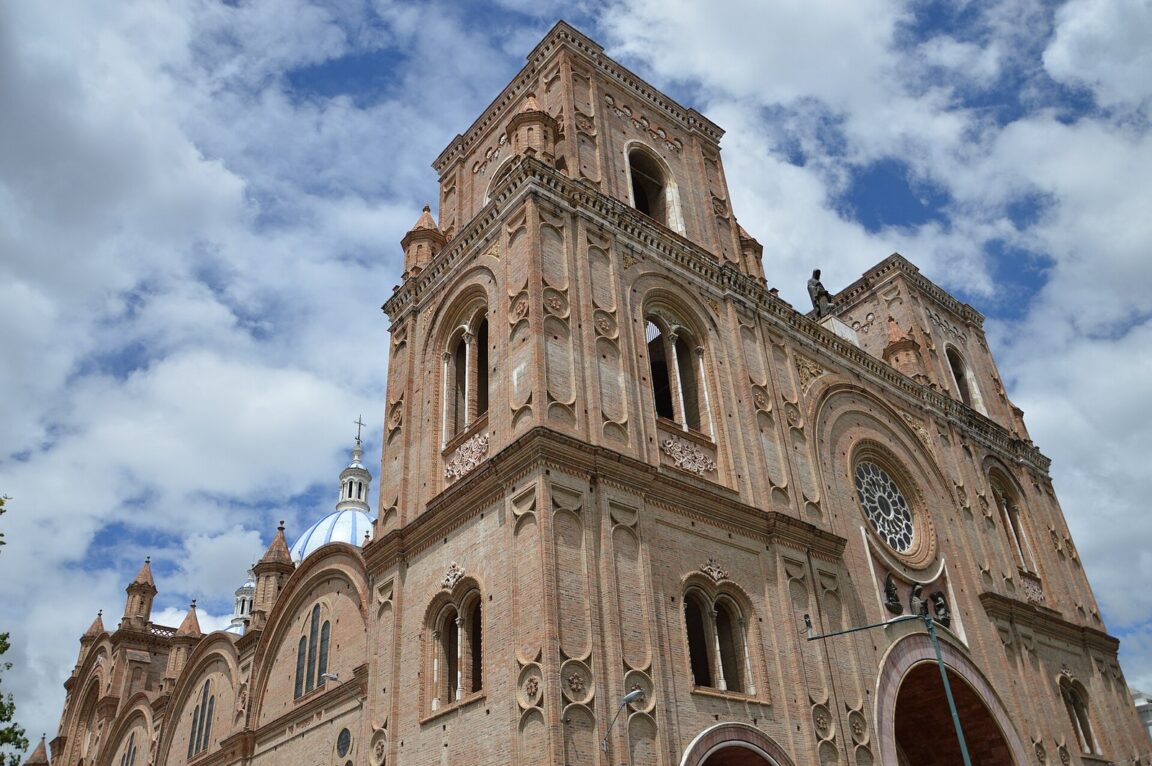
Start at Parque Calderon, the shaded central square, because everything in the historic centre is measured from it. On its west side rises the New Cathedral, the Cathedral of the Immaculate Conception, begun in 1885 to designs by the German friar Juan Bautista Stiehle and built over nearly a century. Its three domes, clad in blue and white glazed tile, are the city’s emblem, and its scale still startles: it was designed to hold thousands of worshippers. Across the square, the Old Cathedral, El Sagrario, begun in the 16th century, now serves as a museum of religious art and gives the clearer sense of the colonial city Cuenca was.
From the square, the grid unfolds in walkable blocks. Calle Larga, running south towards the river, mixes museums, restaurants and bars. The flower market at the Plazoleta del Carmen and the church of Carmen de la Asuncion sit a couple of blocks away, and the covered markets, including the Diez de Agosto market, are the places to see the region’s produce and eat a local lunch. Down the Barranco steps, the Tomebamba riverwalk runs east and west past the Pumapungo complex at its eastern end, where the Museo Pumapungo pairs an ethnographic museum with the archaeological park of Tomebamba, the Inca city beneath Cuenca, complete with terraces, foundations and a small aviary and ethnobotanical garden. That layering, Inca under Spanish under modern, is the city’s whole story in one site.
Why is the Panama hat actually from Cuenca?
The hat is woven from the fibre of the toquilla palm, which grows on Ecuador’s coast. Weavers in Manabi and Azuay provinces produce the bodies by hand, a fine Montecristi hat taking weeks or months of work, and Cuenca became the trade’s finishing and export centre in the 19th century, which is why its workshops line the city today. The name came from the route out: hats shipped through Panama, and worn by workers on the Panama Canal, picked up the wrong country’s name permanently. UNESCO recognised the craft itself in 2012, inscribing the traditional weaving of the Ecuadorian toquilla straw hat on the Representative List of the Intangible Cultural Heritage of Humanity.
In Cuenca, visit a working factory museum such as Homero Ortega, where the process from straw to shaped, trimmed and banded hat is demonstrated, or the smaller hat museums near the Barranco. Buy from the source if you can: prices rise steeply with fineness of weave, and a reputable workshop will show you how to judge a hat by holding it to the light and counting the weave. A genuine fine hat rolls for travel and springs back; the workshops will show you that too.
How many days do you need, and how do you get around?
Three nights is the honest minimum: one day for the historic centre and cathedrals, one for Pumapungo, the hat workshops and the river walks, and one for a day trip to El Cajas or Ingapirca. Four or five nights suit the city’s pace better, because Cuenca rewards repetition: the same square at morning mass, market hour and evening promenade are three different places. The centre is flat and walkable, the modern tram line crosses the historic area and links to the airport side of the city, city buses are frequent, and taxis are metered and inexpensive. Mariscal La Mar Airport sits close to the centre and handles domestic flights, principally to Quito, while the bus terminal runs comfortable long-distance services, including the dramatic mountain road west to Guayaquil past El Cajas.
Altitude is the one planning factor visitors underestimate. At 2,560 metres, most people feel the first evening’s breathlessness on the stairs and a headache if they push. Arrive, hydrate, eat lightly, skip the wine on night one, and save El Cajas, which tops 4,000 metres at its road pass, for later in the stay. The equatorial sun at this height burns fast even through cloud, so sunscreen and a hat, ideally one bought honestly in the city that invented it, are equipment rather than accessories.
Frequently Asked Questions
Is Cuenca safe and easy for a first visit to Ecuador?
Cuenca is widely regarded as one of Ecuador’s calmer and more manageable cities, with a compact, walkable centre. Normal big-city awareness applies, especially at night outside the centre, and conditions anywhere can change, so check your government’s current travel advice before you go.
How do you get to Cuenca?
Fly domestically into Mariscal La Mar Airport (CUE), mainly from Quito, or take a long-distance bus from Quito or Guayaquil. The Guayaquil road crosses El Cajas National Park and is spectacular in clear weather.
What is the best souvenir to buy in Cuenca?
A genuine toquilla straw hat, the real Panama hat, bought at a workshop where you can see the weave grades explained. Ceramics, textiles and jewellery from the craft markets around the centre are the other strong local buys.
How bad is the altitude in Cuenca?
At about 2,560 metres it is noticeable but manageable for most travellers. Take the first day slowly, hydrate, and leave higher excursions such as El Cajas for later in your stay.
Can you visit Ingapirca and El Cajas as day trips?
Yes. Ingapirca, Ecuador’s major Inca site, lies roughly an hour and a half to the north, and El Cajas National Park begins about half an hour west of the city. Both are standard day trips by tour, bus or taxi.
When are Cuenca’s biggest festivals?
Independence celebrations around 3 November are the largest, and the Pase del Nino Viajero procession on 24 December is the most distinctive. Book lodging early for both.