 Jonas Lindqvist
Three days in Riga divides cleanly into three walks that barely overlap: Day 1 for the medieval Old Town, Day 2 for the Art Nouveau streets of the Quiet Centre, and Day 3 for a morning inside the Central Market pavilions, followed by the museums and monuments of the boulevard ring. The Latvian capital is compact, flat and largely walkable, so the plan below keeps each day in one cluster, starts the market morning early when the stalls are fullest, and leaves the evenings free for the Old Town lanes and the canal parks. Book nothing time sensitive except museum visits, check Monday closures before fixing the order, and let the architecture set the pace.
Quick Facts
- Structure: Day 1, Vecriga, the Old Town. Day 2, Alberta iela, Elizabetes iela and the Art Nouveau Museum. Day 3, Riga Central Market in the morning, then the Freedom Monument, the Latvian National Museum of Art or the Corner House
- Historic status: The Historic Centre of Riga, covering the Old Town and the Art Nouveau boulevards, was inscribed on the UNESCO World Heritage List in 1997
- Central Market: Opened in 1930 in five vast pavilions built from reused First World War Zeppelin airship hangar frames, beside the Old Town and the Daugava River. Entry to browse is free
- Art Nouveau Museum: Riga Art Nouveau Museum, Alberta iela 12, set in the restored 1903 apartment of architect Konstantins Peksens. Check current opening days and ticket prices on the museum channels before visiting
- Where to stay: The Old Town for first time atmosphere, or the Quiet Centre near Alberta iela for calmer streets and the best facades at the door
- Walking reality: The centre is flat and compact. Cobbles in the Old Town reward sturdy shoes, and Baltic weather can turn within an hour in any season
- Monday warning: Several Riga museums close on Mondays. If Day 2 falls on a Monday, swap it with the market morning, which works any day of the week
How should the three days be divided?
Riga rewards visitors who resist crisscrossing it. The Old Town sits south of the canal and parks, the Art Nouveau district lies a short walk north of the centre, and the Central Market stands just beyond the Old Town’s southern edge, so each of the three sights that define the city gets a day anchored around it. The same one cluster per day logic that structures a three day Vienna itinerary works perfectly here, at a smaller and more relaxed scale. Distances between clusters are short enough to walk, which means the days connect naturally: an Old Town evening can end with a canal side stroll toward the Quiet Centre, and the market morning flows back into town for lunch.
Day 1: What should a first day in the Old Town cover?
Where does Vecriga begin?
Start at Ratslaukums, Town Hall Square, in front of the House of the Black Heads, the ornate guildhall whose facade of statues, clocks and coats of arms is the Old Town’s postcard. The original building dated to the fourteenth century and served the Brotherhood of Black Heads, a guild of unmarried merchants; the present building is a faithful postwar era reconstruction, completed at the end of the twentieth century after the original was destroyed in the Second World War. From the square, the spire of St Peter’s Church rises a few steps away. St Peter’s, a Lutheran church with medieval roots, has a tower with a lift served viewing platform that gives the best orientation in Riga: the Old Town roofs below, the Daugava River to the west, the market hangars to the south and the Art Nouveau rooftops to the north. Go up on Day 1, because the view explains the geography of the whole three days.
What fills the rest of an Old Town day?
Walk without rushing. Riga Dome Cathedral, founded in the thirteenth century, anchors the western lanes with its cloister and one of Europe’s historically celebrated organs. The Three Brothers, a row of three adjoining houses on Maza Pils iela, show three centuries of domestic architecture side by side, from a medieval merchant house to later, taller neighbours. The Swedish Gate, the only surviving gate in the old town wall, and the neighbouring Powder Tower, now part of the Latvian War Museum, mark the northern edge. In between, the lanes deliver the pleasure of the district: small squares, guild houses, cafes in cellars and courtyards, and the Livu Square terraces for an evening drink. Keep the day deliberately unhurried. The Old Town is small, and its reward is atmosphere, detail and a second look at facades in evening light, not a long checklist.
Day 2: How do the Art Nouveau streets work best?
Why is Riga an Art Nouveau capital?
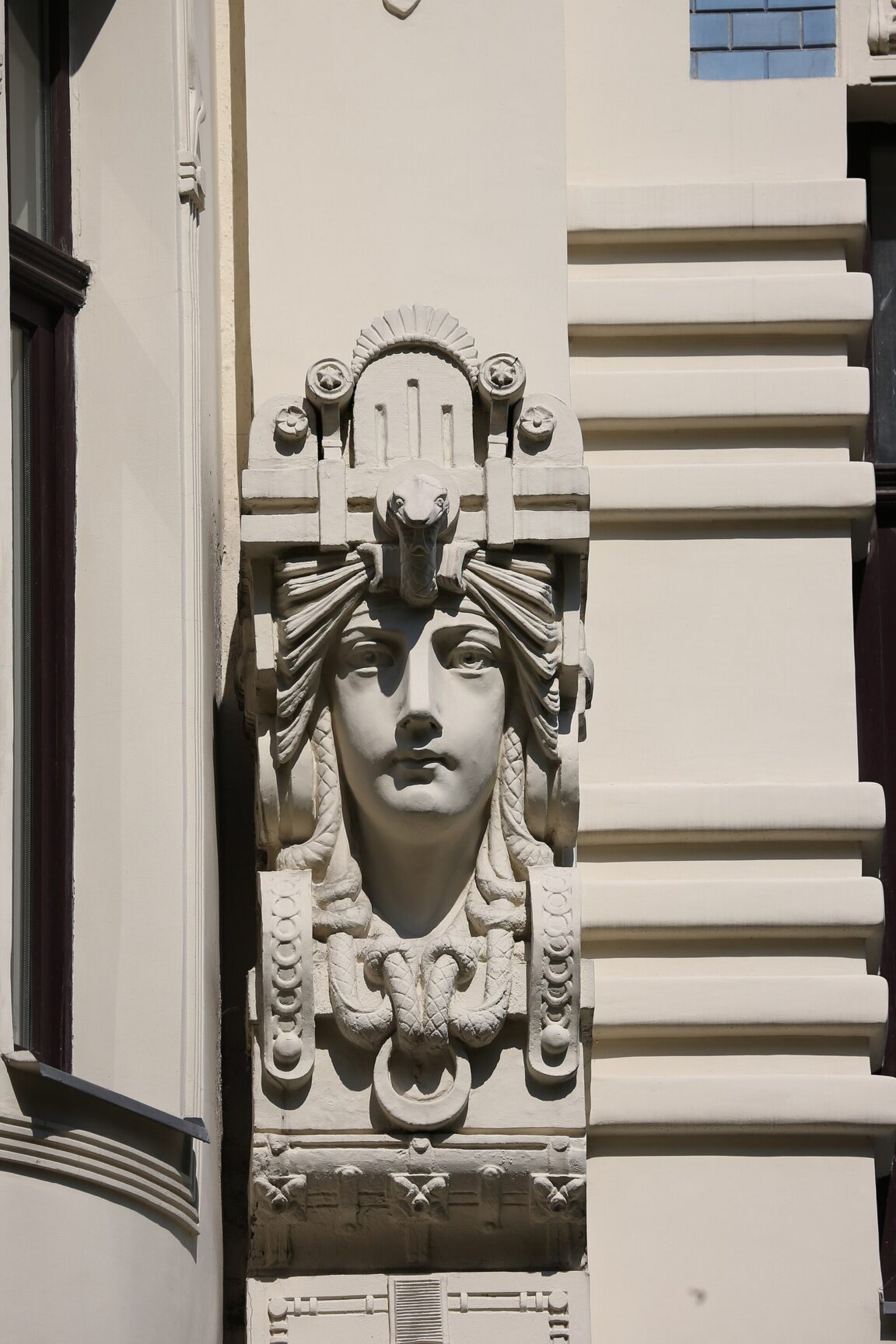
Around 1900, booming Riga built fast and built decoratively. The result, concentrated in the streets north of the centre, is one of the largest and finest collections of Art Nouveau architecture in Europe, hundreds of buildings raised in roughly a decade and a half, their facades crowded with sculpted faces, sphinxes, peacocks, floral swirls and dramatic cornices. The Quiet Centre, Klusais centrs, around Alberta iela and Elizabetes iela, holds the densest stretch. Walk it slowly, on both sides of each street, looking up. Alberta iela is the headline street, where the architect Mikhail Eisenstein, father of the film director Sergei Eisenstein, produced a run of flamboyant facades in the first years of the twentieth century. Alberta iela 2a, with its sphinxes, and Alberta iela 13 and Elizabetes iela 10b are among the most photographed, but the pleasure is cumulative: the whole street is the exhibit, and it is free, outdoors and open at any hour.
What does the Art Nouveau Museum add?
At Alberta iela 12, the Riga Art Nouveau Museum occupies the former apartment of Konstantins Peksens, one of the era’s leading Latvian architects. Restored rooms show how the style worked at domestic scale: tiled stoves, painted ceilings, period furniture, kitchenware and a spiral staircase decorated with floral frescoes. It is the essential complement to the street, turning exterior ornament into a complete way of living, and it rarely needs more than an hour. Pair it with the Latvian National Museum of Art, a short walk away on the boulevard ring, whose grand nineteenth century building holds the national collection of Latvian painting and sculpture. Travellers who enjoyed the museum plus neighbourhood rhythm of a three day Lisbon itinerary will recognise the pattern: one great street, one intimate museum, one national collection, all inside a single walkable district.
How should Day 2 end?
Walk back toward the Old Town through the green belt of parks along the city canal. The route passes the Freedom Monument, the 42 metre granite and copper memorial unveiled in 1935 that stands on Brivibas bulvaris as Latvia’s central symbol of freedom and nationhood, guarded ceremonially and surrounded by the everyday flow of the city. The Latvian National Opera sits beside the canal nearby. An evening performance there, booked ahead through official channels, is a fitting end to the architecture day, and the park paths, lit and lively in summer, make the walk back to either the Old Town or the Quiet Centre a pleasure rather than a transfer.
Day 3: How does a Central Market morning work?
Why go to the market in the morning?
Riga Central Market is a working food market first and a sight second, and mornings are when it works hardest. Opened in 1930, it fills five enormous arched pavilions created from the steel frames of German Zeppelin hangars left from the First World War, a piece of adaptive reuse on a scale few markets anywhere can match. The pavilions are organised broadly by produce, with halls and outdoor areas given to meat, fish, dairy, vegetables and baked goods, plus rows of stalls outside in season. Arrive in the morning for the fullest stalls, the local shoppers and the best choice, and build breakfast or an early lunch from the market itself: smoked fish, dark rye bread, pickles, cheese, pastries and, in summer, berries and mushrooms. Carry small cash as well as a card, bring a bag, and ask before photographing individual stalls, since this is a workplace as much as an attraction.
What comes after the market?
The market sits beside the main bus station and the railway station, at the southern edge of the centre, so the rest of Day 3 can flex with energy and weather. One strong option is the Corner House on Brivibas iela, the former KGB headquarters in Latvia, where guided visits to the ground floor cells and interrogation rooms give a sobering account of the Soviet occupation years; visits are guided and should be booked ahead through the Museum of the Occupation channels. Another is a return to the Latvian National Museum of Art if Day 2 ran long. A third, in good summer weather, is the train ride to Jurmala, the pine backed resort of wooden villas and long sandy beach on the Gulf of Riga, an easy half day escape that shows the other, holiday side of Latvian life. All three options start within a short walk of the market, which is exactly why the market belongs on the final morning, when travellers know the city well enough to choose.
Where should visitors stay and eat?
For three days, choose between two bases. The Old Town puts the lanes, the cathedral and the evening terraces at the door, at the price of late night noise in its busiest streets. The Quiet Centre trades a ten minute walk for calm, grander apartment style hotels and the Art Nouveau facades as a morning view. Eat one meal in the Central Market, one in a modern Latvian kitchen in the centre, where rye, mushrooms, river fish, potatoes and seasonal produce anchor the cooking, and keep one evening simple in an Old Town cellar restaurant. Riga remains one of Europe’s better value capitals, but confirm current prices on official menus rather than trusting any printed figure, since prices move with the season.
Frequently Asked Questions
Is three days enough for Riga?
Yes. Three full days cover the Old Town, the Art Nouveau district and its museum, the Central Market and one major museum or memorial comfortably, with evenings to spare. A fourth day suits a longer Jurmala trip or a day trip to Sigulda and the Gauja valley castles.
When is the Central Market best visited?
In the morning, when stalls are fullest and the market serves local shoppers rather than browsers. Entry to browse is free. Check the market’s official channels for current opening hours, and note that reconstruction work can move sections between pavilions.
Which Art Nouveau street should visitors prioritise?
Alberta iela, continued into Elizabetes iela. The two streets hold the densest run of facades, including Mikhail Eisenstein’s most famous buildings, and the Art Nouveau Museum at Alberta iela 12 sits on the same street.
Are Riga’s main sights walkable from each other?
Yes. The Old Town, the Quiet Centre and the Central Market form a loose triangle of short walks, with the canal parks between them. Trams and buses cover the same ground for tired feet, and the airport bus and train links are straightforward; confirm current routes and timetables on official channels.
What is the best season for this itinerary?
Late spring to early autumn gives long daylight, outdoor terraces and the fullest market stalls. Winter brings short days, cold wind off the Daugava and a handsome Christmas market atmosphere in the Old Town, and it suits travellers who plan more museum and cafe time.
Do museums in Riga close on Mondays?
Several do, including major art venues. Check each museum’s official site when fixing the order of Days 2 and 3, and swap the market morning, which works any day, into any gap a closure creates.
A final practical note before booking anything
Fix the trip in this order: choose the hotel base first, Old Town or Quiet Centre, then check museum opening days against the calendar, then book the Art Nouveau Museum and any Corner House guided visit, then leave the rest loose. Pack for cobbles and changeable Baltic weather, start the market morning early, and look up constantly on Day 2. Riga’s three faces, medieval lanes, exuberant facades and a market inside airship hangars, sit within a half hour of each other, and three unhurried days are enough to let each one register properly.