 Hana Kim
Climbing Mount Toubkal takes two days for most fit hikers: walk from the village of Imlil at 1,740 metres up to a mountain refuge at 3,207 metres on day one, then climb before dawn to the 4,167 metre summit, the highest point in North Africa, and descend all the way back to Imlil on day two. The walking is non-technical in the snow-free months, a licensed local guide is mandatory and checked on the trail, and the real challenges are altitude, loose scree and a very long second day. This guide explains the route, the refuge night, the seasons and the guide rules in the order a first ascent needs them.
Quick Facts
- Summit: Mount Toubkal, also called Jbel Toubkal, 4,167 metres (13,671 feet), the highest peak in Morocco, the High Atlas and North Africa.
- Setting: Toubkal National Park, established in 1942, about 63 kilometres south of Marrakech.
- Trailhead: Imlil, a mountain village at about 1,740 metres, reached by road from Marrakech via Asni in roughly 1.5 to 2 hours.
- Standard route: Two days and one night. Day one climbs to the refuges at 3,207 metres in about 5 to 6 hours. Day two summits and returns to Imlil.
- Guide rule: A licensed mountain guide is mandatory for the summit route and the rule is enforced at checkpoints. Bring your passport.
- Best snow-free window: Roughly May to October for a non-technical ascent. Winter, roughly December to April, is a crampon and ice axe climb.
- Money: Carry Moroccan dirhams in cash. Do not rely on a cash machine in Imlil or anywhere on the mountain.
- Facts checked: 12 November 2026, against Moroccan tourism, refuge and current guide-rule sources linked in this article. Prices and conditions change, so confirm both when you book.
Where is Mount Toubkal, and why does everyone start in Imlil?
Toubkal rises in the High Atlas of central Morocco, inside the national park that carries its name. The Moroccan tourism office presents the park as the gateway to this part of the Atlas, and its Visit Morocco account of trekking in Toubkal National Park follows the same approach almost every climber uses: travel south from Marrakech, sleep or pause in the foothills, and walk in from Imlil. No road goes higher and there is no lift or shortcut. Every ascent begins on foot where the tarmac ends.
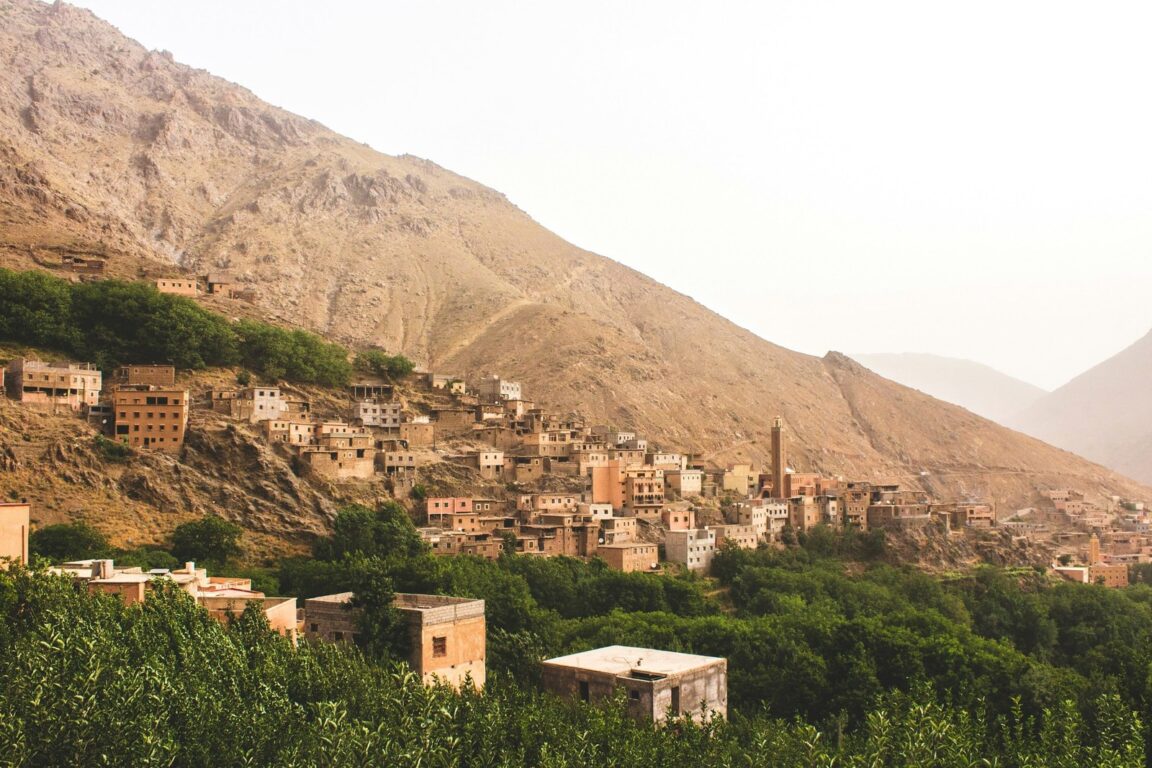
Imlil sits at the head of the Ait Mizane valley, surrounded by walnut, cherry and apple orchards, irrigated terraces and the satellite villages of Aroumd, Tamatert and Targa Imoula. It is a working trekking base, with gear shops, cafes, guesthouses, mule stands and the guides office, rather than a resort. Most climbers spend the night before the trek here or in nearby Aroumd, which helps a little with altitude and makes the first morning simple: breakfast, a passport and guide check, bags loaded, and straight onto the path. If the mountain is one chapter of a wider Morocco trip, plan the city days first with our 2 days in Marrakech itinerary, then treat Imlil as the point where the trip changes pace completely.
How does day one work, from Imlil to the refuge?
Day one is a long, steady uphill walk of roughly 11 kilometres, gaining about 1,467 metres. The path leaves Imlil, climbs to Aroumd, the last village on the route, then crosses a broad, flat flood plain before entering the narrower upper valley. The gradient is mostly forgiving, the surface is a mix of mule track, stony path and village lanes, and the effort comes from duration and altitude rather than any single steep pitch. Groups that rush this section usually pay for it above 3,000 metres, so the correct pace is deliberately unhurried.
About halfway up stands Sidi Chamharouch, at roughly 2,310 metres, a white painted pilgrimage shrine built around a large rock, with drinks stalls gathered nearby. It is the natural rest and refreshment stop, and beyond it the valley empties out: the orchards end, the path zigzags up bare slopes, and the refuges eventually come into view on a shelf above the Mizane gorge. A second account on the official tourism site, Visit Morocco on the walk to the refuge, puts the Imlil to refuge walk at about six hours including stops and notes the gradual ascent broken by flat sections. Fit walkers sometimes arrive in under five hours, but planning on 5 to 6 hours, plus a lunch stop, is the honest basis for the day.
What is the night at 3,207 metres actually like?
Base camp is a pair of neighbouring stone refuges at 3,207 metres: the Refuge du Toubkal, the historic Neltner refuge run under the Club Alpin Francais in Casablanca, and Refuge Les Mouflons, its privately run neighbour a few minutes away. The Refuge du Toubkal lists its dormitories, tariffs and booking contacts on its official Refuge du Toubkal website, and booking ahead is strongly advised, because in the peak spring and autumn weeks the refuges fill, especially at weekends. Most guided treks include the refuge booking, dinner and breakfast in the package price, which removes the most fiddly piece of logistics from the climb.
Expect a functional mountain hut, not a hotel. Sleeping is in shared dormitories with bunk beds and blankets, washing is in shared bathrooms, and meals are served communally in a dining room that doubles as the social centre of the climb. Current trekking guides commonly report a refuge bed with dinner and breakfast in the region of 250 to 300 dirhams per person, but rates vary by refuge, season and whether a guide booked the bed, so treat any figure as a planning range and confirm the current price at booking. Bring cash in dirhams, a sleeping bag liner in summer or a warm sleeping bag in the colder months, earplugs, a head torch, and everything needed for a pre-dawn start laid out the night before. Sleep at this altitude is often light and broken, headaches are common, and an early, quiet evening is worth more than a late, sociable one.
How does summit day unfold, and how hard is it really?
Day two starts in the dark, usually at around 4 or 5 in the morning, after an early breakfast. From the refuge the route climbs the south cirque on a steep, rocky path and long scree slopes, gaining about 960 metres to the summit ridge. The final section follows the ridge to the large metal pyramid that marks the top at 4,167 metres. In clear weather the summit view takes in the wider High Atlas, the valleys falling toward Marrakech to the north and, on the clearest days, the edge of the Sahara to the south. Allow roughly 3 to 4 hours from refuge to summit at a steady, altitude-aware pace.
The climb is graded as a strenuous hike rather than a technical climb in snow-free conditions: no ropes, no glacier travel and no climbing moves are required on the standard route in summer. That does not make it easy. The scree slides underfoot, the air at the summit holds far less oxygen than at sea level, and false summits test patience on the way up. The descent is the underestimated half of the day. After a short stop on top, climbers return to the refuge for food and a rest, collect their overnight gear, and then walk the full valley back down to Imlil, arriving in the late afternoon or early evening. Knees, not lungs, are what most people complain about by Aroumd. A three day version, with an extra night at the refuge or a slower approach through a side valley, is the kinder option for anyone unsure about altitude, and guides will happily arrange it.
Do you really need a guide, and how is the rule enforced?
Yes. A licensed mountain guide is mandatory for climbing Toubkal, and this is an enforced rule, not a recommendation. Current explanations of the rule, including this guide-rule explainer checked on 12 November 2026, describe Royal Gendarmerie checkpoints on the trail between the villages and the refuge where passports and the guide licence are checked, and where hikers without a licensed guide are turned back rather than fined and waved through. Sources differ on whether the requirement dates from late 2018, 2019 or a later tightening, but they agree on the present position: an unguided summit attempt is not a legal option, so do not plan around evading it.
The reliable way to hire is through the Bureau des Guides in Imlil, a reputable Marrakech or Imlil operator, or a guesthouse that books licensed guides, and to ask to see the guide official card before setting off. Agree in writing what the price covers: guiding for both days, the refuge bed and meals, mule support for overnight bags, lunches, and transport between Marrakech and Imlil if it is included. Recent guides commonly report an official guide rate in the region of 500 dirhams per guide per day, with full two day guided packages from Marrakech varying widely by group size and inclusions. Confirm the current rate at the bureau or with your operator before you travel, because a headline price that excludes the refuge or the mule is not the saving it appears to be. No separate national park entry permit or summit permit is normally required beyond travelling with the licensed guide and carrying your passport for the checkpoints.
When is the best time to climb Toubkal?
The straightforward season runs roughly from May to October, when the standard route is usually clear of snow and the ascent is a hike rather than a mountaineering climb. Late spring and early summer bring long days and wildflowers in the lower valley. High summer is hot on the walk out of Imlil and can build afternoon thunderstorms above 3,000 metres, which is one more reason summit day starts before dawn. September and October are many guides favourite months, with stable weather, cooler air and clear summit views, and they are busy weeks at the refuge.
Winter, roughly December to April, changes the mountain completely. Snow and ice cover the upper route, crampons and an ice axe are essential, and knowing how to use them on steep ground is part of the undertaking, not an optional extra. A winter ascent should be booked as a specialist guided climb, with equipment checked in Imlil before departure. Early spring sits between the two regimes and can demand winter kit on the summit slopes even when Imlil feels mild, so the deciding question is never the calendar alone. Ask your guide about current snow conditions in the week of the climb, pack for the answer you receive rather than the season you hoped for, and hold the plan loosely enough to accept a weather delay.
How should you prepare for the altitude and the walking?
Toubkal altitude is real but manageable with basic discipline. The jump from Marrakech, at roughly 450 metres, to a bed at 3,207 metres in a single day is steep, and a night in Imlil at 1,740 metres beforehand genuinely helps. On the trail, walk slowly enough to hold a conversation, drink water regularly rather than in occasional litres, eat at every meal even when appetite fades, and tell the guide early about a headache that is worsening, nausea, dizziness or unusual breathlessness. Altitude illness can affect anyone above about 2,500 metres regardless of fitness, and the correct response to serious symptoms is to stop ascending and, if they do not settle, to descend. A guide decision to turn around is the system working, not the trip failing.
Fitness preparation is ordinary and effective: regular hill walking or stair climbing in the weeks before, long walks on consecutive days to test feet and boots, and no new footwear for summit week. Pack broken-in boots with ankle support, warm layers for a freezing dawn at 4,167 metres even in summer, a waterproof shell, sun protection for intense high altitude light, a head torch, trekking poles for the scree descent, a refillable bottle or filter for water bought or treated along the route, and snacks for summit morning. Check that travel insurance explicitly covers trekking to at least 4,167 metres, because many standard policies cap altitude well below the summit. After the descent, a slow evening is well earned, and the recovery ritual of the city below is a traditional hammam. Travellers extending the trip toward the coast will find the slower counterpoint in our Essaouira travel guide.
Frequently Asked Questions
Can you climb Mount Toubkal without a guide?
No. A licensed mountain guide is mandatory on the summit route, checkpoints on the trail check passports and guide licences, and unguided hikers are turned back. Hire through the Bureau des Guides in Imlil, a reputable operator or your guesthouse, and confirm the guide licence before setting off.
How long does it take to climb Mount Toubkal?
The standard trek takes two days. Day one is about 5 to 6 hours from Imlil to the refuges at 3,207 metres. Day two is a pre-dawn summit climb of about 3 to 4 hours, followed by the descent to the refuge and the full walk back to Imlil on the same day. A three day version is gentler on altitude.
How hard is the Toubkal climb for a first-time high mountain hiker?
In snow-free months it is a hard, non-technical trek rather than a climb, with no ropes or glacier travel on the standard route. The difficulties are the altitude at 4,167 metres, loose scree above the refuge and the very long summit day descent. Good hill fitness and broken-in boots matter more than climbing experience.
What does a two day Toubkal trek cost?
Costs vary by group size and inclusions. Recent guides commonly report a licensed guide in the region of 500 dirhams per day and a refuge bed with dinner and breakfast in the region of 250 to 300 dirhams per person, with full guided packages from Marrakech priced per person and falling as group size rises. Confirm the current rates and exactly what is included, refuge, meals, mule and transport, when you book. Figures checked 12 November 2026.
When can you climb Toubkal without crampons?
Roughly May to October is the usual snow-free window on the standard route, with late May to September most reliably clear. From about December to April the upper mountain normally requires crampons and an ice axe and winter mountaineering skills. Shoulder season conditions vary week by week, so follow your guide current advice.
What should you pack for the refuge night?
Bring a sleeping bag liner in summer or a warm sleeping bag in colder months, earplugs, a head torch, warm layers for the pre-dawn start, toiletries, cash in dirhams, and snacks and water for summit morning. Dormitories provide bunk beds and blankets, and meals are served at the refuge, so a mule can carry the overnight kit while you walk with a daypack.