 Thandiwe Nkosi
Hiking the Drakensberg centres on one wall and two ways to meet it: the Amphitheatre, a basalt cliff about 5 kilometres long and roughly 1,220 metres high in Royal Natal National Park, climbed from behind on the Sentinel Peak trail to the top of Tugela Falls, or faced from below on the Tugela Gorge trail. The Sentinel route is about 12 kilometres return with the famous chain ladders, the park is managed by Ezemvelo KZN Wildlife, every hiker signs the mountain register in and out, a guide is not compulsory for the standard day hikes but is bookable and wise in poor weather, and the reliable windows are March to May for falls in flow and firm trails, and September to October for dry, clear spring hiking before the summer thunderstorm season.
Quick Facts
- The landmark: The Amphitheatre in Royal Natal National Park, northern Drakensberg, a curved basalt wall about 5 km long with cliffs rising about 1,220 m, inside the Maloti-Drakensberg Park World Heritage Site
- The falls: Tugela Falls drops a total of 948 m in five leaps over the Amphitheatre edge, and flows best after the summer rains
- The headline hike: Sentinel Peak and chain ladders to the top of the falls, about 12 km return and 5 to 6 hours from Sentinel Car Park, which sits at about 2,500 m
- The valley alternative: Tugela Gorge, about 14 to 15 km return from the Mahai and Thendele side of the park, viewing the Amphitheatre and falls from below
- The rules: Pay the park entry and any Sentinel hiking fee in cash where required, sign the mountain rescue register before every hike and sign back in on return, and use the lodge shuttle unless you have a proper 4×4 for the Sentinel Car Park road
- Managed by: Ezemvelo KZN Wildlife for Royal Natal, with the Sentinel side accessed via Witsieshoek Mountain Lodge, about 4 hours by road from Johannesburg or Durban
- Best windows: March to May for green hills, moderating temperatures and water over the falls; September to October for dry trails; summer brings afternoon thunderstorms and winter brings bitter summit cold and possible snow
What is the Amphitheatre, and why does it organise the whole trip?
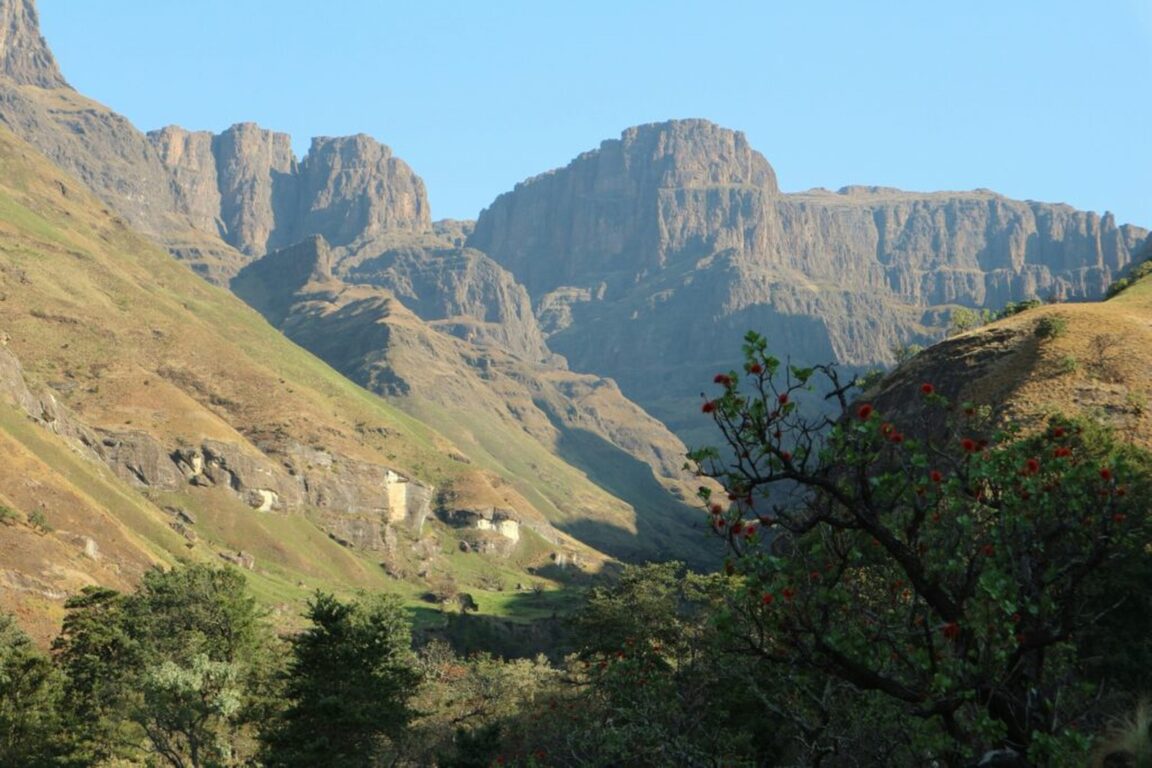
The Amphitheatre is the northern Drakensberg’s defining formation: a near perfect curved wall of basalt running from the Sentinel in the west to the Eastern Buttress, with the plateau on top feeding the Tugela River, which pours over the edge as Tugela Falls before running down the gorge through Royal Natal National Park. The park forms part of the uKhahlamba-Drakensberg Park, inscribed with the Maloti-Drakensberg Park as a UNESCO World Heritage Site in 2000 for both its escarpment scenery and its San rock art heritage. Mont-aux-Sources, at about 3,282 m, is the high point behind the Amphitheatre rim and the source area for rivers flowing both to the Indian Ocean side and inland.
Understanding the geography prevents the classic planning error. There are two trailheads on two different sides of the mountain, reached by two different roads. The Sentinel Car Park, the start of the chain ladders route to the top of the falls, is approached from the Free State side through Phuthaditjhaba and Witsieshoek Mountain Lodge. The Tugela Gorge trail starts inside Royal Natal itself, near the Mahai campsite and Thendele Camp, on the KwaZulu-Natal side. They are not interchangeable starts, and driving between them is a matter of hours, not minutes, so choose the hike first and the base second.
How does the Sentinel Peak and chain ladders hike work?
From Sentinel Car Park at roughly 2,500 m, the trail contours and zigzags up toward the Sentinel, passes below its cliffs, then climbs to the escarpment edge by one of two finishes: the chain ladders, two flights of metal ladders bolted to the rock face, or a steep gully scramble nearby that some hikers prefer on the descent or when the ladders are busy or icy. On top, the walking changes character completely: a broad, high plateau at around 3,000 m leads across to the Tugela River above the falls, where the water slides to the lip and drops away down the Amphitheatre face. The return is by the same route, and most parties take 5 to 6 hours for the roughly 12 km return trip, with the altitude, the ladders and summit weather accounting for most of the spread in times.
The ladders are the mental hurdle, not the physical one. They are sturdy, vertical in places, and exposed enough that hikers with a serious fear of heights should choose the gully or the Gorge trail instead and be honest about it at the trailhead, not at the ladder base. Gloves help on cold metal in the morning. One person on a ladder section at a time, three points of contact, and no overtaking are the working rules, and a queue at the ladders on a clear weekend is normal, so start early.
What does the Tugela Gorge trail offer instead?
The Gorge trail is the connoisseur’s alternative: a valley walk of about 14 to 15 km return from the Royal Natal side, following the Tugela River upstream through grassland, protea veld and indigenous forest patches, past the Tugela Tunnel section and boulder fields, to viewpoints where the full height of the Amphitheatre and, in flow, the falls are framed together. It gains far less altitude than the Sentinel route, involves no ladders on the standard path, and suits strong walkers who want the great view of the wall rather than the summit experience. River levels shape the day: after heavy rain, crossings and the tunnel section can be impassable, which is one more reason the register and a conditions check at the park visitor centre matter.
Royal Natal also supports gentler days that make a two or three night stay worthwhile rather than a single summit dash: short walks to cascades and pools below the camps, the walk toward the Policeman’s Helmet formation, and viewpoints of the Amphitheatre from the park road and the Mahai area at sunrise, when the wall catches first light. Travellers building a longer South Africa route can pair the Berg with the coast using the two days in Cape Town itinerary at the other end of the trip: mountain first, city and ocean second is a well tested order.
What are the permits, fees and register rules?
Two systems meet on this mountain, and keeping them separate avoids most confusion. Inside Royal Natal, Ezemvelo KZN Wildlife charges a daily conservation or entry fee at the park gate; recent published tariffs have listed different rates for South African residents and international visitors, with children at half rate, so confirm the current tariff with KZN Wildlife before travelling and carry cash as a backup even where card payment is offered. On the Sentinel side, access runs through Witsieshoek: the lodge publishes a toll gate fee for entry into the Sentinel Park area, a separate hiking fee payable at the Sentinel Car Park for day hikes, overnight stays on top and one way traverses, and per person shuttle transfers between the lodge and the car park, listed on its published rates for the lodge and Sentinel access. Fees on both sides change, so treat any figure quoted by older blogs as history, check the lodge and park pages in the week you travel, and bring enough rand in cash for gates and car parks, where card facilities are not guaranteed.
The mountain register is not bureaucracy, it is the rescue system. Sign it before every hike, at the visitor centre, your camp or the Sentinel Car Park as directed, with your route and expected return time, and sign back in the moment you return. An unsigned return is how unnecessary searches start. The final road to Sentinel Car Park requires a 4×4; Witsieshoek states this plainly and runs a shuttle for everyone else, and taking a rental sedan up that road is the most common self inflicted disaster of the trip. Book the shuttle with the lodge, agree your pickup time, and keep the lodge’s current conditions contact, the lodge publishes a WhatsApp number for mountain conditions, for the morning of the hike.
Do you need a guide, and when should you hire one?
For the standard Sentinel day hike and the Gorge trail in fair weather, a guide is not a formal requirement: the routes are established, the register system applies, and experienced hikers routinely complete both independently. That is the rule, and it comes with honest conditions. Hire a guide, bookable through Witsieshoek and its adventure desk or through established local operators, if any of the following apply: you have no experience of route finding above 3,000 m, the forecast includes storms, mist or snow, you are attempting the ladders with nervous hikers or teenagers, or you are planning anything beyond the standard day routes, including multi day traverses along the escarpment, where navigation in mist on a largely pathless plateau is a serious undertaking. A guide also converts the summit day culturally, adding Lesotho highland context, Basotho herder encounters on the plateau and the watershed story of Mont-aux-Sources that a map cannot tell.
Whatever you decide, the mountain’s own rules bind everyone: start early enough to be descending before afternoon storm build up in summer, carry water for the whole day because plateau streams are seasonal and should be treated before drinking, pack full rain gear and a warm layer in every month of the year, and turn around at the ladders or the rim if thunder is audible. Altitude at 3,000 m is real for visitors arriving from the coast the day before; a first night at Witsieshoek or Thendele, both well above 1,600 m, is a sensible acclimatisation step rather than a luxury.
When are the weather windows, honestly?
March to May is the connoisseur’s season: the summer rains have filled the Tugela, so the falls are most likely to be flowing, the hills stay green, temperatures moderate and the thunderstorm frequency drops away. September and October offer dry trails, clear air and warming days before the storm season, but the falls may be a trickle or dry after the rainless winter, so choose these months for the wall and the walking, not the waterfall. Summer, roughly November to February, brings the fullest falls and the most dangerous afternoons: electrical storms build over the escarpment with speed, and the standard discipline is a dawn start and a summit by late morning. Winter, June to August, is dry and often brilliantly clear, but the plateau is bitter, the ladders can carry ice, snow falls are possible, and the falls largely rest. There is no bad season here, there are only mismatched expectations, and pairing the month to the goal, falls, summit or solitude, is the whole art of planning the Berg.
Base choice follows the same logic. Stay at Witsieshoek Mountain Lodge for the Sentinel route, inside the park at Thendele Camp or Mahai campsite for the Gorge and valley walks, and give the Amphitheatre at least two hiking days so one weather day cannot end the trip. Safari travellers combining regions will find the Berg pairs naturally with a KwaZulu-Natal or Kruger extension, planned in the spirit of the Londolozi safari guide: book the mountain days with the same buffer you would give a game drive, because in both cases the weather, not the brochure, sets the schedule.
Frequently Asked Questions
How fit do you need to be for the chain ladders hike?
You need solid day hiking fitness rather than climbing skill: about 12 km return, roughly 550 m of ascent from a 2,500 m start, 5 to 6 hours on the move, and a head for heights on the ladders. If you comfortably hike full days at home, train with loaded hill walks for a few weeks and respect the altitude on the day.
Is a guide compulsory in Royal Natal National Park?
No, not for the standard Sentinel and Tugela Gorge day hikes, which experienced hikers complete independently under the register system. A guide is strongly advisable in poor or wintry weather, for nervous parties on the ladders, and for any multi day escarpment traverse. Guides and shuttles are bookable through Witsieshoek Mountain Lodge for the Sentinel side.
What does it cost to hike to the top of Tugela Falls?
Budget for three separate items on the Sentinel side: the Witsieshoek toll gate fee, the Sentinel Car Park hiking fee, and the return shuttle unless you drive a proper 4×4, plus the Royal Natal entry fee if you also enter the park itself. The lodge and KZN Wildlife publish the current figures and revise them, so check both in the week you travel and carry cash for gates and car parks.
When is Tugela Falls actually flowing?
Most reliably in and just after the summer rainy season, with March and April the classic months for a falls focused trip. The 948 m drop is seasonal: after the dry winter it can shrink to a trickle or stop, even though the Amphitheatre itself is spectacular in every month.
Can you hike the Amphitheatre in one day from Durban or Johannesburg?
The drive is about 4 hours each way from either city, so a day trip means a pre dawn start, a shuttle booking, a full mountain day and a long drive back in the dark. It is possible and regularly done, but staying at Witsieshoek or inside Royal Natal converts a stunt into a trip and buys you a second weather window.
What should you pack for a Drakensberg summit day?
Broken in boots, a waterproof jacket and overtrousers, a warm insulated layer and gloves in every season, sun protection for the plateau, at least 2 litres of water per person, food, a headlamp, and a hat. Summit conditions at 3,000 m change in minutes, and hikers are caught out in summer more often than in winter because the valley morning felt warm.