 Hana Kim
Gyeongju is the rare city where the main sights are not in a museum, they are the city. This was the capital of the Silla kingdom for nearly a thousand years, from 57 BC to AD 935, and its royal tombs, temples, palace pond and stone observatory still stand in and around a modern Korean city of rice fields, hanok lanes and coffee shops. Two UNESCO listings cover it: Bulguksa Temple and Seokguram Grotto, inscribed in 1995, and the Gyeongju Historic Areas, inscribed in 2000. Give it two days at minimum, three if you can, and treat the whole place as what Koreans call it, an open air museum.
Quick Facts
- Best for: Travelers who want South Korea’s deepest history in a small, walkable, low rise city rather than a capital
- How long: Two full days for the central sights and Bulguksa, three to add Seokguram properly and a slower Hwangnidan-gil day
- The story: Capital of the Silla kingdom for almost a millennium, and the dynasty that unified the Korean peninsula in the seventh century
- The anchors: Daereungwon tomb complex and Cheomseongdae in the centre, Bulguksa and Seokguram on Mount Toham to the southeast
- UNESCO: Bulguksa and Seokguram listed in 1995, the Gyeongju Historic Areas in 2000
- Getting there: KTX trains serve Singyeongju station, with buses and taxis into the historic centre
- Best seasons: April for cherry blossom around Bomun Lake, late October and November for autumn colour at Bulguksa
Why does Gyeongju feel different from Seoul?
Because the height limit imposed by all that buried and standing history kept it low, green and spread out. Where Seoul stacks its past between towers, Gyeongju’s past is the skyline: great grass covered tumuli rise between streets like a landscaped park that happens to contain kings. The central historic belt can be walked end to end, and the modern layer, the cafes, hanbok rental shops and bakeries of Hwangnidan-gil, sits in converted hanok houses rather than malls. It is the natural counterweight in a Korea itinerary, the place to slow down after the capital, in the same way the coastal pacing in the guide to three days in Busan balances a city break with sea air. Many travelers pair the two, since Busan is the closest big city and the rail link is short.
What should you see in the historic centre?
The Daereungwon tombs and Cheomseongdae
Start with the tombs, because they explain the city. The Daereungwon complex holds large Silla royal tumuli, and one, Cheonmachong, the Heavenly Horse Tomb, is excavated and open, so visitors can walk inside and see how the wooden chamber, stone mound and earth cap were built around the burial and its goods. A short walk away stands Cheomseongdae, the bottle shaped stone tower built in the seventh century under Queen Seondeok and generally described as the oldest surviving astronomical observatory in East Asia. It is small, fenced and easy to underestimate, so read it slowly: 27 stacked stone layers, a square base, and an alignment story that matches the astronomy obsessed court that built it.
Donggung Palace and Wolji Pond at night
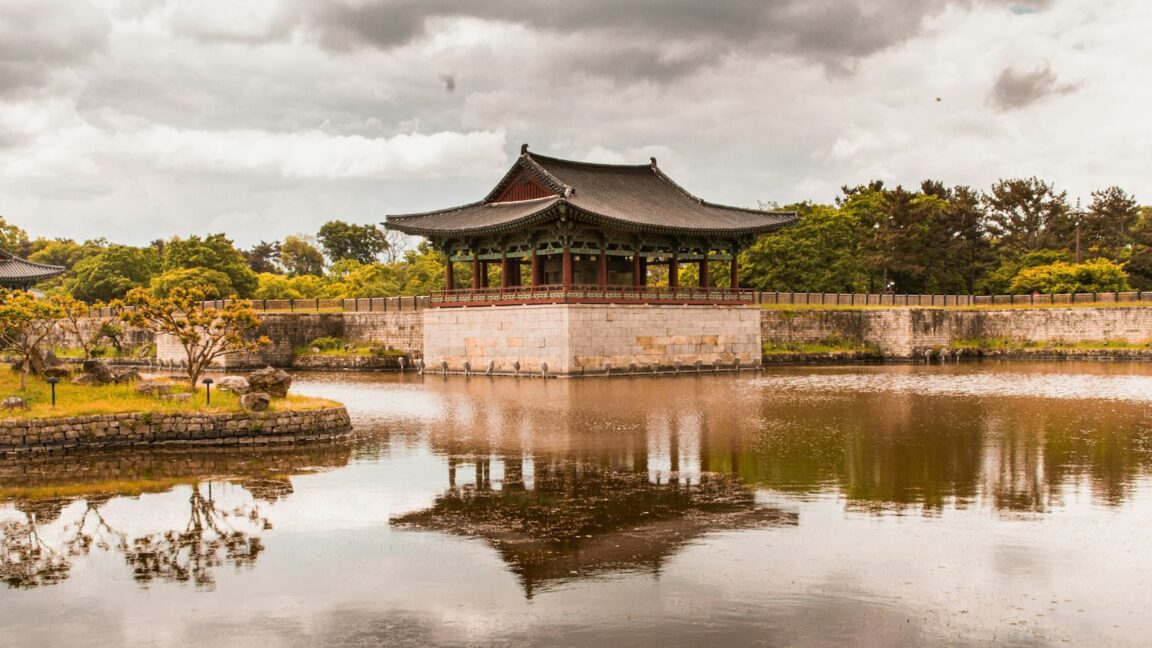
Save the palace site for the evening. Donggung, the East Palace, was the crown prince’s palace, and its Wolji Pond, a designed landscape of curved banks and small islets, was built in 674 as part of a larger palace complex. The excavated pavilions have been reconstructed on their original foundations, and after dark the buildings are lit and reflected in the pond in one of the most famous night views in Korea. Go at dusk, watch the light change, and expect company, because every Korean school group and couple in the city has the same idea.
The Gyeongju National Museum
Do the museum before the tombs if you can, or immediately after. The Gyeongju National Museum holds the gold crowns, jewellery and everyday objects excavated from the tumuli, including the famous gold crown from Cheonmachong, and its open air grounds display the great bronze Bell of King Seongdeok. An hour here converts the grass mounds outside from scenery into evidence.
How should Bulguksa and Seokguram be visited?
Together, on a morning, by bus or taxi to the slopes of Mount Toham southeast of the city. Bulguksa, the Temple of the Buddha Land, was founded in its present form in the eighth century, with construction begun in 751 under the Silla minister Kim Daeseong and completed by the court after his death. Visitors climb toward the halls past the twin stone staircases, Cheongungyo and Baegungyo, the Blue Cloud and White Cloud bridges, now protected rather than climbed, and into courtyards holding two of Korea’s most celebrated stone pagodas: the plain, perfectly proportioned Seokgatap and the ornate Dabotap, the pagoda that appears on the Korean 10 won coin. The wooden halls were rebuilt after wartime destruction in the 1590s, but the stone terraces, bridges and pagodas are Silla work, and the dancheong painting under the eaves carries the full colour system of Korean temple architecture.
Seokguram sits higher up the same mountain, reached by a shuttle bus or a forest path. It is an artificial stone grotto built in the same eighth century campaign, a domed granite chamber holding a monumental seated Buddha gazing toward the East Sea. Visitors view the Buddha from behind a glass screen and photography inside is not permitted, which produces a rarer experience than it sounds: a room full of people actually looking at something. Take the two sites in that order, temple first, grotto second, and be back in the centre by early afternoon.
What else earns time?
Walk Hwangnidan-gil in the late afternoon, when the hanok cafes and small shops are open and the light is kind, and rent a hanbok if that appeals, because Gyeongju is one of the places in Korea where wearing one at the sights feels like participation rather than costume. Ride or walk out to Bomun Lake, the resort area east of the centre, in blossom season. Cross the rebuilt Woljeonggyo bridge, the largest wooden bridge of its kind in Korea, at the southern edge of the centre. And eat the local specialties: Hwangnam bread, the small red bean pastry named for this district, is the souvenir everyone carries home, and the ssambap restaurants serving rice with leaf wraps and a table of side dishes are the classic Gyeongju lunch.
When is the best time to go, and how does it fit a Korea trip?
Spring and autumn are the obvious seasons, April for blossom and October into November for the maples at Bulguksa, but Gyeongju also works in winter, when the tombs under a dusting of snow and the lit pond at night justify the cold. Summer is hot and humid, and the open, shadeless tomb parks demand an early start. Logistically, Gyeongju sits naturally between Seoul and Busan on the rail map, and two nights here in the middle of that route gives a Korea trip its historical spine. Travelers coming from the coast can adapt the pacing of the first time Tokyo itinerary approach in reverse: put the dense, sight heavy days in the middle of the trip, not at the jet lagged start.
Frequently Asked Questions
How many days does Gyeongju need?
Two full days is the working minimum: one for the central tombs, observatory, museum and the palace pond at night, and one for Bulguksa and Seokguram with Hwangnidan-gil in the afternoon. A third day allows Bomun Lake, Woljeonggyo and a slower pace.
Can Gyeongju be done as a day trip from Busan?
It can, and many visitors do it, but it forces a choice between the central sights and Bulguksa, and it misses Donggung Palace and Wolji Pond after dark, which is one of the best experiences in the city. One night is the better minimum.
What is the one sight not to skip?
Bulguksa, for the combination of Silla stone engineering and living temple atmosphere. In the centre, the inside of Cheonmachong tomb is the single most instructive stop, because it shows how every grass mound in the city was made.
Is Gyeongju walkable?
The central historic belt is very walkable, and bicycles are popular for the flat streets around the tombs. Bulguksa and Seokguram require a bus, taxi or tour, as they sit on Mount Toham southeast of the centre.
When is cherry blossom season in Gyeongju?
Typically around the start of April, a little after the southern coast and before Seoul, with Bomun Lake the headline spot. Dates shift each year with the weather, so treat any specific week as an estimate rather than a promise.