 Aiko Tanaka
Kanazawa is the Japanese city that kept what war took from so many others. Never bombed in the Second World War, this castle town on the Sea of Japan coast preserved its samurai quarter, its geisha teahouse streets and one of the Three Great Gardens of Japan almost intact, and it now sits about two and a half hours from Tokyo by shinkansen. Travelers who love Kyoto but not its crowds are the ones who come here, and the comparison is fair: Kanazawa offers the same Edo period depth at a calmer pace, with better seafood.
Quick Facts
- Best for: Travelers who want Edo period streets, a great garden and serious food without Kyoto level crowds
- How long: Two full days for the garden, castle, both historic districts and Omicho Market, three to add the museums slowly
- The anchor: Kenrokuen, counted among the Three Great Gardens of Japan alongside Kairakuen in Mito and Korakuen in Okayama
- Kenrokuen hours: 7am to 6pm from 1 March to 15 October, 8am to 5pm from 16 October to the end of February
- Kenrokuen admission: 320 yen for adults, 100 yen for children aged 6 to 17
- The districts: Higashi Chaya, the largest geisha teahouse district, and Nagamachi, the samurai quarter of earthen walled lanes
- Getting there: Hokuriku Shinkansen from Tokyo to Kanazawa station, then loop buses to the sights
Why is Kenrokuen counted among Japan’s three great gardens?
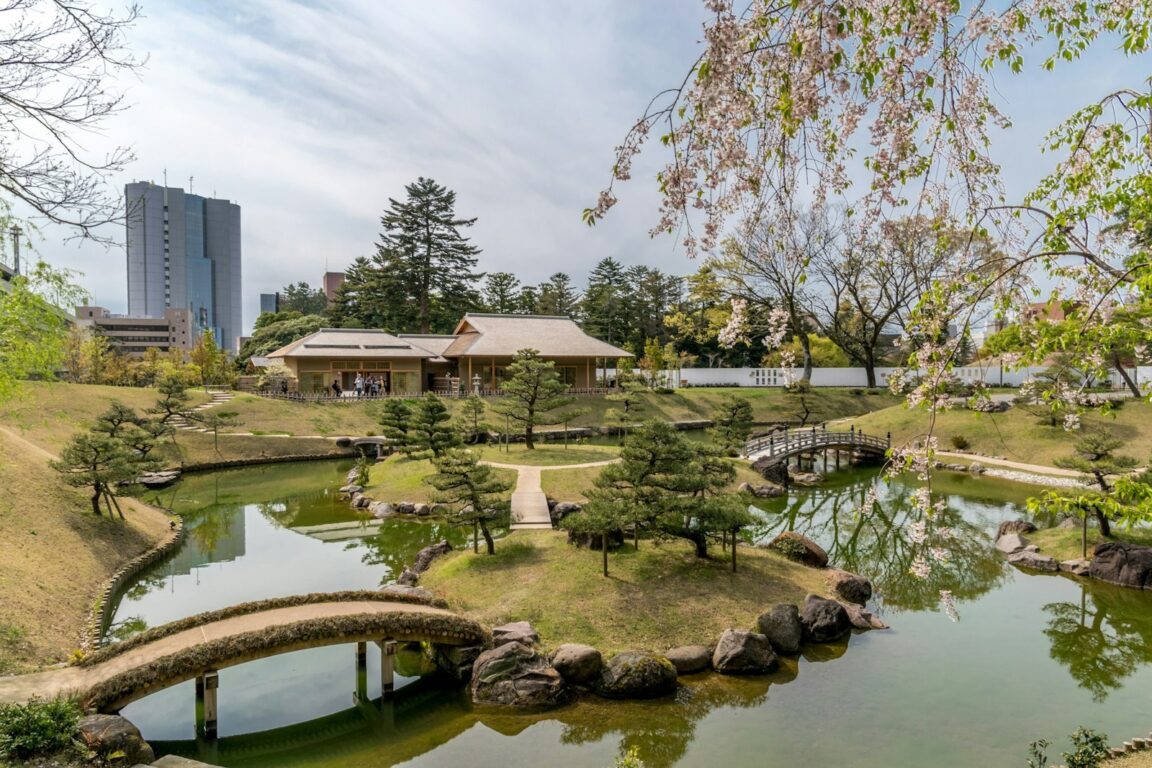
Because it was designed to hold six qualities that classical garden theory said could not coexist: spaciousness and seclusion, artifice and antiquity, flowing water and broad views. The name Kenrokuen means the garden combining six attributes, and the Maeda lords of the Kaga domain, the richest feudal family in Edo period Japan after the Tokugawa themselves, spent from the 1620s into the nineteenth century building it as the outer garden of Kanazawa Castle. The result covers about 11 hectares of ponds, streams, bridges, teahouses and sculpted pines on a hill above the city.
The practical way to visit is early. The garden opens at 7am in the main season, and the first hour belongs to gardeners, photographers and a handful of visitors. Head for Kasumigaike, the largest pond, and the Kotoji-toro, the two legged stone lantern on its shore that is the emblem of Kanazawa, then work outward to the Karasaki pine, trained so its branches reach over the water, and to the small fountain fed by natural pressure from the pond system, considered one of the oldest fountains in Japan. In winter the garden’s famous yukitsuri appear, the conical rope structures that hold the pine branches against Kanazawa’s heavy snow, and the roped trees reflected in the pond are the city’s signature cold season image. Admission is modest, 320 yen for adults and 100 yen for children aged 6 to 17, with hours of 7am to 6pm from 1 March to 15 October and 8am to 5pm from 16 October through February, according to the garden’s official visitor information.
What survived in the historic districts?
Higashi Chaya, the teahouse district
Across the Asano River from the centre, Higashi Chaya is the largest of Kanazawa’s three preserved geisha districts, a street of two storey wooden teahouses with latticed fronts, dating from the 1820s. Two historic teahouses open to visitors, and the gold leaf shops nearby are not a gimmick: Kanazawa produces almost all of Japan’s gold leaf, and the craft runs through everything from lacquerware to the gold leaf soft serve ice cream sold on this street. Come in the late afternoon, when the tour groups thin and the lanterns come on.
Nagamachi, the samurai quarter
On the other side of the centre, Nagamachi is a grid of narrow lanes walled in yellow brown earthen plaster, topped with tile, where the Maeda retainers lived. The Nomura family house is the essential interior: a high ranking samurai residence with a compact, exquisite garden of streams, lanterns and old pine arranged behind the tatami rooms. The lanes themselves, with their water channels and winter straw wrapping on the walls, need no ticket at all.
Kanazawa Castle and the modern museum
Between the garden and the districts, Kanazawa Castle Park holds faithful modern reconstructions of the castle’s gates, turrets and the long Gojukken Nagaya storehouse, rebuilt with traditional joinery after the originals were lost to fire in the nineteenth century. Ten minutes away, the 21st Century Museum of Contemporary Art, a low glass circle in the middle of the city, is the modern counterweight, famous for a swimming pool artwork viewed from above and below. Pairing the castle morning with the museum afternoon is the easiest way to feel the city’s two registers in one day.
Where should you eat?
At Omicho Market, which has fed the city for about three centuries and still functions as Kanazawa’s kitchen. The Sea of Japan side of the country eats differently from the Pacific side: winter brings snow crab and yellowtail, and the market’s sushi counters and kaisendon shops serve seafood rice bowls piled with crab, sea urchin, salmon roe and sweet shrimp. Go before noon, eat at a counter, and buy the local produce you will not see in Tokyo, including the plump Kaga vegetables bred for this region. In the evening, the streets around the station and Katamachi hold the izakaya, and the local sake, brewed with water from the same mountains that fill the garden ponds, is the correct order. Travelers structuring a wider Japan trip can slot Kanazawa after the capital using the pacing in the five day Tokyo itinerary: the shinkansen leg is short enough that Kanazawa works as the trip’s deep breath.
How does the coast beyond the city fit in?
Kanazawa is also the gateway to the Noto Peninsula, the rural arm of Ishikawa Prefecture reaching into the Sea of Japan, with its terraced rice fields, salt pans and fishing towns. The peninsula was struck by a major earthquake on 1 January 2024, and recovery in the northern towns is ongoing, so travelers considering a Noto side trip should check current local conditions and go in a way that supports rather than burdens the communities there. Within the city itself, the D.T. Suzuki Museum, a serene concrete and water complex honoring the Zen scholar who introduced Zen Buddhism to much of the West, and the small streets of the Kazuemachi district along the river, fill a quiet third day without effort. The winter weather deserves respect in planning: Kanazawa sits in Japan’s snow country, and the same moisture that makes the garden green makes December to February cold, wet and atmospheric in roughly equal measure, a contrast worth weighing against the temple weather in the guide to three days in Busan if you are combining the two coasts in one trip.
Frequently Asked Questions
How many days does Kanazawa need?
Two full days covers Kenrokuen, the castle, Higashi Chaya, Nagamachi and Omicho Market without rushing. A third day adds the 21st Century Museum, the D.T. Suzuki Museum and a slower market morning, and makes the trip feel settled rather than sampled.
When is Kenrokuen at its best?
Every season has an argument: cherry blossom in April, irises and green in early summer, maples in late November, and the yukitsuri roped pines in snow in winter, which many Japanese visitors consider the garden’s defining scene. The first hour after opening is the best time of day in every season.
Is Kanazawa a good alternative to Kyoto?
For many travelers, yes. It offers a great garden, geisha and samurai districts and a castle town layout with materially smaller crowds, and it was never bombed, so its historic fabric is original rather than reconstructed. It does not replace Kyoto’s temple density, but it competes on atmosphere and wins on calm.
How do you get around?
The main sights cluster within walking distance of each other around the garden and castle, and loop buses connect the cluster to Kanazawa station. Most visitors walk the centre and use the bus only for the station legs.
What should you buy in Kanazawa?
Gold leaf crafts are the signature purchase, from lacquerware and ceramics to cosmetics, and the food souvenirs are strong: sweet bean jellies, Kaga tea and sake. Buy gold leaf goods from established shops in or near Higashi Chaya, where the craft is the family trade.