 James Wolfe
Edinburgh’s Royal Mile rewards travellers who walk it backwards: start at the Palace of Holyroodhouse at the bottom, climb the quieter Canongate while the castle end is still waking up, and reach Edinburgh Castle as the day tours thin in the late afternoon. The street is four streets in one, Castlehill, the Lawnmarket, the High Street and the Canongate, running about one Scots mile from castle to palace, and every major stop on it rewards the reverse order.
Quick Facts
- Where: The Royal Mile, Edinburgh Old Town, Scotland, running downhill east from Edinburgh Castle to the Palace of Holyroodhouse and the Scottish Parliament.
- Length: About 1.8 kilometres, traditionally one Scots mile, in four sections: Castlehill, the Lawnmarket, the High Street and the Canongate.
- Palace of Holyroodhouse: The King’s official residence in Scotland. Adult tickets were £22 booked in advance and £26 on the day in 2026. From November to March it opens 9:30 a.m. to 4:30 p.m.; it is closed on Tuesdays and Wednesdays from mid September to mid May.
- Edinburgh Castle: Adult tickets were £23.50 online and £26 at the gate in 2026. Open daily from 9:30 a.m., closing at 6:00 p.m. from April to September and 5:00 p.m. from October to March, with last entry one hour before closing. Closed December 25 and 26.
- The Writers’ Museum: Free, in Lady Stair’s Close off the Lawnmarket, open daily 10:00 a.m. to 5:00 p.m., last entry 4:30 p.m.
- Cost of the walk itself: Nothing. The street, its closes and kirkyards are public; you pay only for the interiors you choose.
Why walk the Royal Mile from the bottom up?
Almost every visitor, tour bus and guidebook starts at the castle and walks down, which means the crowds move as one slow river all day: thickest at the top in the morning, thickest at St Giles’ by midday. Walking up reverses the flow. The Canongate, the bottom section, is at its best early, when its kirkyard, tolbooth clock and old burgh frontages belong to dog walkers and residents. The High Street fills as you climb it, which feels like arriving at a festival rather than being swept through one, and a late timed castle ticket, booked in advance like everyone else’s, lands you at the top as the esplanade empties and the light drops over the Firth of Forth.
There is a historical logic too. The Canongate was a separate burgh, grown up around Holyrood Abbey after David I founded it in 1128, and its canons gave the street its name. Edinburgh swallowed it later. Starting at the palace walks you from the younger, quieter burgh into the royal and legal heart of the old town, which is the order the street itself was built in.
What should you see at Holyrood and the Canongate first?
Begin at the Palace of Holyroodhouse, the King’s official residence in Scotland, standing against the crags of Arthur’s Seat. Inside are the state apartments, the throne room and the chambers of Mary, Queen of Scots, who lived here through the most dramatic years of her reign. In 2026 an adult ticket cost £22 in advance or £26 on the day, and the palace keeps winter hours of 9:30 a.m. to 4:30 p.m. from November to March, closing on Tuesdays and Wednesdays from mid September to mid May, so a bottom up walk in winter must start on a Thursday to Monday or skip the interior. The ruined abbey nave beside the palace and the gardens behind it are worth time even on a closed day.
Across the road stands the Scottish Parliament, free to enter on its open days, and then the Canongate proper begins. Pause at Canongate Kirk, the parish church at 153 Canongate with its distinctive Dutch gable, whose kirkyard holds the grave of Adam Smith and a statue of the poet Robert Fergusson outside. The Canongate Tolbooth, its clock projecting over the street since the 1590s, now houses The People’s Story museum, and the Museum of Edinburgh sits opposite in Huntly House. Both are small, free city museums on a Wednesday to Sunday pattern, and both are at their quietest before the downhill crowds arrive.
How do the closes and the High Street reward a slower climb?
Above the Netherbow, where the Canongate becomes the High Street, the Mile narrows and steepens into its famous section. This is the street of closes: narrow, stepped alleys dropping away on both sides, each signed with a name and a history. Dunbar’s Close hides a small garden, Bakehouse Close and Tweeddale Court reward a short detour, and every close frames the same trick, bright street at your back, quiet stone canyon ahead. Walking up, you meet each close against the crowd’s grain and get it to yourself for a moment.
On the High Street itself, John Knox House, the oldest house on the street, dates its story to the Reformation, and St Giles’ Cathedral, the High Kirk of Edinburgh founded in 1124, anchors the middle of the Mile. St Giles’ opens Monday to Friday from 10:00 a.m. to 6:00 p.m., Saturday from 9:00 a.m. to 5:00 p.m. and Sunday from 1:00 p.m. for general visiting, which makes it a natural mid climb stop in the bottom up order. Beside it, Parliament Square and the Mercat Cross mark the civic heart of the old town. Travellers who enjoy building a city walk around its writers should pair this climb with Dublin’s literary pub crawl, done from the books, the same idea in a different old town.
What is the Writers’ Museum detour, and why save it for the top?
In the Lawnmarket, near the top of the Mile, a signposted arch leads into Lady Stair’s Close and Makars’ Court, where flagstones are carved with quotations from Scottish writers. The Writers’ Museum, in the 17th century Lady Stair’s House, is devoted to Robert Burns, Sir Walter Scott and Robert Louis Stevenson, with manuscripts, portraits and personal objects, including Burns’s writing desk and Stevenson’s riding boots. It is free, open daily from 10:00 a.m. to 5:00 p.m. with last entry at 4:30 p.m., and it takes under an hour, which makes it the perfect last interior before the castle.
Saving it for the top also fixes the Mile’s literary geography in your head in the right order: Fergusson’s statue and Adam Smith’s grave in the Canongate kirkyard at the bottom, the Makars’ Court stones and the museum at the top, and Scott’s city spread out below the castle rock at the end. Walkers continuing a Scottish and northern route can extend the pattern with Hadrian’s Wall Path, walked in sections across the border country to the south.
How should you finish at Edinburgh Castle?
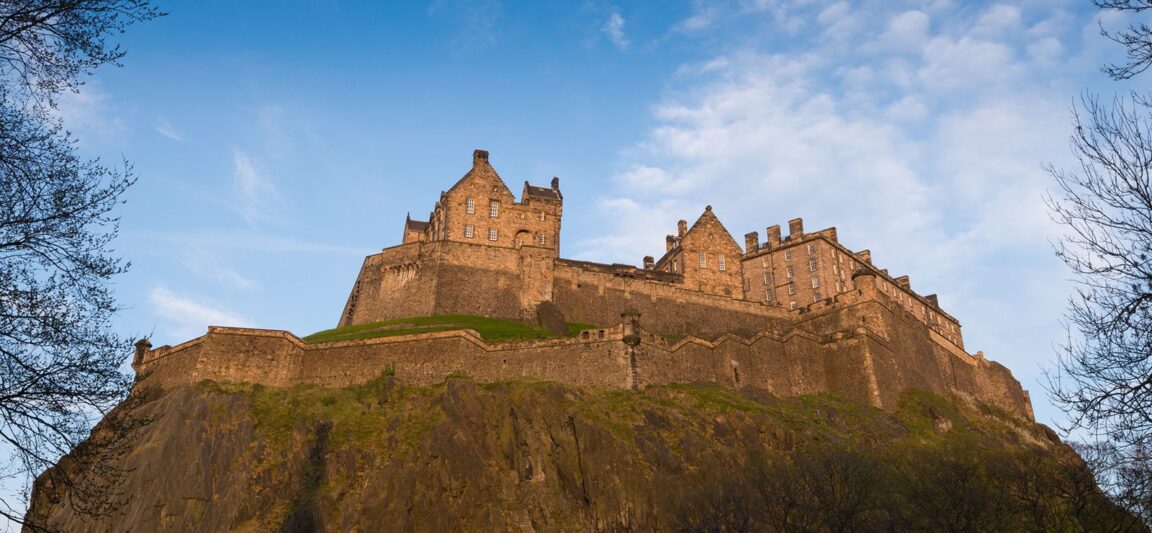
The castle crowns Castle Rock, the plug of an extinct volcano, and holds the Honours of Scotland, the Stone of Destiny, St Margaret’s Chapel and the National War Museum. Book a timed ticket in advance: in 2026 adults paid £23.50 online against £26 at the gate, and once the online allocation sells out, no tickets are sold on site. Hours run from 9:30 a.m. to 6:00 p.m. from April to September and to 5:00 p.m. from October to March, with last entry an hour before closing, so a bottom up day should aim for a mid to late afternoon slot, not the final one.
If your timing lands near 1:00 p.m. on the High Street, you will hear the One O’Clock Gun from the castle above you; it fires daily except Sundays, Good Friday and Christmas Day. Finishing at the esplanade in the late afternoon gives you the castle’s westward view in the day’s best light and an easy downhill stroll, against nobody, back into the old town for dinner. The bottom up walk takes half a day at a strolling pace, a full day with the palace, St Giles’ and the castle all done properly.
Frequently Asked Questions
How long is the Royal Mile?
About 1.8 kilometres, traditionally described as one Scots mile, running from Edinburgh Castle down to the Palace of Holyroodhouse in four sections: Castlehill, the Lawnmarket, the High Street and the Canongate.
Is it better to walk the Royal Mile up or down?
Down is the classic route, but up is the calmer one. Starting at Holyrood puts you in the quiet Canongate early, moves you against the main crowd flow, and delivers you to a prebooked late afternoon castle ticket as the esplanade thins.
How much does Edinburgh Castle cost?
In 2026 an adult ticket was £23.50 booked online or £26 at the gate. The castle opens daily at 9:30 a.m. and closes at 6:00 p.m. from April to September and 5:00 p.m. from October to March, with last entry one hour earlier. Book online in advance, because sold out days offer no tickets on site.
When is the Palace of Holyroodhouse closed?
The palace closes on Tuesdays and Wednesdays from mid September to mid May, and over Christmas. Winter hours, November to March, are 9:30 a.m. to 4:30 p.m. Adult tickets in 2026 were £22 in advance and £26 on the day.
Is the Writers’ Museum free?
Yes. The Writers’ Museum in Lady Stair’s Close, off the Lawnmarket, is free and open daily from 10:00 a.m. to 5:00 p.m., with last entry at 4:30 p.m. It covers Burns, Scott and Stevenson, and the inscribed stones of Makars’ Court sit in the close outside.
Photo: Edinburgh Castle on Castle Rock, at the top of the Royal Mile. Credit: Edinburgh Castle, via edinburghcastle.scot, the castle’s official website (Historic Environment Scotland).