 Camille Baptiste
Nayara Bocas del Toro is an adults-only, all-inclusive resort on its own private island in Panama’s Bocas del Toro archipelago, reached by a boat ride of about 15 to 30 minutes from Bocas Town, and it earns its place on a Caribbean shortlist for three things no mainland resort can copy: overwater villas with private plunge pools and glass floor inlays above a living reef, IBUKU-designed treehouses standing 50 feet up in the canopy, and Kupu Kupu Beach, an aerial beach of white sand built on stilts over the sea because the island’s mangrove shoreline has no natural beach at all. The style throughout is Balinese craft transplanted to an Afro-Caribbean archipelago, down to the century-old Balinese Elephant House restaurant and hand-carved teak canopies over the beds.
Quick Facts
- Where: A private island, Isla Frangipani, in the Bocas del Toro archipelago, Panama, with 3.1 miles of Caribbean shoreline per the resort.
- Access: Boat only. The resort puts the crossing from Bocas Town at about 15 minutes; its own editorial describes the transfer at up to 30 minutes depending on conditions.
- Who it suits: Adults only and all-inclusive, aimed at couples rather than families or groups wanting a town on the doorstep.
- Overwater Pool Villa: 102 square metres (1,100 square feet) of indoor and outdoor living space, king bed under a Balinese Tumpang Sari canopy, glass floor inlay, private pool, fire pit and an ocean-front terrace with a swim-up staircase.
- Presidential Overwater Villa: 191 square metres (2,056 square feet), indoor and outdoor saltwater infinity pool, ceilings above 20 feet, a dedicated 24-hour concierge, one private chef dinner per stay and couples’ spa treatments included.
- Treehouses: Designed by Elora Hardy’s IBUKU studio, built from locally harvested bamboo and hardwoods recovered from the Panama Canal, 50 feet above the ground.
- The beach: Kupu Kupu Beach, the resort’s aerial beach on stilts, about 90 feet long by 20 feet wide, with the Tipsy Bar and tiled stairs that enter the sea like a swimming pool.
What is it like to sleep over the water here?
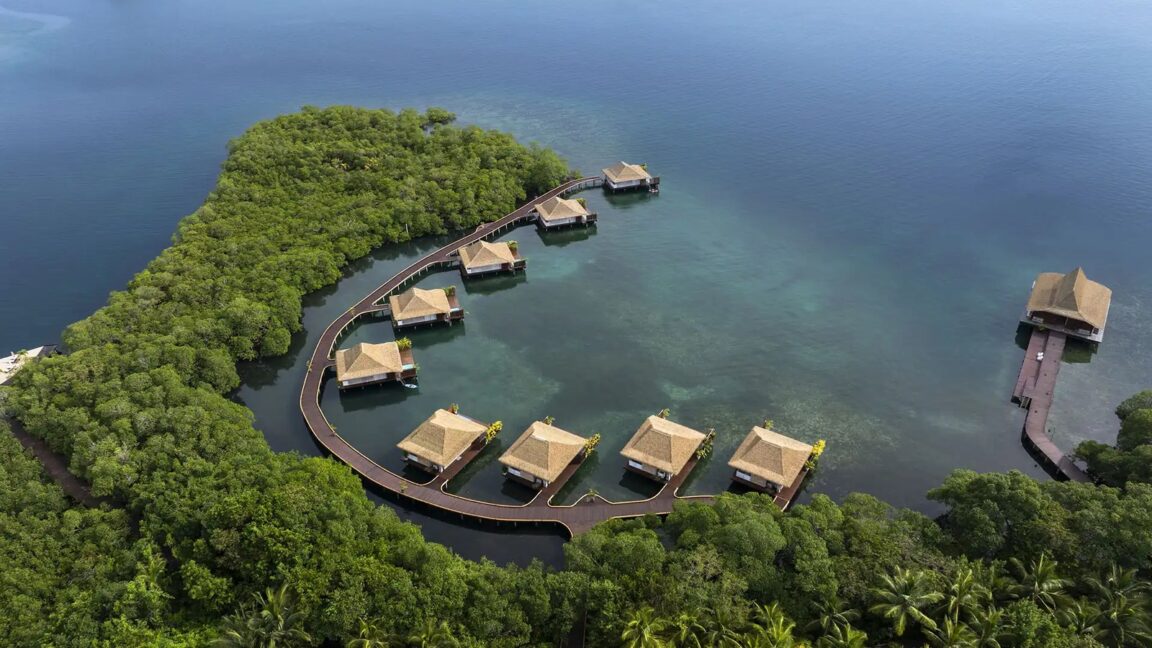
The overwater villas are the resort’s signature, and their details are more thoughtful than the usual deck-and-hammock formula. The standard Overwater Pool Villa runs to 102 square metres split between the interior and a broad ocean-front terrace, with a private plunge pool, a fire pit, and a swim-up staircase that drops straight from the terrace into the Caribbean. Inside, a glass floor inlay keeps the reef in view from the bed level, and the four-poster king sits under a hand-carved Balinese Tumpang Sari canopy, the layered teak structure that gives these rooms their temple-like calm. The Deluxe version keeps the same footprint and pool and leans harder into the carved interiors.
The Presidential Overwater Villa is a different scale of thing: 191 square metres, ceilings above 20 feet, and a saltwater infinity pool that runs from inside the villa out through glass walls toward the sea, reached directly from the bedroom. It carries its own 24-hour concierge, a private wet bar with wine refrigerator, one private chef dinner per stay and couples’ treatments at the Colibri Spa or in the villa. Travellers weighing overwater formats against a classic beach resort can set Nayara beside the very different Kohala Coast model in Hapuna and Mauna Kea’s second act on Hawaii’s Kohala Coast, where the ocean is met from a wide natural beach rather than from a deck above it.
How does an aerial beach work?
Kupu Kupu Beach exists because the island does not. The shoreline is mangrove, and building a conventional beach would have damaged the mangrove and the seabed, so the resort built the beach in the air instead: a platform of white sand on stilts over the water, roughly 90 feet long and 20 feet wide, which the resort bills as the world’s first aerial beach. Four palm trees appear to grow out of the sand; they are planted in tanks below the surface and monitored to keep them healthy. Beneath the sand, a drainage system of some ninety drains covered in geotextile lets rainwater pass while holding the sand in place.
The cleverest detail is the entry to the sea. There are no ladders. Tiled stairs descend to a submerged platform, so walking into the Caribbean feels like walking into a swimming pool, with a mid-level step where swimmers can sit with their feet in the water and park masks and fins between swims. The Tipsy Bar anchors one end of the beach under a curved wood-shake roof, with seating for eight and loungers for about twenty more. It is an engineered solution that sounds like a gimmick and reads, in person-sized terms, as the resort’s social centre: the place the whole island drifts toward by mid-morning.
What about the treehouses and the rest of the island?
The second way to sleep here is vertical. The treehouses were designed by IBUKU, Elora Hardy’s Bali-based studio, and built from locally harvested bamboo together with hardwoods recovered from the bottom of the Panama Canal, wood that grew stronger during its long submersion. At 50 feet above the forest floor they look out over rainforest, mangrove and ocean, with hand-hammered copper Javanese bathtubs and private ocean-view terraces. Between the villas and the treehouses, boardwalks thread a botanical garden across an island where coral reef, mangrove forest and lowland rainforest meet, the combination that led the resort to call Bocas del Toro the Galapagos of the Caribbean.
Dining leans into the Balinese theme at the Elephant House, a Balinese structure about a century old that was transported to the island and now serves dinner over the water. Days organise themselves around the water: snorkelling the reef below the villas, paddleboarding, garden walks and the spa. Because everything arrives and leaves by boat, including the guests, the resort runs as a self-contained world; travellers who want Bocas Town’s bars and Afro-Caribbean street life should plan a town night before or after the island stay rather than treating the crossing as a commute. For a contrasting take on a resort that builds its own landscape, see Under Canvas Grand Canyon, safari tents at the South Rim’s quiet edge, where the design problem was desert cold rather than a missing beach.
Who should book Nayara, and who should not?
Book it for a honeymoon-style stay where the room itself is the destination, for the novelty that survives scrutiny (the aerial beach and the treehouses are genuinely unlike anything else in the Caribbean), and for an all-inclusive format that removes every decision after the boat docks. Skip it if travelling with children, since the resort is adults only; if a natural sand beach under your room is non-negotiable, since the beach here is a beautiful construction rather than a shoreline; or if your Panama trip is really about Bocas Town’s nightlife, which belongs to a stay in town. Rates move with season and villa class and are best checked on the resort’s own booking channel for your dates; what does not change is the structure of the place, a private island that solved its missing beach by building one in the air.
Frequently Asked Questions
How do you get to Nayara Bocas del Toro?
By boat from Bocas Town. The resort describes its private island as about 15 minutes by boat from town; allow up to 30 minutes depending on conditions. There is no road access.
Is Nayara Bocas del Toro adults only?
Yes. The resort is adults only and all-inclusive, and its villa and treehouse mix is designed for couples.
What is the aerial beach?
Kupu Kupu Beach is a white sand beach built on stilts over the sea, about 90 feet by 20 feet, created because the island’s mangrove shoreline has no natural beach. Tiled stairs lead into the water like a pool entry, and the Tipsy Bar sits at one end.
What is the difference between the overwater villa types?
The Overwater Pool Villa and its Deluxe version offer 102 square metres with a private plunge pool, glass floor inlay and swim-up terrace stairs. The Presidential Overwater Villa is 191 square metres with an indoor and outdoor saltwater infinity pool, ceilings above 20 feet, a dedicated 24-hour concierge and a private chef dinner included per stay.
What are the treehouses made from?
Locally harvested bamboo and hardwoods recovered from the Panama Canal, in designs by Elora Hardy’s IBUKU studio. They stand about 50 feet above the ground with views over forest, mangroves and ocean.
Photo: An aerial view of the overwater villas curving around the lagoon at Nayara Bocas del Toro, Panama. Credit: Nayara Bocas del Toro, via the resort’s official website (nayarabocasdeltoro.com).