 LeVar Thomas
Choose Mauna Kea if the beach itself is the holiday: its crescent of white sand on Kaunaoa Bay, the manta rays feeding under the lights after dark, and a landmark golf course redesigned by the son of its original architect. Choose the Westin Hapuna if you want the bigger, broader beach and a more contemporary resort feel, with the same Kohala Coast sunshine and reciprocal access to its sister hotel up the coast. The two properties share the 1,839 acre Mauna Kea Resort, sit a short drive apart, and after Mauna Kea Beach Hotel’s nearly $240 million renovation, confirmed by the resort in February 2026, the comparison is closer and more interesting than it has been in years.
Quick Facts
Where: Kohala Coast, Island of Hawaii, both hotels at 62-100 Kauna’oa Drive, about 35 minutes from Kona International Airport
Mauna Kea Beach Hotel: Opened 1965, developed by Laurance S. Rockefeller, 252 rooms and suites after the renovation, Autograph Collection
The Westin Hapuna Beach Resort: Opened 1994 as Hapuna Beach Prince Hotel, rebranded as a Westin in 2018 after a renovation of nearly $50 million, 249 rooms including 17 suites
The beaches: Kaunaoa Bay at Mauna Kea, a sheltered crescent; Hapuna Beach, a long, wide state beach park frontage, regularly rated among America’s best beaches
Golf: Mauna Kea Golf Course, redesigned by Robert Trent Jones Jr.; Hapuna Golf Course, par 72, up to 6,895 yards, designed by Arnold Palmer and Ed Seay
Shared perk: Reciprocal signing privileges between the two hotels, with a complimentary evening dining shuttle, per the Westin Hapuna fact sheet
What did Mauna Kea’s $240 million renovation actually change?
Almost everything a guest touches. The resort’s own announcement lists 252 fully reimagined guestrooms and suites across the Main Tower and the Beachfront Wing, with the midcentury modern bones deliberately preserved: original terrazzo flooring in the Beachfront Wing, the iconic blue tile in the Main Lobby, and the Main Tower’s wide lanais all stayed. Rooms gained rich woods, handcrafted textiles inspired by Hawaiian weaving and quilting, ceiling fans, plantation shutters, deep soaking tubs, and bedside lighting control panels.
Outside the rooms, the family resort pool was refreshed with a new oceanfront hot tub and five private cabanas, and a new oceanfront wellness retreat added a 2,500 square foot fitness centre and an adults only infinity lap pool. The Rockefeller Art Collection, more than 500 works including Hawaiian kapa cloth and quilts, was professionally restored as a million dollar curated gallery. Photovoltaic solar panels now supply approximately 45 percent of the resort’s electrical energy needs, according to the resort. The Spa at Mauna Kea followed in spring 2026 with 11 treatment rooms, purification gardens, steam and sauna facilities, and a vitality pool.
Which beach is better for swimming: Kaunaoa or Hapuna?
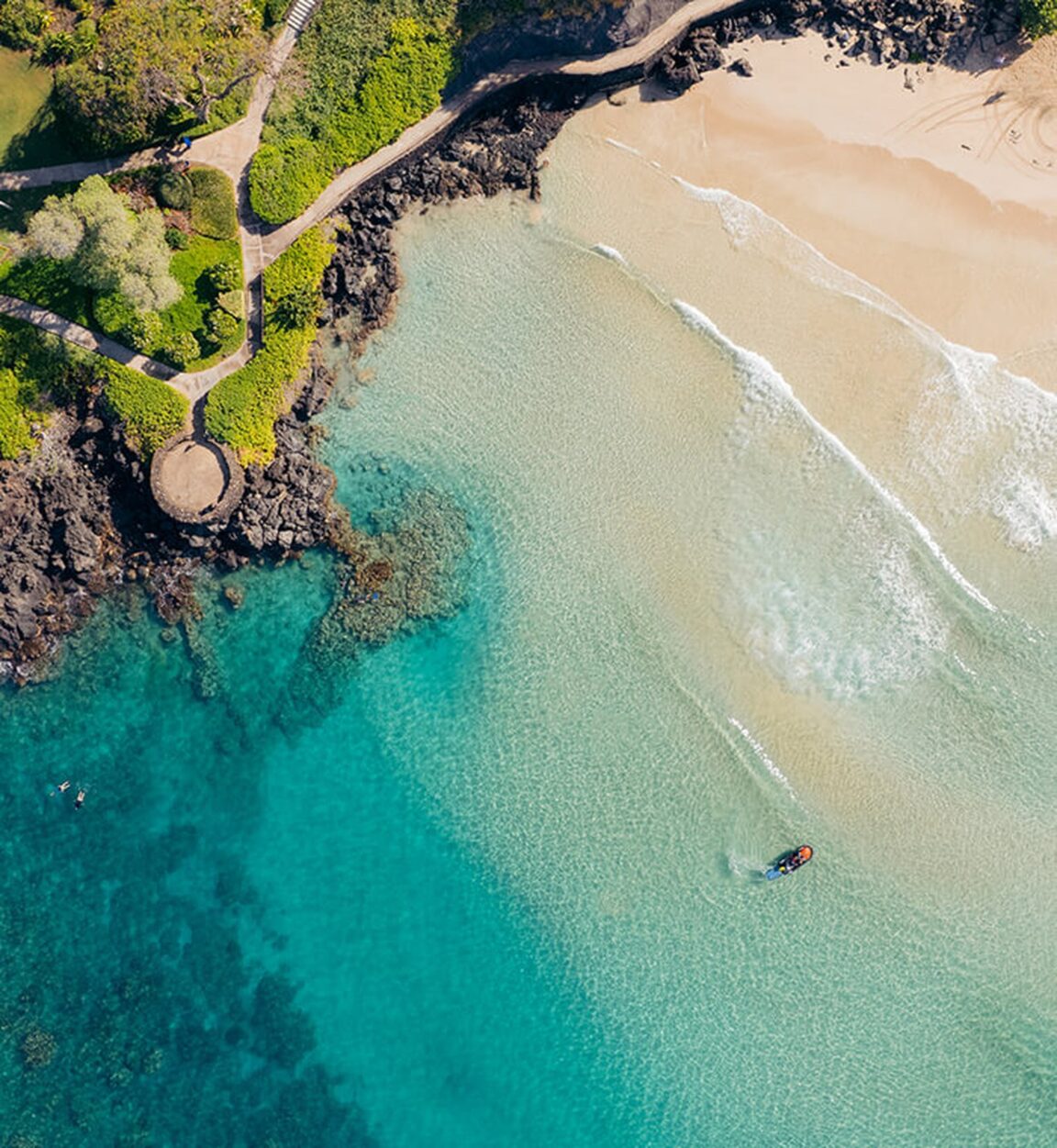
This is the decision that should drive the booking. Kaunaoa Bay, fronting Mauna Kea, is a sheltered crescent with a gently sloping sandy bottom, rocky points at both ends that hold the snorkelling, and a scale that feels private even though all Hawaii beaches are public. Public access parking is famously limited, which keeps the sand quiet, and hotel guests simply walk out of the Beachfront Wing onto the lawn and the sand. In calm conditions it is the better beach for unhurried swimming, floating, and snorkelling the reef edges at either end.
Hapuna Beach, fronting the Westin, is the grander public beach: a long, wide sweep of white sand with room for everyone, bodysurfing and bodyboarding when the shore break is friendly, and a state recreation area’s space to spread out. The trade off is exposure. Hapuna takes the winter surf more directly, and on rough days the shore break deserves real respect at both beaches. Swimmers who want calm water most mornings lean Mauna Kea; travellers who want a big beach day with space, sand, and a livelier scene lean Hapuna. Budget for the wider Hawaii costs either way: our guide to Hawaii’s green fee and the 11 percent lodging tax explains what now lands on the hotel bill.
Where do the manta rays come in?
Mauna Kea owns this category outright. Floodlights above the water at Manta Ray Point, beside the Manta restaurant above Kaunaoa Bay, attract plankton after dark, and plankton attracts manta rays, which loop and barrel roll through the lit water feeding. Guests can watch from the point itself, and guided manta ray night snorkel tours depart from the resort, putting snorkellers on a floating light platform while the rays feed below. It is the single most distinctive evening on the Kohala Coast, it costs nothing to watch from shore, and it is the strongest argument for Mauna Kea if your trip is built around the ocean after dark. Hapuna has no equivalent, though its sunsets over that wide west facing sand run it close for pure scenery.
Golfers versus swimmers: how does each hotel score?
What should golfers choose?
Golfers get two strong, different courses inside one resort. Mauna Kea Golf Course, the island’s first resort course, was originally designed by Robert Trent Jones Sr. and has been redesigned by his son, Robert Trent Jones Jr., as part of the renovation era, keeping the famous ocean crossing holes and the dramatic lava and coastline routing. Hapuna Golf Course, designed by Arnold Palmer and Ed Seay, climbs into the hills above the coast for panoramic views, and received a million dollar enhancement that converted playing surfaces to seashore paspalum, reshaped select fairways, and upgraded bunkers. The Hapuna course plays up to 6,895 yards at par 72, with a course rating of 73.3 and slope of 136 from the championship tees, per the resort. Staying at either hotel, you can play both; golfers who want the storied name on their scorecard stay at Mauna Kea, golfers who prefer the hillier, more forgiving test often end up happier at Hapuna.
What should swimmers and beach people choose?
Swimmers should weight the beach sections above heavily, then the pools. Mauna Kea now pairs its family pool and new hot tub with the adults only infinity lap pool at the wellness retreat, a genuine lap swimming asset that Hapuna counters with its own family pool and adult exclusive infinity pool. On the sand, Kaunaoa wins for snorkelling and calm water, Hapuna wins for space, sand quality in quantity, and long beach walks. Families split the difference by staying at one and visiting the other: the coastal trail between the two beaches runs about a mile, and the evening dining shuttle makes cross resort dinners simple.
How do the rooms and dining compare after the renovations?
Mauna Kea’s renovated rooms lean heritage luxury: quieter, warmer, and tied to the art collection and the building’s 1965 silhouette, split between the elevated Main Tower and the step onto the lawn Beachfront Wing. Hapuna’s 249 rooms were redone in its 2018 Westin rebrand in a brighter contemporary Hawaiian style, with Westin signatures including the Heavenly Bed and Heavenly Shower, and many rooms face the long beach from a terraced hillside. Neither is a wrong answer; Mauna Kea feels like a landmark that has been lovingly restored, Hapuna like a modern resort that happens to share a famous surname.
Dining follows the same pattern. Mauna Kea’s signature Manta, perched above Kaunaoa Bay, was refreshed with a garden to table menu built on the resort’s new 28,000 square foot Ulu Garden, and the beachfront Hau Tree now becomes Hau Tree Cantina in the evening, serving contemporary regional Mexican dishes steps from the sand. Hapuna offers four restaurants and lounges, reciprocal signing at Mauna Kea, and that complimentary evening shuttle, so in practice a stay at either hotel eats across both. For a very different desert take on the restorative resort stay, compare Castle Hot Springs in Arizona.
So, Mauna Kea or Hapuna: which one should you book?
Book Mauna Kea if you want the classic: the sheltered bay, the mantas after dark, the art, the landmark golf course, and the sense of staying somewhere with 60 years of memory in its walls, now thoroughly renewed. Book Hapuna if the big beach is the point, if you prefer a contemporary room product, or if the Westin rate for your dates undercuts its sister by enough to fund the golf and the snorkel tours. Either way, you are buying into the same resort, the same coast, and the same trade winds, and the honest answer is that the second act has made both halves of Rockefeller’s original dream worth the flight.
Frequently Asked Questions
Are Mauna Kea Beach Hotel and the Westin Hapuna the same resort?
They are sister hotels within Mauna Kea Resort, sharing 1,839 acres on the Kohala Coast, with reciprocal signing privileges and a complimentary evening dining shuttle between them, according to the resort.
Can you see manta rays at Mauna Kea without a tour?
Yes. Lights at Manta Ray Point above Kaunaoa Bay attract plankton and feeding mantas after dark, and the viewing point is open to guests. Guided night snorkel tours are the in water option.
Which beach is calmer for children?
Kaunaoa Bay at Mauna Kea is generally the more sheltered swim, with a gentle slope and protected crescent. Conditions change daily at both beaches, so always check the surf before swimming.
How many rooms does each hotel have?
Mauna Kea Beach Hotel lists 252 rooms and suites after its renovation. The Westin Hapuna Beach Resort lists 249 rooms, including 17 suites, in its resort fact sheet.
When was Mauna Kea Beach Hotel built?
It opened in 1965, developed by Laurance S. Rockefeller, and was Hawaii Island’s first resort, according to the resort. Hapuna followed in 1994.