 Jonas Lindqvist
Stay in Bryggen if you want Bergen’s postcard outside your door and do not mind paying for it or hearing the harbour wake up early. Stay on the Nordnes peninsula if you want the quiet version of the same old town, white wooden houses, cobbled lanes, and a ten minute walk back from the fish market. And treat any hotel up the Floyen hillside with one question: does the Floibanen funicular genuinely serve it, station by station, or will you be walking a steep hill in the rain with luggage? Bergen is compact, wet, and vertical, and the right base is the one that matches how you actually move through it.
Quick Facts
City layout: Bergen centre wraps around the Vagen harbour; Bryggen lines its eastern shore, Nordnes is the peninsula on the western side
Bryggen: UNESCO World Heritage Site since 1979, Hanseatic trading wharf, about 62 wooden buildings survive behind the famous facades
Nordnes: Residential peninsula of small old houses and narrow cobbled streets, home to the Bergen Aquarium, per Visit Bergen
Floibanen: Lower station at Vetrlidsallmenningen, a short walk behind the Fish Market; ride to Mount Floyen at 320 metres in about 6 minutes
Funicular price, winter 2026: Adult return NOK 145, one way NOK 80; return with the Bergen Card NOK 75, per Visit Bergen’s published 2026 fares
Funicular hours: Weekdays 07:30 to midnight, weekends 08:00 to midnight, per the operator’s published hours
Airport: Bybanen light rail runs from Bergen Airport to the city centre in about 45 minutes
What is it actually like to stay in Bryggen?
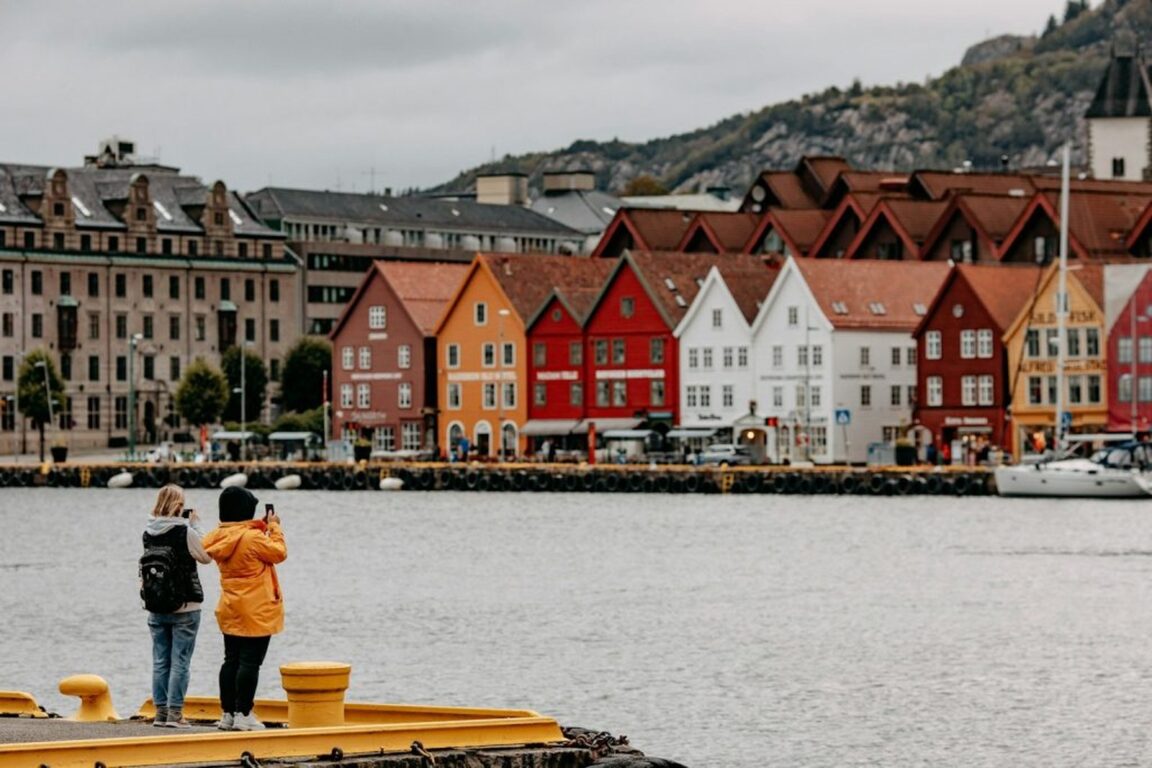
Bryggen is the Hanseatic wharf: a row of gabled wooden warehouses in ochre, rust, and white, rebuilt after the great fire of 1702 on medieval foundations and inscribed by UNESCO in 1979. Staying here, or on the streets immediately behind it, puts the Fish Market, the Floibanen lower station, the fjord boat quays, and the Bryggens Museum within a few flat minutes. Visit Bergen lists hotels right on the wharf, including the Hanseatic Hotel inside the old merchant houses and the Home Hotel Havnekontoret in the former harbour office. For a first visit of two nights or less, this is the efficient choice, and our day by day plan in 2 Days in Bergen assumes exactly this base.
The costs are noise, crowds, and price. Bryggen is Bergen’s busiest ground by day, tour groups move through the alleyways from mid morning, and there is no budget tier on the wharf itself. Rooms facing the harbour get the view and the harbour life that comes with it. Rooms in the lanes behind get the atmosphere, the creaking wooden galleries, and a quieter night. If your trip is a fjord tour with an early boat, or a Bergen Railway departure, Bryggen and the station side streets behind it are still the pragmatic answer: everything leaves from here.
Why do locals point visitors to Nordnes instead?
Nordnes is the peninsula that forms the western arm of the harbour, and it feels like the village Bergen grew around. Visit Bergen describes it for its small, charming old houses and narrow cobblestone streets, close to the Bergen Aquarium at the point. Staying here, for example at the small Klosterhagen Hotel, trades the postcard for residential calm: laundry lines, cats on doorsteps, swimmers heading for the Nordnes seawater pool in summer, and streets that empty after dinner. The walk to Bryggen is roughly ten to fifteen minutes along the harbour, flat and scenic, which in Bergen terms is nothing, until it rains sideways, which in Bergen terms is Tuesday.
Nordnes suits longer stays, repeat visitors, and anyone who finds Bryggen’s daytime crowds wearing. It has fewer hotels, fewer restaurants on the doorstep, and no transport advantage, since you walk or take a short bus ride everywhere anyway. What it returns is sleep quality and a sense of living in the city rather than visiting its museum quarter. Travellers building a wider western Norway trip often pair a Nordnes base with the coastal routes covered in our Norway in a Nutshell route guide.
How does the Floibanen change what a hillside hotel is worth?
The Floibanen funicular has climbed from Vetrlidsallmenningen to Mount Floyen since 1918, rising to 320 metres in about 6 minutes, with cars roughly every 10 to 15 minutes through the day and a service span from 07:30 to midnight on weekdays. That timetable is what makes hillside addresses viable: intermediate stations on the slope are served on the hour and half hour, so a hotel near one of those stops gets a mechanical lift home, while a hotel between stops, or above the top station on an unlit lane, gets a daily hill workout instead.
Price the trade off honestly with the operator’s winter 2026 fares: an adult return is NOK 145 and a one way NOK 80, with the Bergen Card cutting a return to NOK 75. If a hillside hotel saves you NOK 300 a night against Bryggen and you ride down and back once a day, the maths works in winter. In summer, when the return rises and queues at the lower station stretch at midday, it works less well. The real value of the funicular is not the fare, though: it is that a Floyen address gives you the city’s best view, forest trails from the top station, and a 45 to 60 minute downhill walk home through the woods when you feel like it. A hillside hotel is a feature if you will use the mountain daily, and a tax if you will not.
What about the weather: which base handles Bergen rain best?
Bergen is one of Europe’s rainiest cities, and the honest planning unit is not the day, it is the wet walk. Bryggen wins on exposure: the shortest walks to indoor anchors, the Bryggens Museum, the Hanseatic Museum, the covered Mathallen food hall at the Fish Market, and the funicular lower station for a quick escape above the clouds when they lift. Nordnes asks for one longer harbour walk in whatever the sky is doing, then repays you with the cosiest streets to come home to. Hillside bases ask the most of your waterproofs and your knees, and reward you when the weather breaks, because Floyen above a rain washed city is Bergen at its best.
Practically: pack for rain regardless of base, choose Bryggen for a short winter trip when daylight and dry intervals are precious, choose Nordnes for a longer or summer stay, and choose the hillside only with a confirmed funicular station within a few minutes of the door. Whatever you pick, you are rarely more than 20 minutes on foot from the harbour in this compact centre, which is why Bergen tolerates indecision better than most cities.
Which Bergen base should you book, by trip type?
First timers on two nights: Bryggen or the streets behind it, no contest. Fjord tour passengers with early departures: Bryggen or the station side, for the shortest alarm to quay distance. Repeat visitors and slow travellers: Nordnes, for the residential city. View hunters and walkers who will ride the Floibanen daily: a hillside address near a middle station, fare maths checked. Families: the centre near Torgallmenningen, where Visit Bergen notes the widest hotel choice, flat walking, and the light rail to the airport. Bergen’s centre is small enough that no choice is a mistake; it is only a question of which walk you want to take twice a day.
What do the station streets and Torgallmenningen add?
Two more bases deserve a mention before you book. The streets around Bergen Station, east of the centre, suit travellers arriving on the Bergen Railway from Oslo or leaving early for Flam: practical chain hotels, the shortest walk with luggage, and Bryggen still only ten minutes away across the centre. Torgallmenningen, the broad pedestrian square south of the harbour, is the city’s commercial heart, close to the KODE art museums on the Lille Lungegardsvann lake and the Bybanen stop for the airport. It lacks Bryggen’s romance and Nordnes’s calm, but for a one night stopover with an early flight it may be the most sensible address in the city. Both areas also tend to price below the wharf, which in Bergen, one of Norway’s most expensive hotel markets, is a consideration worth weighing against a slightly longer morning walk.
Frequently Asked Questions
Is Bryggen the best area to stay in Bergen for a first visit?
For most first visits, yes. It puts the UNESCO wharf, the Fish Market, the Floibanen, and the fjord boats within a few flat minutes, at the cost of the city’s highest rates and busiest streets.
How long does the Floibanen take and what does it cost in winter 2026?
About 6 minutes from the city centre station to Mount Floyen at 320 metres. Visit Bergen’s published winter 2026 fares are NOK 145 for an adult return and NOK 80 one way, with a Bergen Card return at NOK 75.
Is Nordnes walkable to Bryggen?
Yes, roughly ten to fifteen minutes on foot along the harbour, on the flat. It is a pleasant walk in fair weather and an exposed one in heavy rain.
When was Bryggen added to the UNESCO list?
In 1979. About 62 wooden buildings survive, rebuilt in traditional patterns after the 1702 fire destroyed the quarter.
Do I need a car if I stay in central Bergen?
No. The centre is walkable, the Bybanen light rail covers the airport run in about 45 minutes, and fjord tours and the Bergen Railway leave from the centre.