 River Callahan
Lisbon can work well with a mobility limit, but only if the trip is rebuilt around the flat city rather than the famous one. The workable Lisbon is the Baixa grid and the riverfront, the modern low floor tram 15E to Belem, Carris buses with ramps, and a Metro network where, according to Metro Lisboa reporting in 2026, 47 of 56 stations have full accessibility. The unworkable Lisbon is heritage tram 28, the Alfama lanes and any itinerary that treats the seven hills as a minor detail. Plan for the first city, use lifts instead of climbs wherever a viewpoint matters, and Lisbon stops being a warning and becomes a genuinely manageable capital.
Quick Facts
Best base: Baixa, on the flat post earthquake grid between Rossio and Praca do Comercio, or the riverfront in Belem
Most accessible tram: Tram 15E, modern low floor cars from Praca da Figueira and Cais do Sodre to Belem
Tram to skip: Heritage tram 28E and the other vintage lines, with high steps and narrow doors
Metro: 47 of 56 stations fully accessible according to Metro Lisboa in 2026, so check both ends of every journey and live lift status before travelling
Buses: Carris reports around 90 percent of buses are low floor and more than 73 percent carry full reduced mobility equipment, including a ramp and wheelchair space
Hills to skip entirely: Alfama above the cathedral, the castle climb, Graca and the Bairro Alto lanes on foot
Facts checked: 22 November 2026, against Carris and Metro Lisboa official information
Why does the Baixa grid change everything?
Baixa is the district rebuilt on a flat grid after the 1755 earthquake, and that grid is the single most useful accessibility fact in Lisbon. Streets run straight and level from Rossio down to Praca do Comercio and the Tagus, pavements are wider than in the old quarters, and the main sights of the lower city, including the Rua Augusta Arch and the riverfront promenade, sit on ground that does not demand a climb. A hotel on or just off this grid means breakfast, dinner and the evening stroll all happen without a hill negotiation.
Contrast that with Alfama, Chiado above the Santa Justa lift and the castle hill, where cobbled lanes tilt steeply, pavements narrow to a single file and tram tracks cut across the walking line. Those districts are beautiful from a viewpoint and punishing at street level. The honest strategy is to see them from below, from a lift served viewpoint or from the river, rather than building walking routes through them. Our 3 days in Lisbon itinerary maps the classic first timer route, and the accessible version keeps its Baixa and Belem days while replacing the hill days described here.
Which trams and Metro lines actually have level boarding?
Start with tram 15E. The modern articulated cars on the Belem line have low floor sections and ramp access, and the route itself is a gift: flat riverside running from Praca da Figueira through Cais do Sodre and Alcantara to the Jeronimos Monastery, the Belem Tower gardens and the MAAT museum. Belem is largely level, its museum quarter is modern, and the whole outing can be done without a single steep street. Verify on the day with Carris, because mixed operations can substitute vehicles, but 15E is the only tram a traveller with a mobility limit should build a day around.
The heritage lines are the opposite. Trams 28E, 12E, 18E and 24E use vintage Remodelado cars with high steps, narrow doorways and tight interiors. They are a sightseeing ride for travellers who can climb aboard, not accessible transport, and no amount of advance planning changes the vehicle. The same applies to the Gloria and Bica funiculars, which involve steps and cramped cabins. Treat photographs of tram 28 as the postcard and tram 15E as the transport.
On the Metro, the Red Line to the airport is the modern benchmark, and major interchanges including Marques de Pombal, Saldanha, Sao Sebastiao, Cais do Sodre and Oriente are the reliable anchors. The catch is not the network average but the individual journey: a station counts as accessible only when its lifts are running that day. Metro Lisboa advises passengers with reduced mobility to confirm origin and destination stations in advance, and checking the live lift status before leaving the hotel is the habit that prevents the worst Lisbon experience, arriving at a platform with no working way up.
Are Carris buses the better everyday option?
For many journeys, yes. Carris reports that around 90 percent of its buses have a low floor and more than 73 percent of the fleet has full reduced mobility equipment, with a wheelchair space and an access ramp the driver deploys on request. Buses also solve the geography problem the Metro cannot: they run across the flat districts and along the riverfront, stopping closer to hotels, museums and restaurants than most Metro stations. Signal clearly at the stop, board at the door the driver indicates and allow extra time at busy hours, when a full bus may mean waiting for the next one with space free.
Carris also operates a door to door service for passengers whose disability prevents them using regular public transport, subject to its eligibility rules. Visitors should check the current terms directly with Carris before relying on it, but its existence underlines the practical point: in Lisbon, the bus network, not the famous tram, is the accessible backbone.
Which viewpoints can be reached by lift instead of a climb?
The Santa Justa Lift is the famous answer and the flawed one: it links Baixa to Carmo, it is run by Carris and it is included in the transport network, but queues are long and the experience suits travellers who can stand and manage its cabin. Plan it as an optional extra early in the day, not as a load bearing part of the route. The wider lift strategy matters more. Public lifts around the castle hill, including the lift from Rua dos Fanqueiros toward the castle area, cut out part of the climb, and large modern attractions do the rest: the Oceanario in Parque das Nacoes, the MAAT and the Jeronimos Monastery church are step free or lift served in their main visitor areas, and Parque das Nacoes itself is the flattest, most modern district in the city, built for the 1998 Expo with wide level promenades.
For the classic panorama, choose viewpoints reached by road or lift rather than lanes: the terrace at Portas do Sol involves hill streets to reach, so a taxi or ride service to the door is the sensible version, and the view from the Cristo Rei sanctuary across the river is reached by car and ferry plus level ground at the top. Our companion guide to getting around Lisbon hills with elevators and funiculars covers the lift network in detail for all travellers.
What should a step free Lisbon day look like?
Build each day on one flat anchor. A Belem day rides tram 15E out in the morning, covers the monastery cloisters and the riverfront at ground level, and returns before the afternoon crowds. A Baixa day stays on the grid: the arch, the Comercio square, the riverfront west toward Cais do Sodre and a Metro hop from a confirmed accessible station for anything further. A Parque das Nacoes day uses the Red Line to Oriente and spends itself on level promenades and the Oceanario. One anchor, one sit down lunch, one planned rest: that rhythm, repeated, delivers more of Lisbon than an ambitious hill itinerary abandoned by noon.
Frequently Asked Questions
Is tram 28 wheelchair accessible?
No. The vintage cars on tram 28E have high steps, narrow doors and no ramp or wheelchair space. Use tram 15E to Belem instead, whose modern cars have low floor boarding, and verify the operating vehicle with Carris on the day.
How many Lisbon Metro stations are accessible?
Metro Lisboa reported 47 of its 56 stations as fully accessible in 2026, with lifts between street, concourse and platform. Always check both your origin and destination stations and the live lift status before travelling, because one out of service lift breaks the route.
What is the flattest part of Lisbon to stay in?
Baixa, the grid between Rossio and Praca do Comercio, is the flattest central base, with level streets, the Baixa Chiado and Rossio stations nearby and tram 15E and Carris buses at street level. Parque das Nacoes is even flatter and more modern, but sits further east.
Are Lisbon buses accessible?
Mostly yes. Carris reports around 90 percent of buses are low floor and more than 73 percent carry full reduced mobility equipment including a ramp and wheelchair space. Drivers deploy the ramp on request, so signal clearly at the stop.
Can I reach a Lisbon viewpoint without climbing?
Yes, with planning. Use the Santa Justa Lift between Baixa and Carmo, the public lifts toward the castle hill, or a taxi to a terrace viewpoint such as Portas do Sol, and favour modern lift served attractions including the Oceanario and MAAT.
Should I skip Alfama entirely with a mobility limit?
Skip walking its upper lanes, which are steep, cobbled and narrow. Alfama can still be seen from the riverfront and from viewpoint terraces reached by car, and its ground level edge along the river is far easier than the hill above the cathedral.
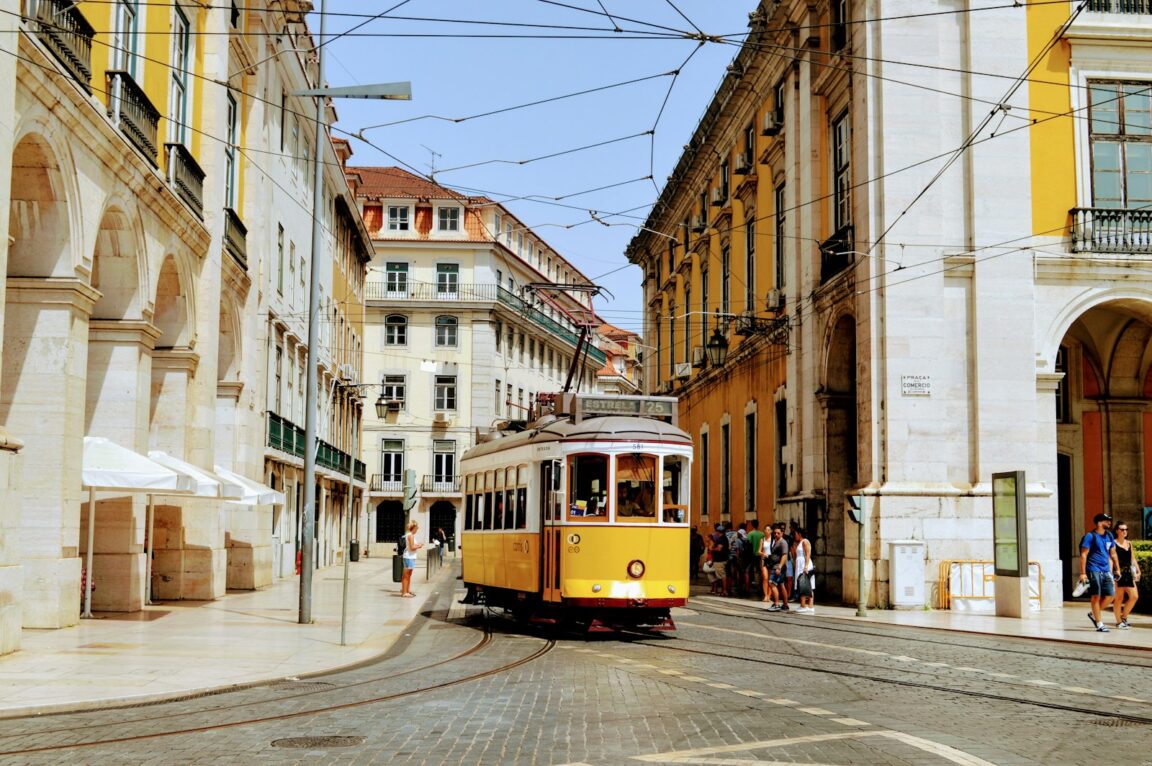
Featured image: a yellow Carris tram on route 25 at Praca do Comercio in the flat Baixa district, Lisbon. Photo via Unsplash, Unsplash License.