 Rafael Santos
Uruguay gives non-resident visitors three separate tax breaks that are easy to confuse and costly to mix up: hotels registered with the Ministry of Tourism invoice non-residents with no VAT at all, year round; restaurants, car rental and event services paid with a foreign-issued card carry a full VAT exemption for non-residents from 15 November 2026 to 30 April 2027 under Decree 271/026; and the separate Tax Free shopping scheme refunds most of the VAT on eligible goods bought at participating shops, claimed at the airport or border when you leave. The standard VAT rate underneath all of it is 22 percent, so using the right scheme on the right purchase is worth real money on a Montevideo or Punta del Este trip.
Quick Facts
- Standard VAT: 22 percent, called IVA in Uruguay.
- Hotels: Non-resident tourists pay 0 percent VAT at hotels and lodging registered with the Ministry of Tourism, all year. Show foreign ID; the invoice is issued without VAT, so there is nothing to claim later.
- Dining, car rental and events: A full 22 point VAT exemption for non-residents paying with a card issued abroad or a transfer from abroad runs from 15 November 2026 to 30 April 2027 under Decree 271/026.
- Wider card discount: A separate 9 point VAT reduction on restaurant, catering, event and car rental spending paid electronically runs to 30 April 2027 under Decree 235/026.
- Tax Free shopping: Year round at participating shops. Eligible goods are clothing, leather and knit goods, food, drink and handicrafts taken out of the country; the refund returns 80 percent of the IVA under Decree 378/012. Invoices must exceed 600 pesos and cannot be combined.
- Claim points: Customs validation and refund desks at Carrasco and Laguna del Sauce airports, the ports of Montevideo and Colonia, the Punta del Este cruise terminal, the bridges to Argentina at Salto, Paysandu and Fray Bentos, and the Chuy crossing. Global Blue operates the system.
- Deadline: Tax Free claims must be made within three months of purchase.
Which scheme applies to which purchase?
The confusion is structural: Uruguay runs point-of-sale exemptions and a departure refund side by side, and they cover different things. Hotels are the simplest case. A non-resident staying at a registered hotel is invoiced without VAT at the desk, on the strength of a foreign passport or ID, in every month of the year. There is no form, no airport desk and no refund to chase, but the property must be registered with the Ministry of Tourism, so an unregistered rental apartment does not qualify.
Services in the high season are the second case. Under Decree 271/026, published in November 2026 and retroactive to 15 November, non-resident individuals paying with a foreign-issued credit or debit card, or by transfer from abroad, receive the full VAT exemption on restaurant and bar bills, catering and party or event services, and car rental without a driver, through 30 April 2027. Running underneath it, Decree 235/026 keeps a 9 point reduction on the same categories for electronic payments more broadly, also to 30 April 2027. In both cases the benefit is applied through the card settlement, so it appears on the card statement rather than as a discount line on the receipt, which is why travellers often think it never happened. Pay in cash and both benefits vanish.
Goods are the third case, and the only one that uses the airport claim route. That is Tax Free, and it works like the European schemes explained in the 2026 guide to Lisbon’s pass and entry-fee maths only in the sense that the paperwork starts at the till: everything after the purchase is different, and Uruguay’s version has its own eligible-goods list and its own minimum.
How does the Tax Free claim route actually run?
Step one happens in the shop, before the invoice is issued: tell the retailer you want Tax Free. The shop must be part of the scheme, the purchase must be for a non-resident, and the single invoice must exceed 600 pesos; receipts from separate purchases cannot be added together to clear the threshold. Eligible categories under Decree 378/012 are clothing, leather goods, knitwear, food, beverages and handicrafts that you will take out of the country. Electronics are not on the list, and neither are services or restaurant meals, which are handled by the card schemes above. The refund is 80 percent of the IVA embedded in the price, roughly 14 percent of the shelf price before the operator’s fee.
Step two happens on departure. Carry the goods in your luggage, keep them available for inspection, and have Customs validate the Tax Free form at your exit point before you surrender your bags. The validated exits cover the way most visitors actually leave: Carrasco International Airport outside Montevideo, Laguna del Sauce Airport at Punta del Este, the ports of Montevideo and Colonia for the Buenos Aires ferries, the Punta del Este cruise terminal, the three river bridges to Argentina at Salto, Paysandu and Fray Bentos, and the land crossing at Chuy for Brazil. Uruguay’s system is digital, with validation kiosks at Carrasco, and the refund is paid back to the card through Global Blue, the scheme’s operator. Claims must be completed within three months of the purchase date.
What catches travellers out?
Three errors account for most lost money. The first is paying for meals and rental cars in cash or with a locally issued card, which quietly cancels the seasonal exemptions that would otherwise have been automatic. The second is discovering Tax Free at the airport: without the shop-issued form from the moment of purchase, there is nothing Customs can validate, however eligible the goods. The third is category confusion, expecting a refund on electronics or on services, or expecting the hotel exemption at an unregistered property. Border shoppers crossing from Brazil should also note that the claim points include Chuy and the Argentine bridges, so a land exit works as well as a flight, provided the form is validated at the crossing itself. Travellers continuing into Argentina’s wine country after a Montevideo stay can plan the onward leg with the Rioja station quarter tasting rooms of Haro as the model for how seriously this corner of the wine world takes its cellar doors, even if the tax schemes stop at the river.
Frequently Asked Questions
Do tourists pay VAT on hotels in Uruguay?
No. Non-resident tourists are invoiced without VAT at hotels and lodging registered with the Ministry of Tourism, all year round. Show a foreign ID document at the property; no refund claim is needed afterwards.
How do I get the restaurant VAT exemption?
Pay with a credit or debit card issued abroad. From 15 November 2026 to 30 April 2027, Decree 271/026 gives non-residents the full 22 point exemption on restaurant, bar, catering, event and car rental spending, applied through the card settlement and visible on your statement.
What goods qualify for Tax Free refunds?
Clothing, leather and knit goods, food, drink and handicrafts bought at participating shops and taken out of the country, on a single invoice over 600 pesos. The refund is 80 percent of the IVA. Electronics and services do not qualify.
Where do I claim the Tax Free refund?
Have Customs validate the form at your exit point: Carrasco or Laguna del Sauce airports, the ports of Montevideo or Colonia, the Punta del Este cruise terminal, the Salto, Paysandu and Fray Bentos bridges, or Chuy. Global Blue pays the refund to your card. Claim within three months of purchase.
Can I combine receipts to reach the Tax Free minimum?
No. Each invoice must exceed 600 pesos on its own; separate receipts cannot be added together.
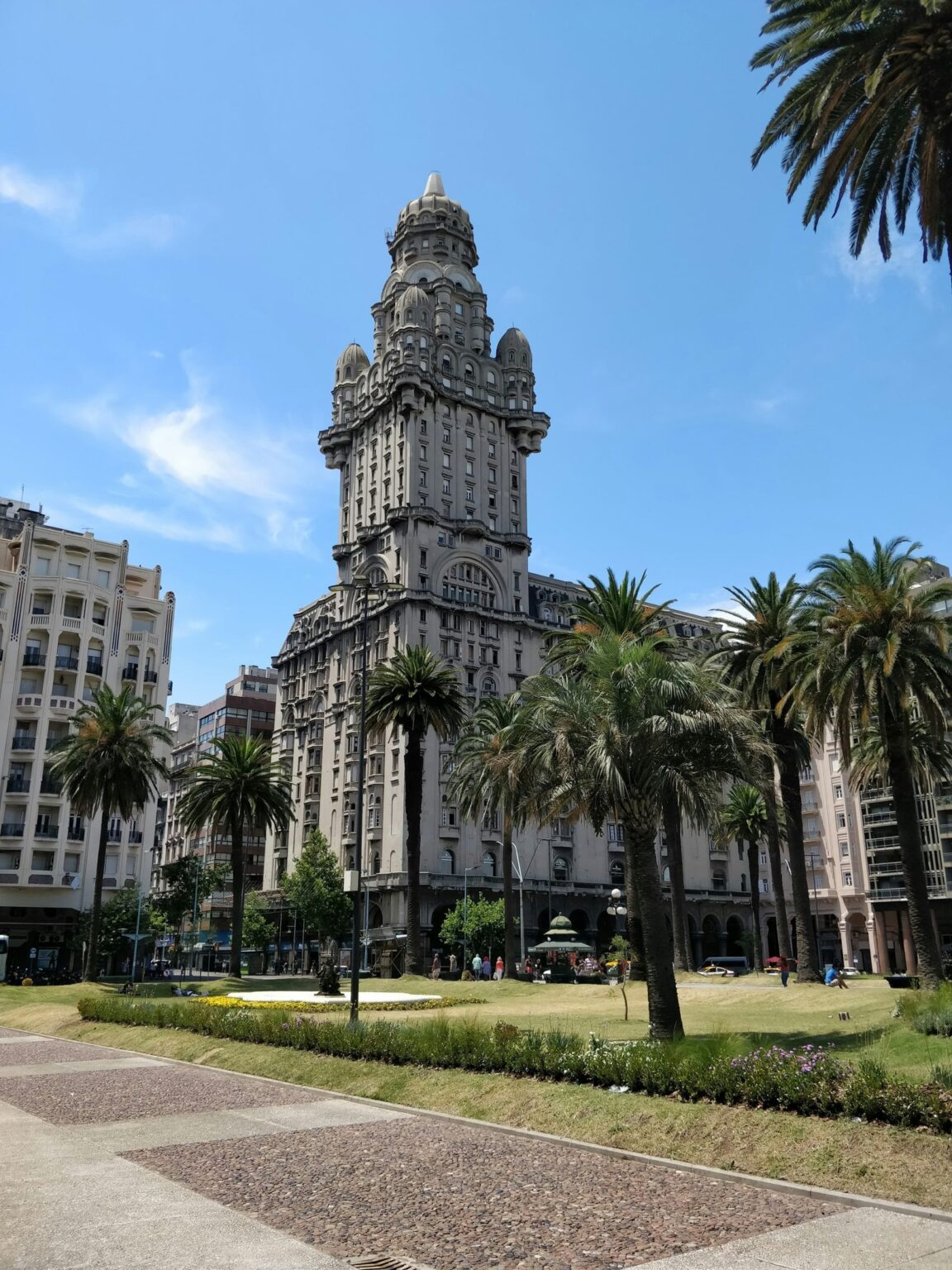
Photo: The Palacio Salvo above Plaza Independencia in Montevideo, Uruguay. Credit: Guilherme Hellwinkel, via Unsplash.