 James Wolfe
Theodore Roosevelt National Park rewards travellers who treat it as three parks rather than one: the South Unit at Medora, with the 36 mile Scenic Loop Drive, the Maltese Cross Cabin and the park’s wild horses, the quieter North Unit about 70 miles away near Watford City, and the remote Elkhorn Ranch Unit in between, where only foundation stones remain at the end of a short path along the Little Missouri River. The park is open 24 hours a day all year, entry costs US$30 per private vehicle for seven days, fees are card only, and the whole park protects more than 70,000 acres of North Dakota badlands along the river that Roosevelt himself credited with making him president.
Quick Facts
- Where: Western North Dakota badlands along the Little Missouri River, in three separate units: South, North and Elkhorn Ranch.
- Entrance fee: US$30 per private vehicle, US$25 per motorcycle and US$15 per person on foot, bicycle or horseback, each valid seven days, per the National Park Service. The park went fully cashless on 1 May 2026; cards and digital payment only.
- Hours: The park is open 24 hours a day, every day of the year, in all three units. Visitor centre hours vary by season.
- South Unit base: Medora, at Interstate 94 exits 24 and 27. The South Unit Visitor Center is at 201 East River Road North, Medora, ND 58645.
- North Unit: On Highway 85, about 14 miles south of Watford City, roughly 70 miles from the South Unit by road.
- Elkhorn Ranch Unit: Roughly midway between the other units and reached by gravel roads; ask park staff for current directions before setting out.
- Wildlife: Free-roaming bison in both main units, a wild horse herd in the South Unit, and large prairie dog towns along the loop drive.
Why is this the Maltese Cross country?
Theodore Roosevelt first came to these badlands in 1883 to hunt bison, and he returned to ranch here through the hardest years of his early life. His first Dakota ranch was the Maltese Cross, whose cabin now stands beside the South Unit Visitor Center in Medora, furnished with period pieces and some of Roosevelt’s own belongings, with ranger-led cabin tours in summer during visitor centre hours. His second and beloved ranch was the Elkhorn, deeper in the badlands, where he lived the strenuous life he later said he would never have traded. Roosevelt is often quoted in park interpretation to the effect that he would not have become president without his time in Dakota Territory, and the park, the only national park named for a single person, was established as a memorial park in 1947 and became a national park on 10 November 1978.
That history is not decoration here; it is the organising idea of a visit. Read the South Unit as the public face, with the cabin, the film and the loop drive, and the Elkhorn as the private one, a quiet river bottom where the story actually happened. Travellers who enjoy pairing a gateway town with its landscape can compare Medora’s role with the Black Hills base towns in the family guide to the Black Hills and Custer State Park, another northern plains landscape where the town and the wild ground explain each other.
How should you work the South Unit and Medora?
Start at the South Unit Visitor Center in Medora, pay or show a pass, see the Maltese Cross Cabin while the light is good, then drive the 36 mile Scenic Loop. The loop is the park’s greatest hits in one paved circuit: painted badlands formations, overlooks above the Little Missouri, prairie dog towns close enough to watch from the car, and the park’s best odds of bison and wild horses from the road. The wild horses, a free-roaming herd descended from ranch stock, live in the South Unit and are the sight many visitors remember longest; give them the same road space and respect as the bison, and expect traffic to stop when either herd decides to cross.
Medora itself is the service town, a small western gateway with lodging, food and the summer Medora Musical season that makes it the natural base for the South Unit and for an Elkhorn attempt. The Theodore Roosevelt Presidential Library, about a mile and a half from the South Unit entrance, adds a half day for travellers who want the full Roosevelt story. Book Medora lodging early for summer; the town is small and the season is short.
What makes the North Unit worth the drive?
The North Unit, up Highway 85 south of Watford City, is the same badlands in a quieter key: a scenic drive through more heavily wooded coulees, caprock formations, and strong chances of bison, deer and bighorn sheep with a fraction of the South Unit’s traffic. It sits about 70 miles from Medora, roughly an hour and a half by road, which makes it a deliberate day trip or an overnight pivot rather than an add-on. Travellers with two park days should give one to each main unit instead of doubling down on the loop; the contrast between the units is the park’s real lesson in how varied the badlands are. The split-park decision resembles the one solved in Saguaro National Park’s two halves, east versus west, where the right answer was also to see both sides rather than crown a winner.
How do you reach the Elkhorn Ranch Unit, and what is there?
The Elkhorn is the unit most visitors never make, and that is part of its value. It lies between the two main units and is reached by gravel roads, about 46 miles from Medora with a long gravel stretch, so conditions matter: ask at a visitor centre for current directions and road state before committing, carry water, and do not rely on a phone signal. At the site itself there is no reconstructed ranch house. Only the cabin’s foundation stones remain, at the end of a short mowed path of about 0.7 miles along the Little Missouri River, with interpretation explaining the ranch Roosevelt built in 1884 and the winter that ended his ranching life. It is a place for readers and quiet travellers rather than sightseers, and it completes the arc that begins at the furnished Maltese Cross Cabin: the first ranch survives as an object, the second as a footprint in the grass.
When should you go, and what should you watch for?
Late spring through early autumn is the full park: visitor centres on longer hours, cabin tours running, Medora in season and gravel roads to the Elkhorn at their most reliable. Summer heat on exposed badlands trails is real, with little shade, so hike early and carry more water than the distance seems to need. Winter is stark and beautiful and nearly empty, with fees collected at visitor centres rather than entrance stations in the colder months and some roads liable to close in snow. In every season the park stays open around the clock, entrance passes run seven days across all units, and the cashless rule means a card or digital payment is not optional. Check current alerts on the park’s NPS page the morning you drive, especially for the Elkhorn’s gravel approach.
Frequently Asked Questions
How much does Theodore Roosevelt National Park cost?
US$30 per private vehicle, US$25 per motorcycle or US$15 per person entering on foot, by bicycle or on horseback, each valid for seven days across all units. Payment is by card or digital method only since 1 May 2026; cash is not accepted.
Where are the wild horses?
In the South Unit. The free-roaming herd descends from historic ranch stock and is most often seen from the 36 mile Scenic Loop Drive near Medora.
What remains at the Elkhorn Ranch?
Only the foundation stones of Roosevelt’s Elkhorn Ranch cabin, reached by a mowed path of about 0.7 miles along the Little Missouri River. The site is undeveloped by design; check directions and gravel road conditions with park staff first.
How far is the North Unit from Medora?
About 70 miles by road, roughly an hour and a half. The North Unit entrance is on Highway 85 about 14 miles south of Watford City.
Is the Maltese Cross Cabin original?
Yes. It is Roosevelt’s original first ranch cabin, relocated beside the South Unit Visitor Center in Medora and furnished with period items including some of his own belongings.
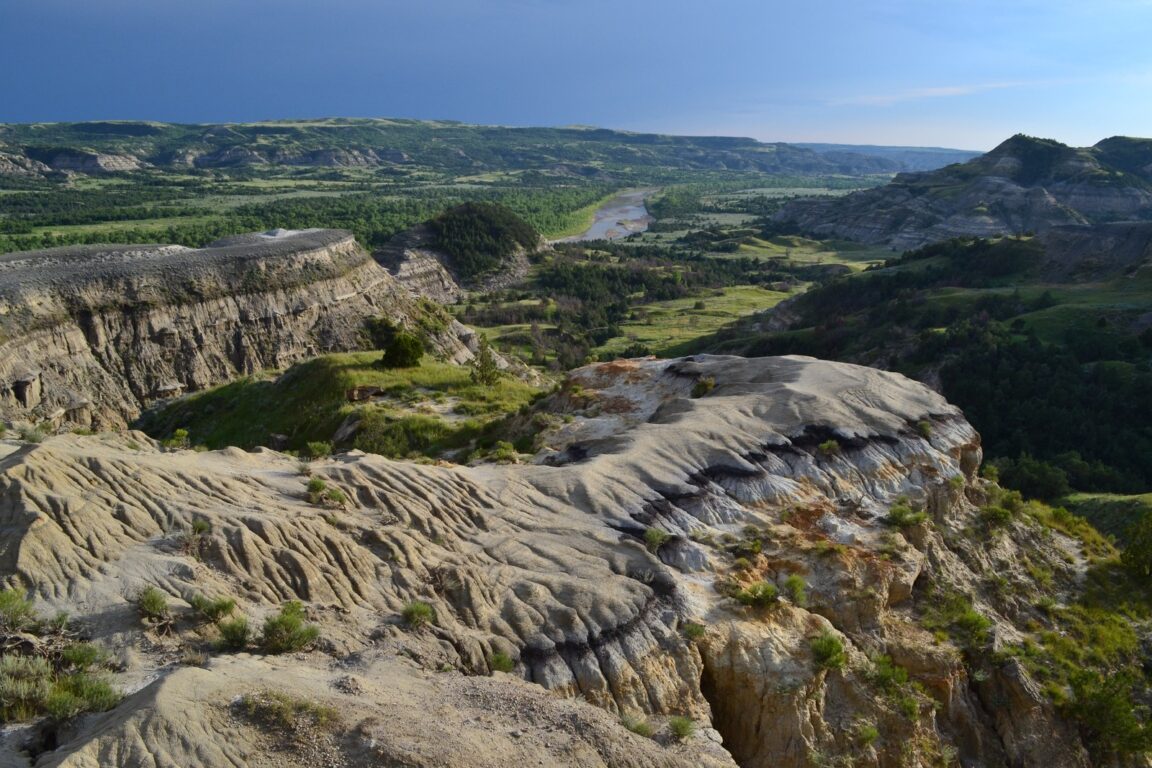
Photo: Painted badlands formations in Theodore Roosevelt National Park, North Dakota. Credit: National Park Service, via nps.gov, the park’s official website.