 Lucas Meyer
With one day in Tucson, choose Saguaro West for the classic postcard: the densest saguaro forest, the six-mile Bajada Loop Drive, Signal Hill petroglyphs and the Arizona-Sonora Desert Museum on the same road. Choose Saguaro East for the bigger, quieter park: the eight-mile paved Cactus Forest Loop, older and taller cactus stands, and trailheads climbing toward the Rincon Mountains. One $25 vehicle pass covers both districts for seven days, so the real decision is not money. It is whether your day is built around density and a museum pairing, or around space and a scenic drive.
Quick Facts
- The split: Two districts flank Tucson. The Tucson Mountain District (West) and the Rincon Mountain District (East) are about 30 miles apart, roughly an hour’s drive across the city. There is no road connecting them inside the park.
- Entrance: $25 per private vehicle, $20 per motorcycle, $15 per person on foot or bicycle, valid 7 days for both districts, per NPS. An America the Beautiful pass covers entry.
- Park hours: The park itself is open 24 hours for walking and cycling. Both visitor centres open 9:00 a.m. to 5:00 p.m. from October 1 to May 31, and 8:00 a.m. to 4:00 p.m. from June 1 to September 30, closed Thanksgiving and Christmas Day.
- West address: Red Hills Visitor Center, 2700 North Kinney Road, Tucson, AZ 85743.
- East address: Rincon Mountain Visitor Center, 3693 South Old Spanish Trail, Tucson, AZ 85730.
- Drives: East, the Cactus Forest Loop Drive, 8 miles, paved. West, the Bajada Loop Drive, about 6 miles, graded dirt.
- Camping: No campgrounds in the West district. East has backcountry campgrounds in the Saguaro Wilderness, by permit.
What is actually different between the two districts?
Geology and age. The West district protects the Tucson Mountains, a younger, rockier range where saguaros crowd the slopes in the dense stands most visitors picture. The East district protects the Rincon Mountains, a larger and higher range, and a much bigger block of parkland: its cactus forest grows on gentler bajadas below the peaks, the individual saguaros include some of the park’s oldest and largest, and the trail network climbs from desert into grassland and pine forest at elevation. The East district is also the only side with wilderness backcountry camping.
Scale changes the feel. West is compact enough to see well in half a day and pairs naturally with neighbouring attractions on Kinney Road. East rewards a full day and a slower hand: an eight-mile loop with picnic areas, overlooks and trailheads you could spend a week walking. If your Tucson trip includes other desert parks, the pacing logic in the family guide to the Grand Canyon’s South Rim applies here too: one district done properly beats both districts done as drive-throughs.
Why do most first-timers pick the West district?
Because the West delivers the highest concentration of saguaros per hour. The Bajada Loop Drive, about six miles of graded dirt road suitable for ordinary cars in dry weather, winds through dense cactus forest with pullouts, picnic areas and short trails. The paved Desert Discovery Trail, a half-mile loop near the visitor centre, is the park’s best short introduction, with exhibits and shaded resting places. The Valley View Overlook trail leads to the classic framed view across the Avra Valley. At Signal Hill, a short climb reaches a hilltop covered in petroglyphs left by the Hohokam people, the West district’s essential cultural stop.
The Red Hills Visitor Center orients the day with its desert garden, exhibits and ranger advice on heat and trail conditions. Sunset is the West district’s headline act: the Tucson Mountains catch the last light, the saguaros silhouette, and Gates Pass, on the road back to Tucson, is the city’s famous sunset viewpoint. Photographers with one evening should spend it on this side.
What does the East district do better?
Room to breathe, and the long view. The Cactus Forest Loop Drive is eight paved miles, open to vehicles from 5:00 a.m. to 8:30 p.m., rolling through an old-growth cactus forest with the Rincon Mountains rising behind it. Traffic is lighter than in the West, the picnic areas are quieter, and the trailheads serve hikers rather than sightseers: routes climb from the cactus forest toward Mica Mountain through country that changes with every thousand feet of elevation. The short Desert Ecology Trail, a paved quarter-mile loop, gives the East its accessible interpretive walk.
East is also the district for returning visitors and for anyone whose priority is walking rather than driving. Its backcountry campgrounds, reached only on foot and used by permit, make multi-day Saguaro trips possible, something the West cannot offer at all. And because the loop road is paved, East is the safer choice after rain, when the West’s dirt Bajada Loop can turn rough. Travellers building a wider Arizona and Utah park circuit can set this district logic beside the Guadalupe Mountains guide to desert peaks and canyon rules for another park where the drive-versus-hike decision shapes the whole visit.
How does the Desert Museum pairing change the choice?
It is the West district’s trump card. The Arizona-Sonora Desert Museum stands at 2021 North Kinney Road, about two miles south of the Red Hills Visitor Center on the same road. It is a mostly outdoor museum, part zoo, part botanical garden and part natural history museum, founded in 1952, where nearly two miles of paths wind through desert habitats holding native animals, including a hummingbird aviary and mountain lions, in enclosures built into the landscape. The museum is open 365 days a year; from October to May hours are 8:30 a.m. to 5:00 p.m. General admission is $29.95 for ages 13 to 64 and $24.95 for ages 3 to 12, per the museum’s official site, with children 2 and under free.
The pairing works because the two visits teach the same desert at different depths. Do the museum in the cool of the morning, when the animals are active and its paths give you the names of everything you will see wild in the park. Then cross into Saguaro West for the Bajada Loop and a short trail, and finish at Gates Pass for sunset. Attempting the museum plus both park districts in one day produces three rushed stops; the museum plus West, done in that order, is one of the best single desert days in the American Southwest.
Can you do both districts in one day?
Yes, and many visitors do, but go in with the right expectations. The districts sit about 30 miles apart with the whole of Tucson between them, so the transfer alone costs roughly an hour each way in traffic. A workable both-districts day starts at the East district’s loop at opening, walks one short trail, crosses the city over lunch, and spends the afternoon and sunset in the West. A better both-districts trip gives each side its own half of a two-day stay, with the Desert Museum attached to the West day.
Heat discipline governs everything from May to September. NPS advises avoiding outdoor exertion in the middle of the day in summer, and the visitor centres shift to earlier hours, 8:00 a.m. to 4:00 p.m., from June. Carry about a quart of water per person per hour of hiking, start trails at dawn, and remember there is no water on the trails themselves. Dogs are allowed only on a short list of named roads and paved trails in each district, on a leash, and never on wilderness trails. One entrance pass, bought at either district, covers both for seven days, so keep the receipt on the dashboard.
So which district should you choose?
Choose West if you have half a day, if this is your first saguaro forest, if you want the Desert Museum, or if sunset photography is the point of the trip. Choose East if you have a full day or more, if you hike, if you dislike crowds, or if you are returning to Saguaro and want the park’s wilder half. Choose both, on separate days, if Tucson is your destination rather than your stopover. There is no wrong answer, only a wrong pace: the desert rewards the district you slow down in.
Frequently Asked Questions
Does one entrance pass cover both Saguaro districts?
Yes. The $25 private vehicle pass, $20 motorcycle pass and $15 per-person pass are each valid for seven days and cover both the Tucson Mountain (West) and Rincon Mountain (East) districts, per the National Park Service.
How far apart are Saguaro East and Saguaro West?
About 30 miles, with Tucson between them. Allow roughly an hour to drive from one visitor centre to the other in traffic. No road connects the districts inside the park.
Which district has the most saguaros?
The West (Tucson Mountain) district has the densest saguaro stands, which is why it is the classic first visit. The East (Rincon Mountain) district is larger, quieter and known for old-growth cactus forest and mountain hiking.
Can you camp in Saguaro National Park?
Only in the East district, at backcountry campgrounds in the Saguaro Wilderness, reached on foot with a permit. There is no camping of any kind in the West district and no car campground in either district.
What are the visitor centre hours?
Both visitor centres open 9:00 a.m. to 5:00 p.m. from October 1 to May 31 and 8:00 a.m. to 4:00 p.m. from June 1 to September 30, and close on Thanksgiving and Christmas Day. The park itself stays open 24 hours for walking and cycling.
Is the Arizona-Sonora Desert Museum inside the national park?
No. It is a separate, private non-profit museum at 2021 North Kinney Road, about two miles from the West district’s Red Hills Visitor Center. It charges its own admission, $29.95 for ages 13 to 64 and $24.95 for ages 3 to 12, and opens 365 days a year.
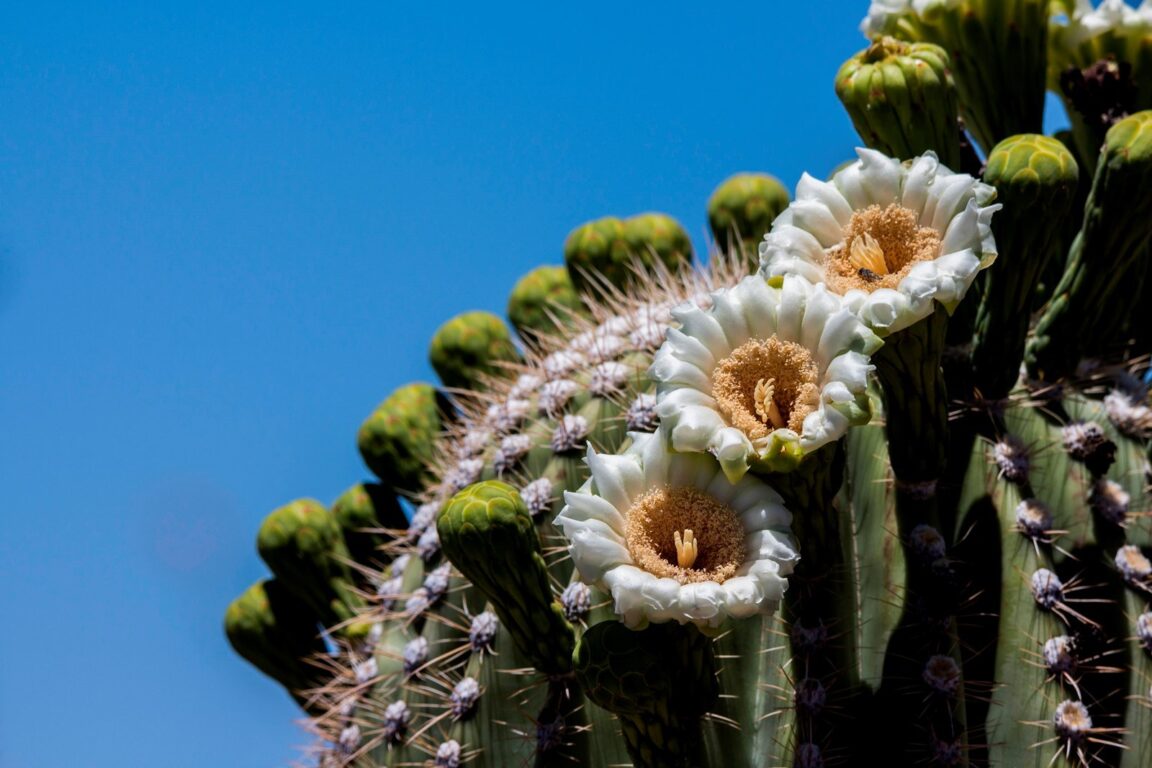
Photo: A saguaro in bloom in Saguaro National Park, Arizona. Credit: National Park Service, via nps.gov, the park’s official website.