 River Callahan
Santa Rosa is the Channel Islands trip for travellers who have already done Santa Cruz and want the wilder version: at roughly 53,000 acres it is the second largest island in California, it holds one of only two natural Torrey pine groves in the world, and it takes about three hours by boat from Ventura to reach. There is no entrance fee, no vehicle, no shop and no shortcut. Book the Island Packers boat first, then the Water Canyon campsite, and check the park’s current fire recovery closures before choosing your hikes.
Quick Facts
- Where: Santa Rosa Island, Channel Islands National Park, California, about 40 nautical miles from the park visitor centre in Ventura.
- Size: Approximately 53,000 acres, about 15 miles wide by 10 miles long, the second largest island in California, per the National Park Service.
- Park entry: Channel Islands National Park charges no entrance fee. The real cost is boat transport.
- Boat: Island Packers, the park concessionaire, sails from Ventura Harbor (1691 Spinnaker Drive). Trips to Santa Rosa run April through early November, typically 2 to 4 days per week, and take about 3 hours, per NPS.
- Camping: Water Canyon Campground, 15 sites, $15 per night per site, reservations required on Recreation.gov. The campground is a 1.5-mile hike from the pier.
- On the island: No transport, no stores and no vehicles for visitors. Everything is reached on foot, and drinking water is available at the campground and the historic ranch area.
How is Santa Rosa different from Santa Cruz?
Scale and solitude. Santa Cruz is the park’s front door, an hour from Ventura with frequent boats. Santa Rosa is the backcountry version of the same park: a bigger island of rolling grassland, deep canyons and long empty beaches, with a fraction of the visitors. The island was a working ranch well into the modern era, and the historic ranch buildings at Bechers Bay, where the boat lands, still anchor the visit. From the pier, every sight worth seeing is a real hike, which is the island’s filter and its reward.
Santa Rosa also carries the park’s deepest human story. People have lived on and visited these islands for more than 13,000 years, and the island’s canyons hold evidence of the pygmy mammoths that once roamed a larger, joined landmass scientists call Santa Rosae. The endemic island fox, found nowhere else on Earth, is the largest native land mammal you are likely to meet on the trails. Travellers who enjoy islands that resist easy itineraries can compare the planning mindset with Isle au Haut, Maine, Acadia’s quiet half reached by mail boat.
What makes the Torrey pine grove worth the hike?
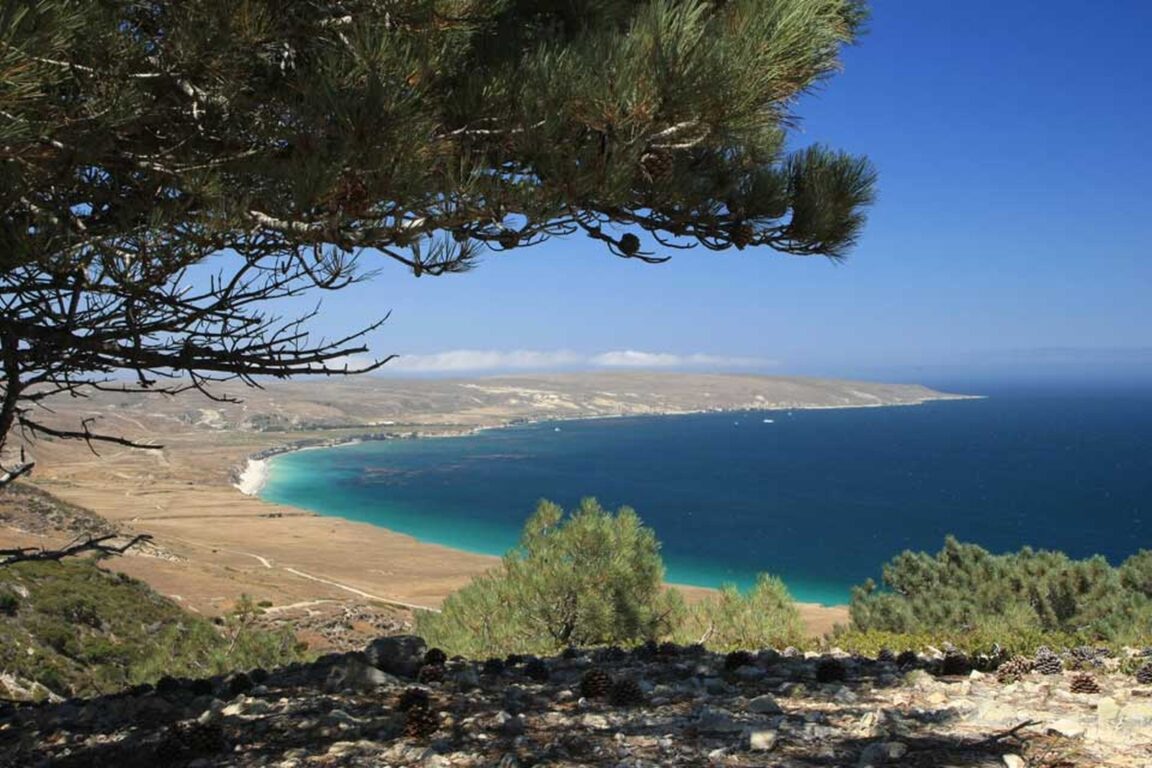
Above Bechers Bay stands a grove of Torrey pines, one of only two natural stands of the species in the world. The other grows on the mainland coast near San Diego. Torrey pines are among the rarest pines in North America, and on Santa Rosa the wind has sculpted them into the gnarled, leaning forms that make the grove feel like a bonsai forest at full scale. The Torrey Pines Trail climbs from the ranch area through the grove, with views back over Bechers Bay and across the Santa Barbara Channel, and it is the single hike to prioritise on a day trip.
Build the day around boat time honestly. Day passengers typically get only a few hours ashore after a crossing of about three hours each way, so the Torrey Pines loop plus the ranch area and Water Canyon Beach is a full and satisfying day. Campers, who usually stay a minimum of about three days because of the boat schedule, can range much further.
What is Lobo Canyon, and who should attempt it?
Lobo Canyon is Santa Rosa’s signature inland hike: a sculpted sandstone canyon where wind and water have carved the rock into smooth bowls, knobs and narrow passages, with a creek that runs to a small cove on the north shore. It is the island’s best argument for camping rather than day-tripping, because the round trip from Bechers Bay is a long day on foot over exposed ground, and it competes with the Torrey Pines for the same limited hours.
The canyon rewards hikers who start early, carry all their water and treat the route finding seriously, since island trails and ranch roads are less manicured than mainland park trails. In the canyon walls, observant hikers may spot fossil material in the rock, a reminder that pygmy mammoths once walked this ground; fossils and all natural features are protected and must be left exactly as found. If your hours are short, choose Torrey Pines. If you have a second full day, Lobo Canyon is the walk that explains why Santa Rosa devotees keep returning.
How do the ferry, the crossing and seasickness really work?
Island Packers is the park’s authorised boat concessionaire, and its Santa Rosa trips depart Ventura Harbor for the pier at Bechers Bay. NPS lists the crossing at about 3 hours, with trips running April through early November on 2 to 4 days per week, so the calendar, not your preference, sets the itinerary. Landing involves climbing from the boat up a steel-rung ladder to the pier, and when the pier is closed, landings are made by skiff onto the beach.
The crossing is open ocean, and the Santa Barbara Channel earns its reputation: afternoon winds build steep chop, and the return leg is often rougher than the morning run out. Travellers prone to seasickness should take medication before boarding rather than after the swell starts, choose a seat outside near the stern, fix their eyes on the horizon and treat the crossing as part of the expedition rather than a commute. The compensation is wildlife: the channel is a migration corridor for whales and dolphins, and crossings regularly pause for sightings. There is no transport on the island, so everything you bring crosses on your back from the pier.
What do campers need to know about Water Canyon?
Water Canyon Campground sits about a quarter mile up its canyon and a 1.5-mile flat hike from the pier, sheltered from the island’s strong northwest winds. Its 15 sites each take up to 5 people and come with a picnic table, a food storage box and a tall windbreak, with restrooms and water provided. Sites cost $15 per night and reservations are required in advance on Recreation.gov; there are no walk-ups. Book boat transport before or alongside the campsite, since a site without a boat seat is useless, and note that beach camping areas elsewhere on the island follow strict seasonal rules.
Two current cautions belong in every 2026 and 2027 plan. First, seasonal closures protect nesting snowy plovers and pinnipeds on parts of the coast, so some beaches close for months at a time. Second, Recreation.gov and NPS advise that the island’s southeast quadrant remains closed during recovery from the 2026 wildfire. Check the park’s alerts page in the week you travel and shape your route to the open northwest and central ground: Torrey Pines, Lobo Canyon, Water Canyon and the Bechers Bay shore are the core that justifies the trip in any season the boats run. For a different kind of island water day in the same park, see sea kayaking the Apostle Islands’ red cliffs and sea caves for how rangers in another island park handle cold water and cave conditions.
Frequently Asked Questions
How long is the boat ride to Santa Rosa Island?
About 3 hours each way from Ventura Harbor with Island Packers, per the National Park Service. Trips run April through early November, typically 2 to 4 days per week.
Does Channel Islands National Park charge an entrance fee?
No. The park charges no entrance fee. Your costs are the Island Packers boat ticket and, if camping, $15 per night per site at Water Canyon Campground, reserved on Recreation.gov.
Can you visit Santa Rosa as a day trip?
Yes, but the maths is tight: roughly six hours of boat travel for a few hours ashore. Day visitors should focus on the Torrey Pines grove, the historic ranch area and Water Canyon Beach. Lobo Canyon suits campers better.
Is there water and food on Santa Rosa Island?
Drinking water is available at Water Canyon Campground and at the public restrooms in the historic ranch area. There are no stores, so all food and supplies must be carried in, and all rubbish carried out.
What should seasick-prone travellers do?
Take seasickness medication before boarding, sit outside near the stern, watch the horizon and expect the afternoon return crossing to be rougher than the morning run. The channel is open ocean, not a sheltered harbour cruise.
Photo: Bechers Bay and the Santa Rosa Island coast seen from the Torrey pine grove above the bay. Credit: National Park Service, via nps.gov, the park’s official website.