 Hana Kim
Jeju’s visa-free entry is real, generous and narrow: most nationalities can enter Jeju Island without a Korean visa for up to 30 days, but only on a direct international flight or ferry to Jeju, only for tourism or transit, and only while they stay on the island. The moment the plan includes Seoul, Busan or any mainland stop, the Jeju exception stops applying and mainland Korea’s normal visa and K-ETA rules take over. Book the routing first and the hotels second, because the routing is what makes the status legal.
Quick Facts
- The rule: Visa-free entry to Jeju for up to 30 days, status Tourist/Transit (B-2), under the Jeju Special Act, per Korean consulate notices.
- How you must arrive: Directly into Jeju by international flight or ferry. Arriving via Seoul, Busan or any other Korean port of entry voids the exception.
- Where it is valid: Jeju Island only. Travel onward to mainland Korea requires a visa or specific permission.
- Who is excluded: Citizens of 23 countries named by the Ministry of Justice must hold a Korean visa even for Jeju.
- K-ETA: Travellers from countries that are visa-free for Korea generally still need a K-ETA to board a flight to Jeju, unless their nationality is temporarily exempt. Check k-eta.go.kr before booking.
- Verify: Confirm your own passport’s status on the official Hi Korea portal (hikorea.go.kr) before paying for flights.
What exactly is the Jeju visa-free exception?
Jeju runs its own entry rule, written into the Jeju Special Act rather than Korea’s general immigration law, and operating since 2002. Its purpose is simple: make the island easy to reach for international visitors without routing everyone through mainland visa processing. Under the rule, a foreign traveller who arrives directly at a Jeju airport or port for tourism or transit can enter without a visa and stay up to 30 days. Korean consulate notices describe the status as Tourist/Transit (B-2).
The exception is broader than Korea’s standard visa waiver in one way, since it covers most nationalities in the world, and narrower in every other way. It is tied to the island, to the direct arrival and to the 30-day cap. It is not a Korean visa, it cannot be converted into one in-country, and it does not grow into mainland access with time served. Travellers who already understand Korea’s paperwork will recognise the contrast with the national system covered in the guide to South Korea’s e-Arrival Card: the mainland runs on K-ETA and arrival cards, while Jeju runs on this older, island-only rule sitting beside them.
Which nationalities qualify, and which are excluded?
Most passport holders qualify. The exception works on an exclusion model rather than an approval model: if your country is not on the exclusion list, you can generally use it. The Ministry of Justice excludes citizens of 23 countries, who must obtain a regular Korean visa in advance even for a Jeju-only trip. The list in force since 1 June 2022 (Ministry of Justice Notice No. 2022-189) includes, among others, Afghanistan, Bangladesh, Egypt, Ghana, Iran, Kyrgyzstan, Myanmar, Nepal, Nigeria, Pakistan, Sri Lanka, Syria, Uzbekistan and Yemen.
Treat any printed list, including this one, as a starting point rather than a guarantee. The exclusion list is reviewed and can change, and airlines check nationality against the current rules before issuing a boarding pass. The reliable pre-booking step is to verify your passport on the official Hi Korea portal or with the Korean consulate in your country, and to do it before paying for a non-refundable routing.
Why does the direct flight requirement matter so much?
Because the exception attaches to how you enter Korea, not to where you sleep. A traveller who flies into Jeju directly from abroad, including on a routing that connects in a third country outside Korea, enters under the Jeju rule. A traveller whose routing touches Seoul or Busan first has already entered Korea at that mainland airport, under mainland rules, and the Jeju exception never engages. Consulate examples make the line concrete: India to Jeju on a direct flight qualifies; India to Seoul to Jeju does not, and requires a Korean visa.
In practice this eliminates many of the cheapest routings, which connect through Incheon. Island hoppers should search for flights that land at Jeju International Airport (CJU) as the first Korean soil they touch, from gateways such as direct regional services in East and Southeast Asia, and should read the itinerary’s first Korean airport before anything else on the ticket. The same logic applies by sea: a direct international ferry to a Jeju port qualifies; a ferry or flight that clears immigration on the mainland first does not.
Can you go from Jeju to mainland Korea afterwards?
Not on the Jeju exception alone. A visitor who entered under the island rule and who would normally need a visa for Korea must obtain permission before travelling to Seoul, Busan or anywhere else on the mainland, and travelling without it is a punishable offence under the Jeju Special Act. If your passport is visa-free for the whole of Korea under the standard waiver and K-ETA system, your mainland movement rests on that separate status, not on the Jeju rule, which is why the two systems must never be blurred in planning.
The clean way to build a combined trip is to qualify for mainland entry in your own right, through a visa or the standard waiver plus K-ETA, and treat Jeju as one stop among others. The risky way is to assume a Jeju stamp opens the country. It does not. Travellers continuing to the mainland for a wider Korean itinerary can pair this explainer with a 3-day Busan itinerary only once their mainland status is independently in order.
Where does K-ETA fit into a Jeju trip?
K-ETA, the Korea Electronic Travel Authorization, is the mainland pre-travel screening for visa-waiver nationalities, applied for only through the official k-eta.go.kr site. Since 1 September 2022, citizens of countries that enter Korea visa-free have also needed a K-ETA to board a flight to Jeju. Korea has temporarily exempted many nationalities from K-ETA, with the exemption currently running to 31 December 2026, but exemption lists change and are nationality-specific. The Jeju visa-free rule itself, for travellers from visa-required countries, is a separate channel and does not involve K-ETA.
The practical sequence is: identify which system covers your passport, check the exclusion list if you plan to use the Jeju rule, check K-ETA applicability and any temporary exemption if you are a waiver nationality, then book a routing whose first Korean landing matches the status you are relying on. Do all four steps before paying, because the failure mode is a denied boarding at the departure airport, not a conversation at Jeju immigration.
Frequently Asked Questions
How long can I stay in Jeju without a visa?
Up to 30 days, for tourism or transit, under the Jeju visa-free entry rule, provided you arrived directly into Jeju and remain on the island.
Can I fly into Seoul and then take a domestic flight to Jeju visa-free?
No. Entering through Seoul means entering Korea under mainland rules, so you need a Korean visa or standard waiver status with K-ETA as applicable. The Jeju exception only applies to direct international arrivals into Jeju.
Can I visit Seoul after entering through Jeju?
Not on the Jeju exception alone. Travellers who would normally need a visa must get permission before mainland travel, and going without it is punishable under the Jeju Special Act.
Which countries are excluded from Jeju visa-free entry?
Twenty-three nationalities are excluded by the Ministry of Justice and need a visa even for Jeju. The list includes Afghanistan, Bangladesh, Egypt, Ghana, Iran, Nepal, Nigeria, Pakistan, Sri Lanka, Uzbekistan and Yemen, among others. Verify the current list on the Hi Korea portal before booking.
Do I need a K-ETA for Jeju?
If your nationality enters Korea under the standard visa waiver, yes, a K-ETA is generally required to board a flight to Jeju as well, unless your nationality is temporarily exempt. The current temporary exemption runs to 31 December 2026 for listed nationalities. Check k-eta.go.kr for your passport.
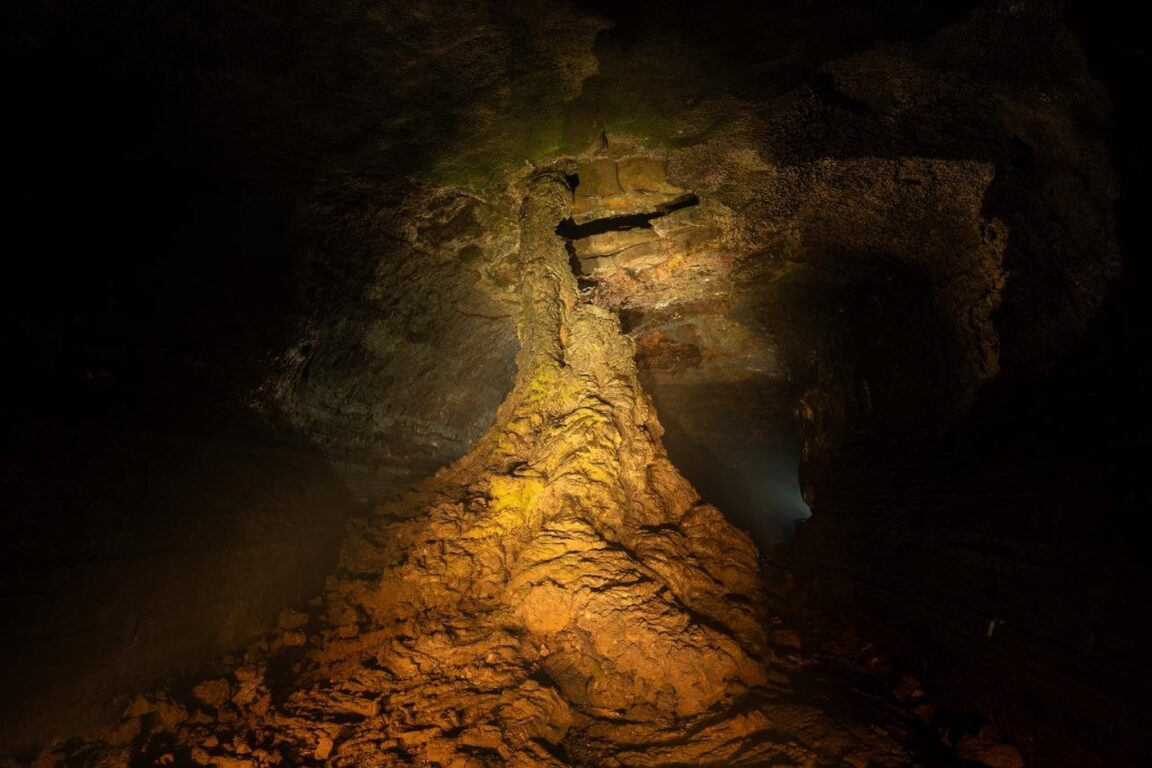
Photo: The lava column inside Manjanggul Cave on Jeju Island, South Korea. Credit: Visit Jeju, the Jeju Tourism Organization, via visitjeju.net, the island’s official visitor site.