 Jordan Ellis
Galena rewards travellers who plan it as a history town first and a shopping street second: more than 85 percent of the city sits inside the Galena Historic District on the National Register of Historic Places, the Ulysses S. Grant Home keeps set hours on a hill above the river, and the floodgates at the end of Main Street explain, in steel and earth, why this lead-mining boomtown looks almost exactly as it did in the 1860s. Come for a full day at minimum, start at the Grant Home when it opens, and walk Main Street after the day-trip crowds thin.
Quick Facts
- Where: Galena, Jo Daviess County, in the Driftless Area of northwestern Illinois, on the Galena River near the Mississippi.
- Historic district: Over 85 percent of the city is listed in the National Register of Historic Places, per Galena Country, the official visitor authority.
- Grant Home: 500 Bouthillier Street. Open Wednesday to Sunday, closed Monday and Tuesday. March to October hours are 9:00 a.m. to 4:45 p.m.; November to February hours are 9:00 a.m. to 4:00 p.m., per the official Grant Home site.
- Grant Home cost: Suggested donation of $5 for adults and $3 for children, with tours capped at 16 guests.
- Washburne House: Open Fridays and Saturdays, 10:00 a.m. to 1:00 p.m., May through October only.
- Best base: Stay on or just off Main Street so the hillside streets, stairs and trolley stops are all walkable.
Why does Galena look frozen in the 1860s?
The short answer is lead, then the lack of it. Galena is named for galena, the lead ore in the surrounding hills, and the town was platted in 1826 during what became the first great mineral rush in the United States. By 1845 the district was producing about 80 percent of the nation’s lead, steamboats loaded ore at the foot of Main Street, and the population climbed past 14,000, larger than Chicago at the time. The money built the brick commercial blocks on Main Street and the captains’ and mine owners’ houses stacked on the benches above the river.
Then the ore economy faded, the river silted, and the railroads and the California gold rush pulled people away. Galena shrank instead of rebuilding, which is precisely why so much survived. When the Galena Historic District was established in the 1960s, it captured some 85 percent of the town. The result is not a reconstructed pioneer village but a working small town whose storefronts, churches and houses are genuinely old, a distinction you feel block by block. Travellers pairing Galena with other Driftless stops can plan the same slow, small-town rhythm in Decorah, Iowa, the Driftless Norwegian heritage town across the Mississippi valley.
What are the floodgates at the end of Main Street?
The broad green slope between downtown and the Galena River is a levee, and the gates set into it are the town’s insurance policy. The river that carried Galena’s ore also flooded it repeatedly, worst of all in 1937, when up to five feet of water stood on Main Street. The U.S. Army Corps of Engineers built the earthen levee and floodgates between 1948 and 1951, and the gates still close when high water on the Mississippi backs up into the Galena River. Visitors usually enter town through this system without noticing it, so it is worth pausing on the levee walkway: it frames the classic view back over the rooftops and explains why the lowest street in town is also its most protected.
How should you visit the Ulysses S. Grant Home?
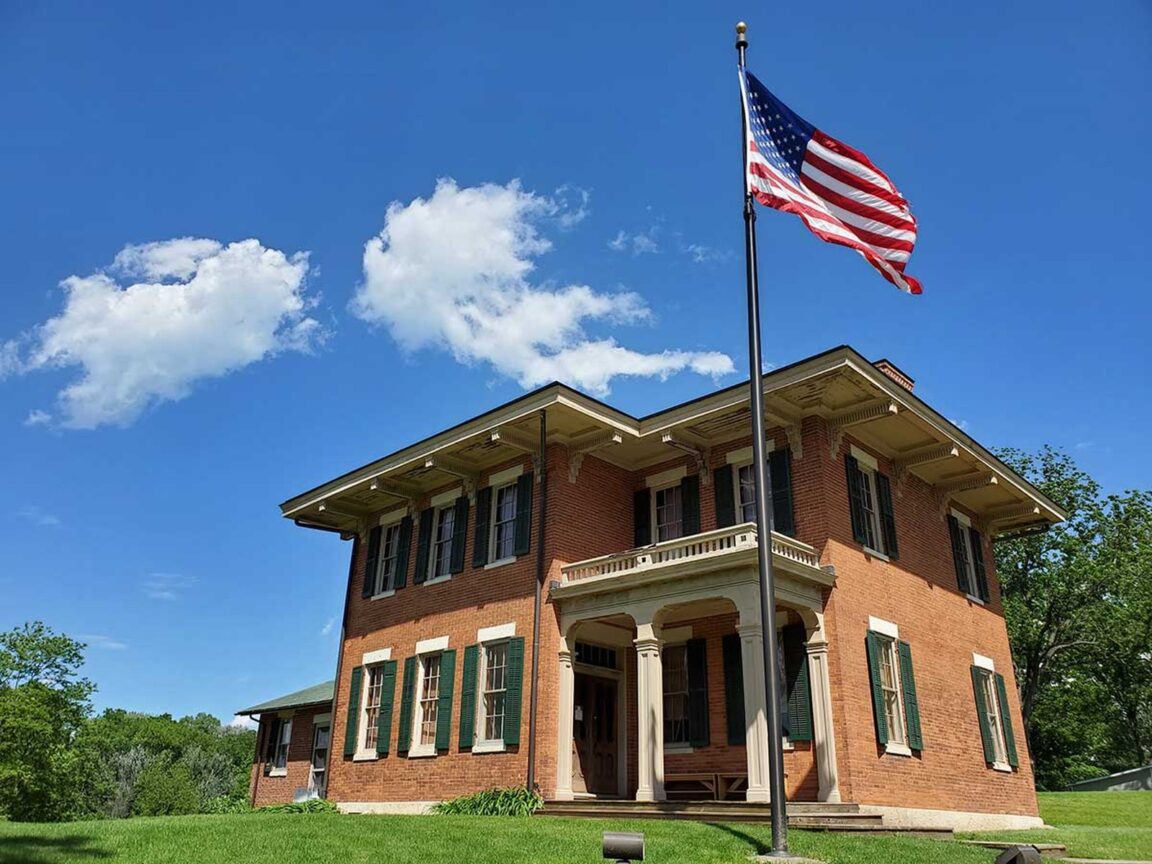
The Italianate brick house at 500 Bouthillier Street was built in 1860 and presented to Ulysses S. Grant and his family in 1865 by Galena citizens, in thanks for his Civil War service. Grant had arrived in Galena in 1860 to work in his father’s leather goods store, left as a soldier, and returned as the most famous man in America. The state historic site preserves the house with original Grant family furnishings, and interpreter-led tours run through the day, with group size capped at 16 for a comfortable tour.
Timing matters. The home is open Wednesday to Sunday only, so a Monday or Tuesday trip to Galena misses its centrepiece entirely. From March to October, hours run 9:00 a.m. to 4:45 p.m.; from November to February they shorten to 9:00 a.m. to 4:00 p.m. Admission works on a suggested donation, $5 for adults and $3 for children. Go early in the day, before Main Street peaks, and combine it with the neighbouring Washburne House, the home of Congressman Elihu Washburne, Grant’s political patron, which opens only on Friday and Saturday mornings from May through October. The Old Market House on Commerce Street, Galena’s 1845 market and city hall, completes the state historic sites cluster.
How do the benches, stairs and trolley shape a day?
Galena is built into a hillside, and its geography is a three-level puzzle. Main Street runs flat along the river. Above it, residential streets climb in a series of benches or terraces, connected by long public staircases that reward the climb with views over the rooftops to the river. The Grant Home sits on one of these upper benches, which is why the walk up Bouthillier Street feels like leaving the commercial town and entering the residential one.
Trolley tours solve the hill problem for visitors who cannot or do not want to climb: narrated trolley loops cover Main Street and the hillside homes and give first-timers an orientation pass before walking. A good order is trolley first for the overview, then the Grant Home on foot, then Main Street at street level, then one staircase climb, Bench Street or the steps near the floodgate, for the panorama. Wear shoes meant for brick, stone and stairs, not sandals.
What else deserves time beyond the boutiques?
Main Street’s shops fill a few hours easily, but Galena’s depth is in its smaller stops. The Dowling House, built of limestone in 1826 and the oldest house still standing in Galena, began as a fur trading post and opens for guided tours in season. The DeSoto House Hotel, opened in 1855 on Main Street, is the town’s grand survivor, a working hotel where Lincoln-era Galena put up its visitors. Church steeples, the old Illinois Central depot by the river, and the Galena and U.S. Grant Museum round out a second day. For another small town that treats its gateway role seriously, see Ely, Minnesota, the Boundary Waters gateway town, a useful comparison in how a historic main street serves a much bigger landscape.
When is the best time to visit Galena?
May through October is the full version of Galena: the Grant Home on its longer hours, the Washburne House open on Friday and Saturday mornings, trolley tours running and every Main Street business on full hours. Autumn suits the Driftless hills, when the river bluffs colour and the crowds thin after summer. Winter is the quiet, local Galena: the Grant Home shifts to its shorter November to February hours and closes two days a week as always, some businesses trim their days, and in exchange Main Street is uncrowded and the brick town reads at its most atmospheric. Whatever the season, build the plan around the Grant Home’s Wednesday to Sunday pattern first and fit everything else around it.
Frequently Asked Questions
Is the Ulysses S. Grant Home open every day?
No. The Grant Home is open Wednesday to Sunday and closed Monday and Tuesday year round. Hours are 9:00 a.m. to 4:45 p.m. from March to October and 9:00 a.m. to 4:00 p.m. from November to February, per the official site, and it closes on major holidays including New Year’s Day, Thanksgiving and Christmas Day.
How much does the Grant Home cost?
There is no fixed ticket. The site asks a suggested donation of $5 for adults and $3 for children, and tours are limited to 16 guests at a time.
Why is Galena called a boomtown if it is so small now?
Galena boomed on lead. In 1845 the district produced about 80 percent of the lead in the United States and the town’s population passed 14,000. When the ore economy collapsed, the town shrank rather than rebuilding, preserving its 19th century streets.
What are the gates you drive through entering Galena?
They are floodgates in the Army Corps of Engineers levee built between 1948 and 1951 after repeated Galena River floods, the worst in 1937, when Main Street took up to five feet of water.
How much of Galena is historic?
Over 85 percent of the city lies within the Galena Historic District on the National Register of Historic Places, according to Galena Country, the official visitor authority.
Photo: The Ulysses S. Grant Home in Galena, Illinois. Credit: U.S. Grant Historic Sites, via granthome.org, the site’s official website.